This article is written by Pritesh Bahadur, Graphic Era Hill University, B.A. LL.B. (Hons.), Final Year (10th Semester), Batch 2020–2026, during his internship at LeDroit India.
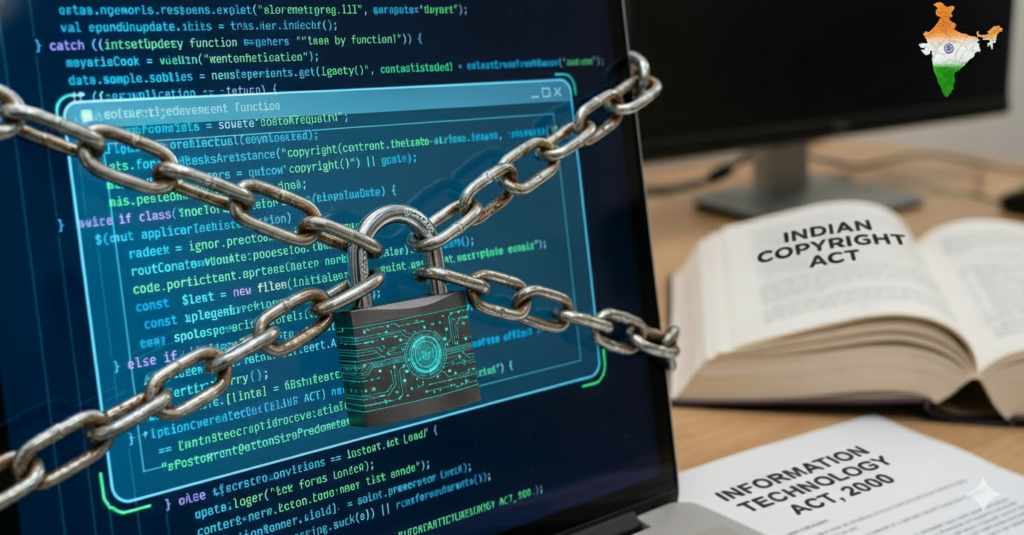
Scope of Article
- Practical definition of software piracy and why India uses a dual-track approach.
- Copyright Act rules for software (exclusive rights, infringement, civil and criminal remedies).
- Compensation & Penalties for those responsible for copyright infringement.
- Where the two frameworks overlap and where they diverge.
- Intermediary safe harbor: no generalized monitoring, specific/URL-level notice, 36-hour takedown window.
- Existing Case Law regarding the abuse of software, including:
- MySpace vs. Super Cassettes (Intermediary liability)
- Microsoft v. Waidande (End-user piracy)
- Practitioner playbook: Injunctions, Local Commissioners, forensics, Section 43 claims, and FIRs.
- Checklists: Prepared specifically for rights holders/counsel, SMEs/developers, and platforms/intermediaries.
Keywords
Software piracy; Copyright infringement; IT Act offences; Intermediary liability; Safe harbour; Digital evidence.
Abstract
In this article, we take a close look at how we can effectively tackle the relentless challenge of software piracy by using India’s dual tracked legal framework. In this section, we’ll take a closer look at the crucial role of intermediaries, those digital middlemen who rely on “safe harbor” protection to stay shielded from liability. As we’ll see, that protection isn’t automatic; it depends entirely on them stepping up and acting on specific notices within that high-pressure, 36-hour window.
By walking through some landmark court cases and diving into the technical side of digital evidence, I’ve tried to build a practical roadmap for legal professionals who are navigating the messy world of IT Act offences and looking for real-world solutions for their clients. Finally, I wish to demonstrate that when we combine these digital-age strategies with traditional claims for copyright infringement, rights holders can walk away with fair, evidence-backed results that actually hold up in court. This approach protects the spark of innovation while ensuring that the scope of intermediary liability remains balanced and fair for everyone involved.
The Intersection of Code and Law: India’s Dual-Track Framework
When we talk about the software piracy situation in India, we aren’t just looking at a single law, but really a “dual-track” conversation where the Copyright Act of 1957 (hereinafter referred to as the Copyright Act) converges with the IT Act of 2000 (hereinafter referred to as the IT Act). In everyday terms, piracy covers a paraphernalia of issues; everything from a company using more software installations than they actually paid for to someone who distributes those “cracked” versions or keygens that bypass security. The said framework is vital because it treats software as a “literary work” that deserves protection, while simultaneously providing a clear path to address unauthorised access and source code tampering.
The Copyright Lens: Software as a Literary Work
Under the Copyright Act , software is given the same level of respect and protection as a classic novel or any other form of art, classified formally as a “literary work”. This enables the creator to recognise their exclusive rights to decide who gets to copy, sell, resell or adapt their code. If those rights are ignored, say, through unlicensed multi-seat installations or the distribution of cracked binaries; the law steps in with a mix of civil and criminal weight. You can head to court for an immediate injunction to put a stop to the infringement, but it is worth noting that ‘knowing’ infringement is a serious criminal offense that the Supreme Court has flagged as both cognizable and non-bailable.
The Digital Edge: Compensation and Crimes under the IT Act
While the Copyright Act treats software as a “creative work,” the IT Act views it through the lens of digital security and data integrity. This is where things get really practical: if someone hacks into a system to bypass a license or tampers with the underlying source code, the IT Act steps in to provide a remedy that the Copyright Act alone might miss. Specifically, Section 43 is a powerful tool for rights holders, allowing them to claim civil compensation (sometimes up to ₹5 crores) from anyone who accesses or downloads data without permission. It’s essentially the law’s way of saying, “You didn’t just copy this; you broke into a digital space you weren’t invited into.”
To dive a bit deeper into the numbers and consequences, Section 66 of the IT Act is where things take a serious turn. If the unauthorised acts we talked about, like hacking or illegal copying, are done with a “dishonest” or “fraudulent” intent, the law shifts from simple compensation to criminal liability. The potential jail time for the same is up to three years or a heavy fine, or sometimes both.
Then there’s Section 65, which specifically targets the “source code” itself. In the world of software piracy, this often looks like someone intentionally hiding, altering or destroying the computer source documents to bypass license checks or wipe away digital footprints. Since the source code is the lifeblood of any program, the law treats tampering (includes hiding, altering or destroying) with it as a distinct and severe offence.
The Practitioner’s Playbook: Strategies for Enforcement and Compliance
In the world of legal strategy, we often observe that the most effective and efficient way to protect a software isn’t by choosing just one path, but by running both the Copyright Act and the IT Act “tracks” simultaneously. It is similar to the dual server authentication (or a dual security system) currently in use by Meta (whatsapp, facebook,etc.) and other tech giants.
First, we usually head to a civil court to secure a quick “ad-interim” injunction. This is a crucial first step because it legally freezes the situation and stops unauthorized use right away. Followed by a request for a local Commissioner to be appointed—someone who can step in, inspect the site, and perform forensic imaging to lock down the digital evidence before it can be deleted or tampered with.
While that civil process is moving, we can simultaneously file a Section 43 complaint with an Adjudicating Officer(hereinafter referred to as the AO) if the financial loss is under ₹5 crore. If the evidence starts to show that the piracy was an act of deliberate dishonesty or involves tampering with the source code, we can then escalate the process into a criminal complaint under Sections 65 or 66 of the IT Act. Through this multi-faceted or layered approaches, we can ensure that the rights holder’s concerns are covered from every angle, by getting the immediate relief in the form of an injunction while also covering long-term compensation and accountability enforceable by the law
Intermediary Responsibility and the 36-Hour Takedown Window
When we talk about the platforms that host or transmit content, the “intermediaries” like social media sites or cloud providers, the law provides a specific “safe harbor” to protect them from being held liable for every single thing their users upload or may upload. Meanwhile, it cannot be considered a free pass but a conditional protection. According to the landmark MySpace v. Super Cassettes ruled by the Delhi High Court which held that platforms don’t have to act as “internet police” by pre-screening every file, but they must have “actual knowledge” or prior information of an infringement to lose their immunity.
In a practical scenario, once a platform receives a specific notice (usually including the exact URL of the pirated software), the clock starts ticking. Under the 2021 Intermediary Rules, they have a strict 36-hour window to take said content down without fail. To stay on the good side of the law, these platforms (or intermediaries) need clear “hygiene” practices: a defined protocol for users to report piracy, a designated grievance redressal officer, and a firm policy for dealing with repeat offenders. It’s a delicate balance designed to protect the flow of the internet while giving creators a fast, effective way to stop piracy at the source in a timely manner.
Judicial Precedents: Lessons from Microsoft v. Waidande
In a significant real-world application of these laws, the Delhi High Court’s Ruling in Microsoft v. Waidande provides a clear blueprint for how end-user piracy is handled in India. In this case, the court granted a permanent injunction against a company for using unlicensed versions of Microsoft Windows and Office. What makes this case a meaningful precedent for businesses and developers is the deserved award of ₹20 lakhs (or 20 lakhs) in damages. It serves as a precedent that the cost of using pirated software can far outweigh the price of a legitimate license.
The success of the case relied on a very specific “evidence kit” that rights holders should keep
in mind. Microsoft didn’t just walk into court with a hunch; they brought a solid paper trail,
including investigator reports and a clear count of unauthorized installations. A court appointed Local Commissioner conducted an on-site inspection and used forensic imaging to lock in the digital proof, playing a vital role. This combination of traditional investigative work
and modern digital forensics is exactly what’s needed to turn a suspicion of piracy into a winning
legal claim.
SME and Developer Compliance: Building a Culture of SAM
Moving on to the Checklists for Small and Medium Enterprises (hereinafter referred to as SMEs) and Developers, this where the legal theory converges with the day-to-day reality of running a business or a dev team. If you’re a SME, staying on the right side of the law isn’t simply about avoiding a lawsuit, it’s about building a culture of Software Asset Management (SAM). I would suggest keeping a live, updated register of how many installations you have versus the licenses you’ve actually paid for. It may sound simple to newcomers, but veterans can tell you how easily “license creep” happens when a team grows exponentially.
For the Developers, technical controls are your best bet. Implemented license servers and robust endpoint management doesn’t just protect the software; it puts in place the “digital paper trail” (like system lots) that proves you’re playing by the rules. And if you ever encounter a vendor knocking on your door for a SAM review or sending a cease-and-desist letter, the best choice is to be proactive. Courts in India tend to look much more favourably on companies that show genuine effort to co-operate and fix licensing gaps immediately rather than those that try to hide the evidence of their lack of drive.
Following the MySpace ruling, the platforms aren’t mandated to magically become mind readers or pre-screen every single file, but they must act the moment they have “actual knowledge” or notification of piracy. In practice, this means having a rock-solid workflow to process specific, URL-level notices within that critical 36-hour window. It’s also about being firm with those who are persistent in these abusive acts, a graduated response is a necessity to put a stop to their wrongdoings without fail. Start with warnings and disclaimers escalating towards permanent account termination, this shows the law that the platform is an active and responsible player in the digital ecosystem.
Strengthening the System: A Look at Policy Fixes
While our current legal framework provides a solid foundation, there is always room for improvement to make the gears of justice turn with less friction. One of the most helpful changes would be to officially codify “concurrency”, basically the addition of a clear clause in the law that confirms you can pursue remedies under both the Copyright Act and the IT Act simultaneously without hitting a wall such as “res judicata” or repetitive legal barriers. This could allow factual findings from one ‘track’ or field to be used in another, saving everyone valuable time and resources.
Another monumental way forward would be a national standard for digital evidence. If we had a universal protocol for things like “hashing” data (using SHA-256 for example) and maintaining a strict chain of custody, the readability of electronic proof would skyrocket across all courtrooms. When coupled with a standardized, model format for piracy notices, such that platforms know exactly what information to expect and regulate, these reforms would create a much more predictable and efficient environment for both creators and users.
Closing Thoughts: A Calibrated Path Forward
As we have found,; In India, the most effective way to tackle software piracy is not to use a sledgehammer, but to apply a calibrated, dual-track approach. By balancing the creative protections of the Copyright Act cooperating with the technical and financial safeguards of the IT Act, we establish a system that is both fair and firm.
When the rights holders act with carefully documented evidence, platforms or intermediaries conform to the 36-hour duty, and the courts provide swift injunctions, the entire digital ecosystem becomes more secure. Moving forward, clearer rules on how these laws work together (namely Copyright Act and IT Act) and redefined standards for digital forensics will only help reduce friction, ensuring that innovation is protected while keeping the internet open and functional for everyone.