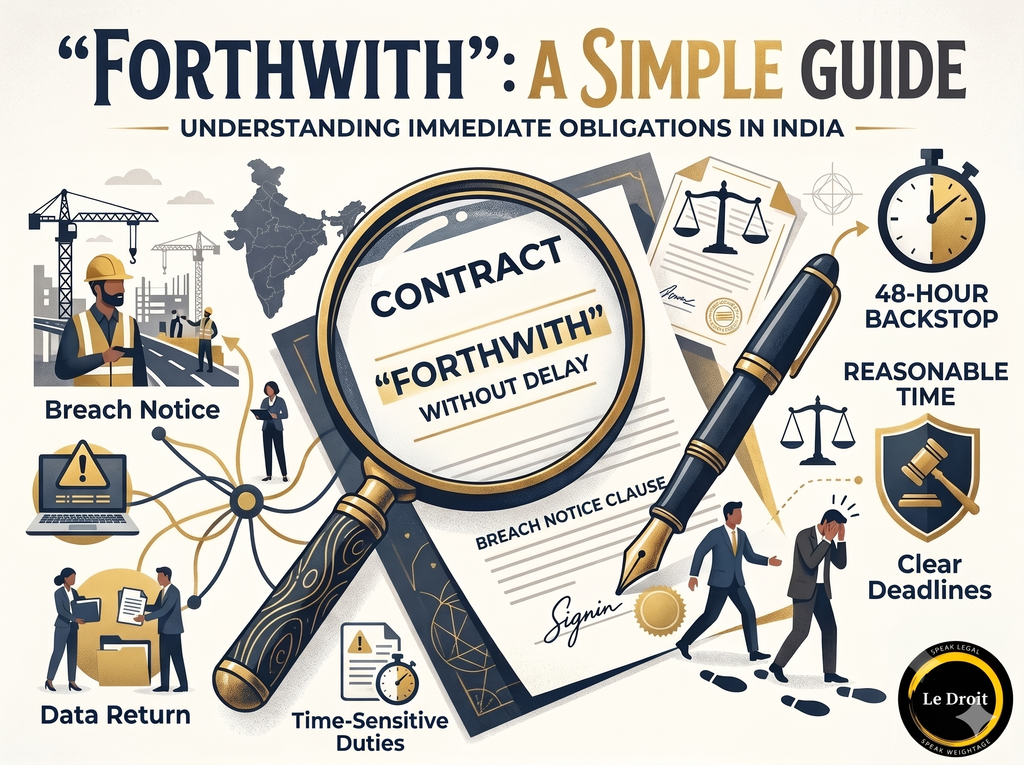
Introduction
“Forthwith” is a word commonly used in contracts to mean immediately, without delay, as in “the Receiving Party shall forthwith return all Confidential Information” or “notice of breach shall be given forthwith.”
In plain words: it’s a slightly old-fashioned, formal way of saying “right away,” but unlike a specific number of days, it doesn’t tell either party exactly how much time they actually have, which is precisely where the drafting risk lies.
Legal Foundation: What Does Indian Law Say About It?
“Forthwith” is not defined in the Indian Contract Act, 1872, or in the General Clauses Act, 1897. Where a contract or statute uses the word without defining it, Indian courts apply ordinary rules of interpretation and generally construe “forthwith” to mean within a reasonable time, having regard to the nature of the obligation and the surrounding circumstances, not literally “the same second” or even necessarily “the same day.” This is consistent with how courts have historically construed similar words like “immediately” and “without delay” in commercial contexts, as requiring prompt action, but action that is reasonably achievable given the practical steps involved.
The problem for drafters is exactly this flexibility: because “reasonable time” depends on context, what one party considers forthwith compliance, say, returning documents within a week, a counterparty might argue was unreasonably slow. This ambiguity is precisely why “forthwith” is a word litigators like and drafters generally shouldn’t.
Courts assessing what “reasonable time” meant in a given dispute typically look at several contextual factors together: the nature and complexity of the act required, whether the obligated party had everything needed to comply readily at hand, any industry custom around how quickly such an act is normally performed, and whether the delay actually caused the other party any identifiable prejudice. This multi-factor, fact-specific approach is exactly why a dispute over “forthwith” compliance can be genuinely difficult to predict in advance, and why experienced drafters prefer to remove that uncertainty by specifying an objective number of hours or days wherever the stakes of a delayed response are high enough to matter.
Practical Relevance: Why Does It Matter in Actual Contracts?
“Forthwith” shows up in time-sensitive obligations across almost every contract type:
- Confidentiality and data protection clauses, requiring the forthwith return or destruction of confidential information or personal data on request or termination.
- Breach and default clauses, requiring a party to forthwith notify the other of a breach, security incident, or change in circumstances.
- Termination clauses, requiring a party to forthwith cease using licensed material, software, or trademarks once the licence ends.
In each case, if a dispute arises about whether the obligated party acted quickly enough, the word “forthwith” gives a court or tribunal room to decide what “reasonable” meant in that specific situation, which is exactly the kind of uncertainty most commercial parties would rather avoid.
The word also appears regularly in court orders, injunctions, and regulatory directions in India, where a tribunal or authority requires compliance “forthwith,” and the same reasonable-time interpretive principle generally applies, with courts assessing after the fact whether the party’s actual response time was justifiable given what compliance genuinely required, rather than holding the party to an impossible standard of instantaneous action.
This same reasoning extends to injunctions and interim court orders using the word, where a party found to have delayed compliance well beyond what the circumstances genuinely required can face contempt proceedings, making the reasonable-time standard considerably higher-stakes in a litigation context than in an ordinary commercial notice clause, and reinforcing why careful compliance teams treat any order using “forthwith” as demanding priority, immediate attention rather than routine, queued processing.
Practical Application: How Is It Drafted or Used?
The better drafting practice, especially for genuinely time-critical obligations, is to replace “forthwith” with a specific, measurable deadline. Where “forthwith” is retained (often because it reads as more urgent than a numbered deadline, or is used deliberately in a notification context), it helps to pair it with a backstop number of days.
A typical clause looks like this:
“Notification of Breach. The Receiving Party shall notify the Disclosing Party forthwith, and in any event within forty-eight (48) hours, upon becoming aware of any unauthorised disclosure or use of the Confidential Information.”
When drafting or reviewing this, make sure it:
- Replaces “forthwith” with a specific number of hours or days wherever the obligation is genuinely time-critical, such as breach notification or data incident reporting.
- Pairs “forthwith” with a numeric backstop (“forthwith, and in any event within X days”) where retaining the word for emphasis, so there’s still an objective fallback if “forthwith” itself is disputed.
- Checks for consistency across the contract — using “forthwith” in one clause and “immediately” or “without undue delay” in another can invite an argument that the drafters intended different standards.
- Considers the practical feasibility of the deadline, since a court assessing “reasonable time” will look at what was actually achievable, not just what the contract demanded.
- Avoids “forthwith” in obligations where the required action genuinely depends on external factors (like regulatory approval) that make a fixed, short timeline unrealistic.
Common Drafting Mistakes to Avoid
- Using “forthwith” for an obligation where a party will realistically need days, not hours, to comply (such as returning physical equipment or documents from multiple office locations), setting up an unintentional, technical breach the moment compliance takes longer than a literal reading of the word suggests.
- Mixing “forthwith,” “immediately,” and “without delay” across different clauses in the same contract without realising a court may read the varying language as intentionally signalling different standards of urgency.
- Relying on “forthwith” in a cross-border contract without considering how a foreign court or arbitral tribunal, potentially applying different interpretive conventions, might read the term differently than an Indian court would.
- Failing to specify what happens if the obligated party cannot comply “forthwith” due to genuinely unforeseen circumstances, leaving no clear process for a short, justified extension.
- Assuming “forthwith” automatically means “within 24 hours” or some other specific period the drafter has in mind, when no Indian court has adopted such a bright-line rule, the standard remains “reasonable time in the circumstances,” which can vary significantly by context.
A Worked Example
A financial services company, Trustline Capital, includes a clause in its vendor data processing agreement requiring the vendor to “forthwith notify” Trustline of any data security incident. When the vendor suffers a breach affecting customer records, it takes four days to notify Trustline, having spent that time conducting an initial internal investigation before escalating externally.
Trustline argues this breaches the “forthwith” notification requirement, pointing to the serious regulatory implications under India’s data protection framework of a delayed response. The vendor counters that four days was a reasonable period in the circumstances, given the genuine complexity of confirming the breach’s scope before notifying a client, and that “forthwith” under Indian interpretive principles means “within reasonable time,” not “instantaneously.”
Because the contract never paired “forthwith” with a specific numeric backstop, the dispute turns into precisely the kind of fact-intensive, arguable question the vague standard invites, with Trustline and the vendor’s lawyers trading competing views of what was “reasonable” for a breach of this nature and scale. Had the clause instead specified “forthwith, and in any event within 24 hours of discovery,” the dispute would likely never have arisen, the vendor’s four-day response would have been a clear, unambiguous breach of an objective deadline, rather than an argument about reasonableness.
Business Connection: How Does It Relate to Real-World Legal Operations?
Vague timing language like “forthwith” is a common source of avoidable disputes, particularly in data breach notification and confidentiality return obligations, where the gap between what one party did and what the other party expected can turn into a real compliance or litigation issue.
Standardising contract language, and flagging vague time-bound obligations like “forthwith” during contract review, is a practical use case for contract lifecycle management and AI-assisted contract review tools: catching ambiguous timing language before signature, and suggesting a specific, enforceable deadline instead.
This is especially important for organisations managing regulatory-sensitive obligations, such as data breach notification under evolving Indian privacy law, where the difference between a vague, arguable standard and a specific, numeric deadline can directly affect whether the organisation can demonstrate timely compliance to a regulator.
Vendor and partner contracts deserve particular scrutiny here, since a vague “forthwith” obligation owed to a business by a third-party vendor is only as good as that vendor’s own internal incident response discipline, and a business relying on such a clause to meet its own downstream regulatory deadlines should confirm the vendor’s contractual commitment is tight enough to actually support that reliance.
Call to Action: Where Can You Learn More?
Terms like this one don’t sit in isolation, they sit inside a much larger body of corporate and commercial law. If you want a structured, foundational understanding of how Indian company law shapes the contracts, governance, and compliance work you do every day, LeDroit India’s Company Laws in India Certificate Course is a good next step.