Introduction
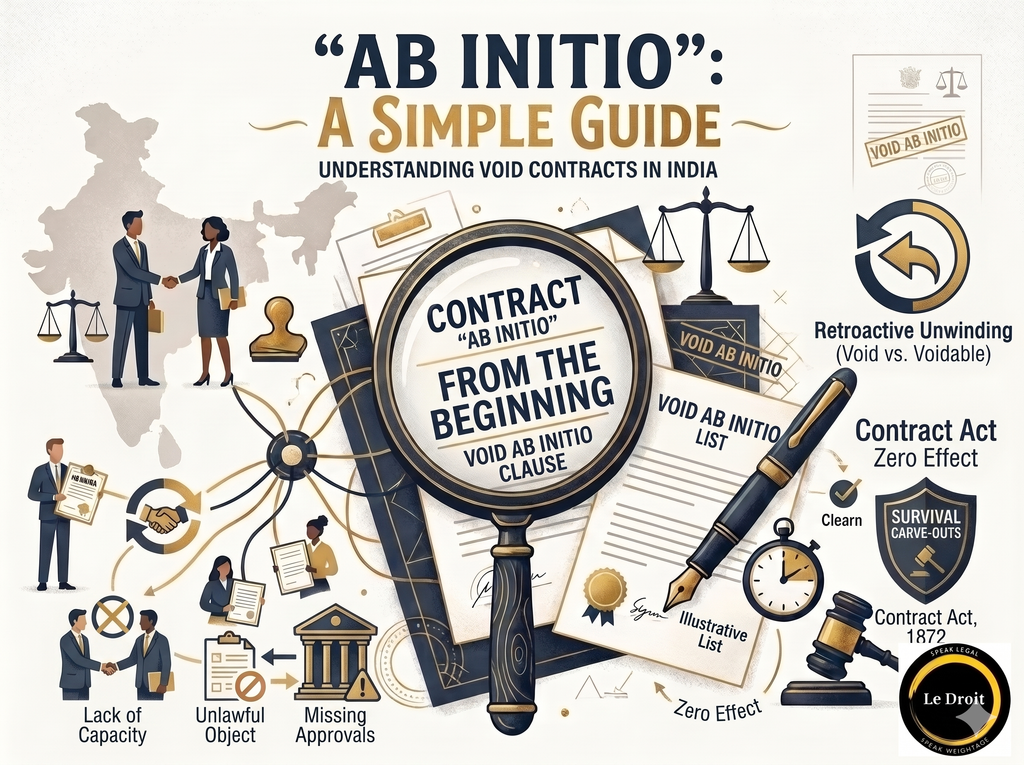
“Ab initio” is a Latin phrase meaning “from the beginning.” In contracts, it’s most commonly used to describe an agreement, clause, or transaction that is treated as void from its very inception, as though it never legally existed at all, rather than simply ending or being cancelled from some later point in time.
In plain words: if a contract is void ab initio, the law treats it as if it was never a valid contract in the first place, not as something that was valid and later terminated. That distinction has real legal consequences.
Legal Foundation: What Does Indian Law Say About It?
The Indian Contract Act, 1872 draws a sharp line between a void agreement and a voidable contract. Under Section 2(g), an agreement not enforceable by law is void, and under Section 2(j), a contract that ceases to be enforceable becomes void when it ceases to be enforceable. A voidable contract, defined in Section 2(i), is one that remains valid and enforceable unless and until the party entitled to avoid it (for instance, a party whose consent was obtained by coercion, fraud, or undue influence, under Sections 15–19) actually chooses to do so.
The leading illustration of “void ab initio” in Indian contract law is Mohori Bibee v. Dharmodas Ghose (1903, Privy Council), which held that an agreement entered into by a minor is void ab initio, not merely voidable, because a minor lacks the capacity to contract under Section 11 of the Act in the first place. Because the agreement never had legal existence, the ordinary remedy of restitution under Section 65 (which allows a person who received a benefit under an agreement later discovered to be void to be asked to restore it) was held not to automatically apply to a minor’s agreement in the way it would to a contract void for some other reason.
This is also why “void ab initio” needs to be distinguished carefully from termination or rescission for breach. Terminating a contract for breach, under principles reflected in Sections 39, 64, and 73–75 of the Act, generally operates prospectively, the contract was valid, and obligations that accrued before termination (including the right to claim damages for breach) survive. Treating something as void ab initio, by contrast, generally unwinds the transaction from the start, which is a fundamentally different and often more drastic legal outcome.
It’s also worth distinguishing void ab initio from voidable contracts more carefully in practice. A voidable contract, such as one induced by misrepresentation or undue influence, remains fully valid and enforceable unless and until the disadvantaged party elects to avoid it, meaning the contract has legal effect right up until that election is made, and the party may also choose to affirm and continue with it instead. A void ab initio agreement, by contrast, never had legal effect in the first place, there is no election to make because there was nothing valid to affirm. This difference matters enormously for how long a party has to act, and what happens to anything already done under the agreement in the meantime.
Practical Relevance: Why Does It Matter in Actual Contracts?
“Ab initio” and the void/voidable distinction it reflects matter in:
- Capacity-related disputes, such as agreements entered into by minors or persons of unsound mind, which are void ab initio rather than merely terminable.
- Agreements with an unlawful object or consideration under Section 23, which are void ab initio because the law never permitted them to exist.
- Regulatory non-compliance, where a transaction entered into in breach of a mandatory licensing or approval requirement may be treated as void ab initio rather than merely defective.
- Drafting termination and survival clauses, where it matters enormously whether the parties intend certain obligations (confidentiality, indemnities, accrued payment obligations) to survive termination, which they generally should, versus being void ab initio, which they generally should not.
Treating the wrong scenario as “void ab initio” in a contract can unintentionally wipe out obligations, like confidentiality or indemnity, that the parties actually wanted to survive even after the main agreement ends.
Practical Application: How Is It Drafted or Used?
“Ab initio” is typically used deliberately and sparingly, for specific scenarios where the parties genuinely intend a complete, retroactive unwinding, rather than as a loose synonym for ordinary termination.
A typical clause looks like this:
“Void Ab Initio. If any Governmental Authority determines that this Agreement was entered into without a Required Approval, this Agreement shall be deemed void ab initio, and each Party shall, to the extent permitted by applicable law, restore to the other Party any benefit received under this Agreement, provided that this clause shall not apply to, and shall not affect the survival of, the Confidentiality and Indemnification clauses of this Agreement.”
When drafting or reviewing this, make sure it:
- Uses “void ab initio” only where a genuine, complete retroactive unwinding is intended, and uses “terminate” or “rescind” for ordinary, prospective endings of the contract.
- Expressly carves out clauses meant to survive (confidentiality, indemnity, limitation of liability, accrued payment obligations), since a blanket “void ab initio” provision can otherwise unintentionally wipe these out too.
- Addresses restitution explicitly — what happens to payments, deliverables, or benefits already exchanged — rather than leaving it to Section 65 and general principles to sort out after the fact.
- Distinguishes clearly, in termination clauses, between termination for breach (prospective) and any specific circumstances the parties want treated as void ab initio (retroactive), so the two aren’t conflated.
- Flags regulatory approval conditions precisely where a void ab initio consequence is tied to a missing licence or approval, since the scope of the required approval needs to be unambiguous for this clause to operate predictably.
Common Drafting Mistakes to Avoid
- Using “void ab initio” loosely as a synonym for “terminate” or “cancel,” when the two carry fundamentally different legal consequences, one unwinds the contract retroactively, the other simply ends it going forward.
- Drafting a blanket void ab initio clause without carving out confidentiality, indemnity, and limitation of liability provisions, unintentionally eliminating protections the parties clearly intended to survive any termination of the underlying deal.
- Failing to address what happens to payments, deliverables, and benefits already exchanged when a contract is declared void ab initio, leaving restitution to be argued out under general principles rather than addressed clearly in the contract itself.
- Tying a void ab initio consequence to an ambiguously defined “Required Approval,” creating uncertainty about exactly which regulatory conditions, if missing, actually trigger the retroactive unwinding.
- Confusing a minor’s incapacity to contract (which makes an agreement void ab initio under Mohori Bibee) with an adult’s misrepresentation or undue influence (which typically makes a contract merely voidable), applying the wrong remedy framework to the wrong category of defect.
A Worked Example
A renewable energy company, Suryoday Power, signs a power purchase agreement with a state utility, conditioned on obtaining a specific regulatory clearance before the agreement becomes operative. Due to an internal oversight, Suryoday begins supplying power and invoicing the utility for six months before anyone notices the clearance was never actually obtained.
When the gap is discovered, the utility’s legal team argues the entire agreement is void ab initio for want of the required regulatory approval, meaning, taken to its logical extreme, that Suryoday was never entitled to any of the payments it has already received and must refund them in full. Suryoday’s lawyers push back, pointing out that the contract’s own void ab initio clause expressly carves out confidentiality and indemnification, but says nothing about the payments already made for power already supplied and consumed.
After negotiation, the parties agree on a pragmatic resolution: the agreement is treated as void ab initio going forward (meaning no further supply occurs under its terms until the clearance is properly obtained), but the six months of power already supplied and consumed is treated as a separate, quasi-contractual restitution matter under Section 65 principles, with Suryoday retaining reasonable compensation for value genuinely delivered, rather than a wholesale, punitive clawback of every payment made. Had the original clause explicitly addressed restitution for benefits already exchanged, rather than leaving the question to general principles, this months-long negotiation could likely have been resolved by simply reading the contract.
Business Connection: How Does It Relate to Real-World Legal Operations?
Getting the void-versus-voidable-versus-terminated distinction wrong in a contract template has outsized consequences, it can determine whether confidentiality and indemnity protections survive a dispute, and whether restitution of payments already made is automatically required.
Contracts conditioned on a regulatory approval or licence are a particular area of risk worth flagging systematically, since the consequences of that condition failing, whether void ab initio, suspension, or simple termination, are often drafted inconsistently across an organisation’s template library, and the gap tends to surface only once a regulatory problem has actually materialised.
This is exactly the kind of nuanced legal distinction that benefits from consistent review across a contract portfolio: contract lifecycle management and AI-assisted review tools can flag where “void ab initio,” “terminate,” and “rescind” are used inconsistently or interchangeably across templates, helping legal teams standardise language so survival and restitution outcomes are actually what the business intends.
Call to Action: Where Can You Learn More?
Terms like this one don’t sit in isolation, they sit inside a much larger body of corporate and commercial law. If you want a structured, foundational understanding of how Indian company law shapes the contracts, governance, and compliance work you do every day, LeDroit India’s Company Laws in India Certificate Course is a good next step.