This article is written by Simran Sanjay Doshi, Studying at Kes ‘Shri Jyantilal H. Patel Law College, L.L.B, 1st Year during her internship at Le Droit India.
Scope of the article
1. Introduction
2. Facts of the case
3. Issues before the Court
4. Statutory or Legal Framework
5. Judgement and Reasoning of the Court
6. Legal Principles and Significance of the Case
7. Critical Analysis and Comparative Study
8. Contemporary Relevance in Commercial and Digital Transactions
9. Conclusion
10. Reference
Abstract:
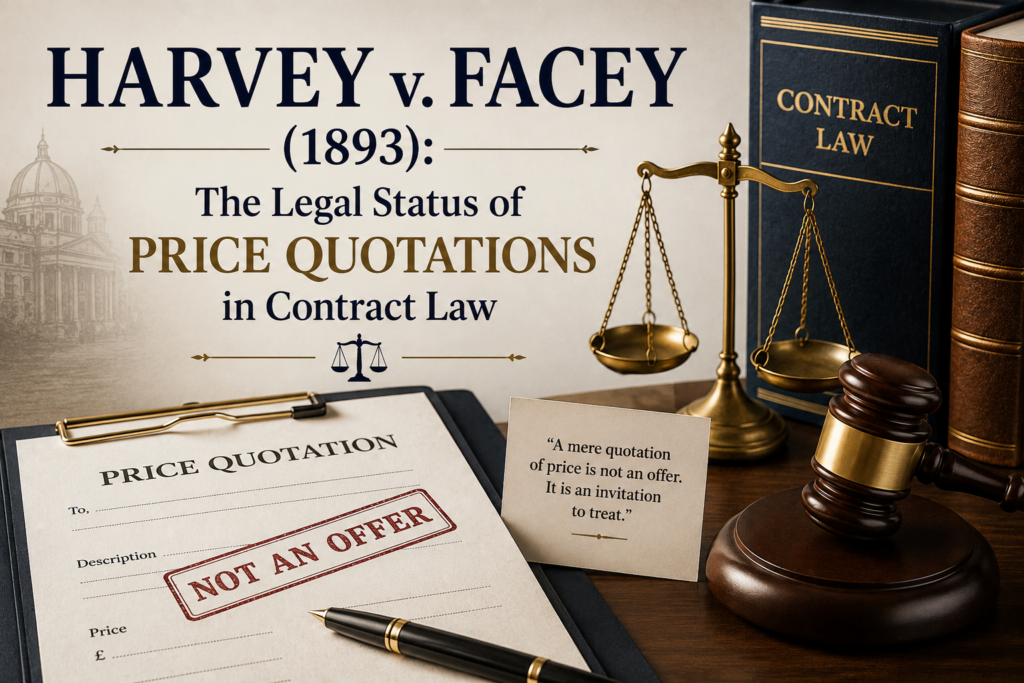
Under the contract law the distinction between the offer and mere statement of information is one of the most fundamental principles. According to the decision passed in the landmark case Harvey v. Facey (1893) (AC 552), where it clarified that the price quotations does not automatically amount to any legally binding offer between the parties. The case is regarding the proposed sale of property where the dispute arose because of the exchange of telegrams.
Here the buyer believed that the statement constituted by seller of the lowest price is capable of acceptance. Therefore, the dispute went to Court and Privy Council held that unless it does not demonstrate that there was any intention to contract, there was only communication of information which was merely supplied. This judgement has become a leading authority on the offer and acceptance principles and it continues to influence common law jurisdictions, including India. As per the Indian Contract Act, 1872, for interpreting the provisions related to offer and acceptance these case plays an important role.
The principles established in Harvey v. Facey are still highly relevant in this modern era of digitally negotiating, shopping online and communicating electronically. Hence, by distinguishing between the negotiations which are preliminary from contractual offer legally enforceable, it promotes certainty in decisions of commercial transactions.
Key Words: Harvey v. Facey, Commercial transaction, Telegram, Indian Contract Act, 1872, Offer and Acceptance, Invitation to treat/offer, Price Quotations, Contract law.
Introduction
The legally enforceable agreements creating obligations between the parties are governed by contract law. The essential elements like lawful offer and lawful acceptance are to be satisfied for the formation of a valid contract. The communications during the commercial negotiations the parties often exchange quotations, lists of prices, catalogues, or advertisements which at first appear to be similar to offers, but it does not necessarily create legal obligations. Hence, for determining that a binding contract is formed or not, it becomes essential to distinguish between the actual offer from just mere statement of information.
To determine this distinction the landmark cases Harvey v. Facey is one of the most significant judicial decisions. Regarding the sale property known as ‘Bumper Hall Pen’ in Jamaica, the case arose from the telegram exchanges. Where buyer argued that the statement of ‘lowest price’ made by the seller constituted an offer, which buyer immediately accepted but the contention of seller was that he responded merely to the request for information and never intended to make an offer for sale. Here, the Privy Council ruled in seller’s favour and held that unless there is intention to enter into a binding agreement, the only communication of information does not amount to legal offer.
The establishments of an important principle that every price quotation cannot be treated as an offer which are capable of acceptance. This article examines the relevance and rise in obligations for the parties through the facts, issues, judgements and the legal statutory framework.
Facts of the case
The appellants, Mr. Harvey and his parties, were conducting business in Kingston, Jamaica and the respondent, Mr. Facey who was the legal owner of the piece of land called ‘Bumper Hall Pen’. At that time when buyer was interested in purchasing this property, there was Facey who was already negotiating the potential sale of same property to the Mayor and Council of Kingston. Therefore, to initiate negotiations, the appellant Harvey sent a telegram to Facey asking two questions:
- “Will you sell us Bumper Hall Pen?”
- “Telegram your lowest cash price.”
Facey replied to it as “Lowest price of Bumper Hall Pen is £900”, through telegram instead of directly answering whether he intends to sell the property. Harvey believing this response as a definite offer to sell property for £900, he immediately send another telegram stating that at the quoted price the property is accepted and requesting to provide necessary documents of property like title deed for completing the sale.
However, Facey refused to procced with the transactions as he stated that his telegram merely communicated lowest price and it was never intended to be and offer which becomes capable for acceptance. He also said that the answer was given for only second question of Harvey and he never agreed to sell the property.
Due to interpretation differences of both parties, they arose a dispute about whether a valid contract had been formed. Harvey approached court seeking for specific performance, arguing that telegram exchanges of sale of property constituted a binding agreement. On the other side, Facey argued that there had been no offer, no acceptance of an offer and therefore no formation of any enforceable contract between them.
The matter reached eventually to the Judicial Committee of the Privy Council, where it was required by them to determine whether statement made by Facey of the lowest price amounted to the legal offer or just merely information provided during commercial negotiations. The Court’s decision on this has become one of the most influential precedents on laws relating to offer and acceptance.
Issues before the Court
The primary issues before the Court where as follows:
- Whether the telegram of Facey’s statement “Lowest price of Bumper Hall Pen is £900” does it amount to a valid offer which is capable of acceptance?
- Whether subsequent telegram of Harvey about price acceptance of £900 does it create a legally binding contract between parties?
- Whether under contract law, a mere price quotation without any clear intention to sell can be treated as an offer?
- Whether correspondence between parties for the formation of a valid contract does it satisfy the essential requirements?
Statutory or Legal Framework
Under the English common law, the case Harvey v. Facey was decided by the Judicial Committee of Privy Council, which principles are laid down and accepted in India.
- Section 2 (a) of Indian Contract Act, 1872 defines the Proposal/ Offer as follows:
“Where one person signifies to another his willingness to do or abstain from doing anything with a view to obtaining the assent of that other person, he is said to make a proposal.”
Under this section a definite intention is essential to express in an offer to enter into legal relationship just mere information stating or price quotations does not indicate such willingness. Here, in this case Harvey v. Facey, only the lowest price was communicated which does not have intention to sell, hence it did not satisfy this legal requirement of proposal.
- Section2 (b) of Indian Contract Act, 1872 defines Acceptance as follows:
“When the person to whom the proposal is made signifies his assent thereto, the proposal is said to be accepted.”
Under this case Harvey v. Facey, the Facey’s telegram was not a proposal and Harvey’s reply cannot create a valid contract. Since, the acceptance cannot convert mere information into a legally binding offer.
- Section 7 of Indian Contract Act, 1872 it provides that acceptance must be Absolute and Unqualified. If no offer exists, then acceptance has no legal effect. Hence, Facey never made contractual offer and the communication lacked under this section.
- Section 10 of Indian Contract Act, 1872, where it stays that the basic requirements of the valid agreement to be in existence is lawful offer and lawful acceptance. Since, no offer existed in Harvey v. Facey, there was no agreement and consequently it lead to no enforceable contract.
Judgement and Reasoning of the Court
The Judicial Committee of the Privy Council held that no binding contract had been formed between the parties and thus ruled in the favour of the respondent Mr. Facey. The observation of the Court was that Harvey’s request for information regarding the minimum price of the property and to it Facey’ reply through telegram stating “Lowest price of Bumper Hall Pen is £900” was merely a response to Harvey which did not amount to a legal offer capable of acceptance.
It was carefully examined by Court the exchanges of the telegrams. Where the Harvey’s first telegram contained two questions which are already stated above. To which the Facey replied and answered only the second question regarding lowest price and first question he did not respond regarding his willingness to sell. Therefore, upon this the Court concluded that Facey had no intention expressed to enter into a binding agreement.
An offer must clearly indicate the offeror’s willingness to be legally bound upon acceptance was emphasized by Privy Council. Mere information without words showing that there was intention to sell cannot be said to be a contractual offer. Since, no legal offer existed Harvey’s subsequent telegram accepting property of £900 has no legal effect.
The negotiations are common under commercial transactions where Court observed that it does not automatically create contractual obligations. If parties would become legally bound even when they just intended to negotiate where every price quotation treated as an offer, results in uncertainty and unfairness.
Since, no valid offer followed by acceptance, no existence of an enforceable contract and due to this Privy Council dismissed the claim of specific performance of Harvey as the essential elements were absent.
An important rule of contract law was established by this judgement that a quotation of price is generally regarded as a supply of information rather than an offer, unless any intention contrary found.
Legal Principles and Significance of the Case
This case established several important legal principles which ensures certainty and fairness in commercial transaction are:
- Distinction between an offer and a mere statement of information
The most significant principle established was that a statement a price does not constitute an offer automatically, unless clearly expresses intention to enter into binding agreement. Prevents parties from being bound unintentionally during preliminary negotiations.
- Intention to create legal relations and importance of offer and acceptance
This principle states that a valid offer must demonstrate a clear intention to create legal relationships and there has to be a corresponding acceptance. Since, Facey had no intention to sell the property no offer was made and hence no legal effect can be there for acceptance of it existed.
- Protection of commercial negotiations
This judgement principle protects the business by ensuring that they can exchange information freely without fear of creating any legally binding obligations unintentionally. This promotes commercial flexibility and honest bargaining.
- Enduring Significance
This principle laid down that this case Harvey v. Facey is in consistent with Section 2 (a), Section 2 (b), Section 7 and Section 10 of Indian Contract Act, 1872 which requires a clear proposal and valid acceptance before a contract can arise. The judgement is important in Indian contract law also.
It was decided more than a century ago but still today it continues to be cited as one of the legal authorities in the formation of contract.
It promotes certainty, predictability and fairness in business transactions. It also applicable in modern commercial dealing also.
Critical Analysis and Comparative Study
The case Harvey v. Facey is widely recognized as one of the most influential judgements on the offer and acceptance principles. The distinction provided by Privy Council contributes significantly to contract law development by ensuring parties doing business transaction are not unintentionally bound. The judgement emphasized on the intention of objective. Here, the Facey’s mere statement of lowest price was there no intention to sell was only treated as supply of information and this promotes certainty and consistency in contractual dealings.
It promotes commercial freedom where the rule established a practical balance between legitimate expectations protecting and freedom of negotiations preservation. The critics argue that Court emphasis on the literal meaning of the wording communicated rather than considering broader context. In modern world it is stated that such communications through emails, text messages, etc reduced the ambiguity and prevents the litigation unnecessary.
It can be understood by comparing with leading decisions on offer and acceptance can be:
In Carlil v. Carbolic Smoke Ball Co. (1 QB 256), where the Court of Appeal emphasized that advertisements constituted a valid unilateral offer as the company clearly intends to be legally bound as it demonstrates deposit of £1000 in bank and this offer can be to public at large which anyone can accept.
In Pharmaceuticals Society v. Bootscash Chemist (1 All ER 482), where displaying the goods with the prices is only an invitation to offer and not an offer. The customers act presenting goods at the cash counter and constitute the offer which the shopkeeper could accept or reject. This approach in Court examines intention behind communication before determining whether a contract exists.
Contemporary Relevance in Commercial and Digital Transactions
Although the judgement of the case Harvey v. Facey was decided in long century back in 1893, it’s principle still remains highly relevant in the emerging today’s digital and technology driven economy. Modern transactions are increasingly conducted through electronic communication like emails, online marketplace or e-commerce websites. Therefore, in such environments determining whether a communication amounts to an offer or merely provides information has become important. Online business they frequently display on websites with prices and these are treated as invitation to offer rather than binding offer. This approach reflects principle established in Harvey v. Facey that a price displayed or communicated does not automatically create a contractual obligation.
The decision relevant equally in the context of negotiations through email and electronic contracts. Parties exchange multiple email price discussions, payment terms, etc and court continue to examine whether these communications demonstrate a clear intention to create legal relations or merely represent ongoing negotiations. If every generated price automatically treated as binding offer, business face legal consequences and therefore the distinguish between the genuine contractual offer and quotation of price remains essential.
Conclusion
The most important decision in law of contract formation is through the landmark case Harvey v. Facey. The judgement established that supply of information or mere price quotation does not amount to legal offer unless a clear intention is demonstrated. Privy Council provided principle which distinguishes negotiations from enforceable promises which guide courts across common law jurisdictions.
The reasoning also consistent with the Indian Contract Act, 1872 and reinforces particularly the definite offer followed by unconditional acceptance as essential requirements. The significance of this judgement it goes beyond traditional commercial transactions and applies in today’s digital economy, which protects negotiations and prevents unintended contractual liability.
This case still continues to serve as leading authority on the legal status of price quotation even though it is been decided in more than a century ago. Thus, it’s relevance demonstrates that the fundamental principle are capable of addressing both the traditional disputes and challenges of modern commerce.
Reference
2. https://lawbhoomi.com/harvey-vs-facey/
3. https://fr.scribd.com/document/867350273/Harvey-vs-Facey-case#google_vignette
4.http://student.manupatra.com/Academic/Studentmodules/Judgments/2022/June/MANU_UKPC_0001_1893.pdf
5. https://www.dhyeyalaw.in/harvey-v-facey-a-landmark-case-on-offer-and-acceptance
6. https://wildproductivity.co.uk/harvey-v-facey-1893/
7. https://fr.scribd.com/document/831353694/Harvey-v-Facey
8. https://indianlegalsolution.com/case-comment-on-harvey-v-facey/
9. https://www.legalserviceindia.com/legal/article-16228-offers-and-contracts-in-harvey-v-s-facey.html