This article is written by Neeraj Jain of Siksha O Anusandhan National Institute of Law pursuing B.A. LL. B. (H) is in 3rd year during his internship at LeDroit India.
Scope of Article
- Introduction to drone ecosystem in India and regulatory evolution
- Detailed overview of the Drone Rules, 2021 and subsequent amendments
- The Digital Sky platform: features, functionalities, and operational mechanics
- Compliance requirements for drone pilots: registration, licensing, and UIN
- No Permission No Takeoff (NPNT) policy and airspace zoning
- Case studies, enforcement actions, and recent judicial interpretations
- Challenges, penalties, future reforms, and best practices for pilots
Keywords: Drone regulations, Digital Sky platform, NPNT policy, UIN certification, DGCA compliance, airspace deconfliction, remote pilot license.
Abstract
The drone industry in India has experienced a compound growth, as the business has been used in various sectors such as agricultural purpose, surveillance, and logistics and hence stringent regulations must be in place to secure safety and security. The Drone Rules, 2021, managed by the Directorate General of Civil Aviation (DGCA), transformed the system, making it less complex and providing Digital Sky platform a unified digital system to perform all drone-related tasks.
The platform requires unique identification numbers (UIN), licensing of pilots, and the so-called No Permission No Takeoff (NPNT) system, which allows to de conflict the airspaces within the frame of green, yellow, and red zones in real-time. In order to reduce the risks such as collision during flights and invasion of privacy, drone pilots are required to abide by strict conditions which include remote pilot certificates, permission to fly and work within the stipulated limits of operation.
In 2022-2025 amendments have further liberalized nano drone requirements along with increasing the penalties of ₹1 lakh. This paper clarifies the multiple compliance avenues by illustrating cases and examples in the UAV Rules, 2021, with regards to promoting a safe generation of an online sky featuring up to 10,000 registered pilots by 2026. It illuminates such issues as the lack of digital literacy and suggests drone proliferation reforms to be sustainable.
Besides, the shifting paradigm highlights the desire among the government to promote innovation and focus on the safety of the population as demonstrated by the introduction of sophisticated technologies such as AI-based surveillance and real-time information analytics into the regulatory environment. This balanced solution does not only solve short-term issues of operations but also prepares the scalability of growth indifferent of whether it is in the city or the countryside where various applications may be extended to precision agriculture, emergency response operations, etc.
Introduction to India’s Drone Ecosystem
The drone industry in India is no longer a fledgling technology, the industry in India expanded to be a 10,000-crore market by 2026 through government efforts such as the Make in India initiative and adoption of the technology in industry application in precision farming and disaster management. The regulatory environment transformed the guarded UAV Policy 2014 into the liberalized Drone Rules, 2021 which cut the compliance procedures by a quarter (to three-five) delivering a 300 percent registration boom.
The nerve centre is the Digital Sky platform which was introduced in 2019 and implemented according to the Rules fully after 2021. It combines the GIS mapping, automated permissions, and real-time tracking, which make sure that drones work within specific airspaces. This change will tackle previous bottle necks such as manual approvals that match FAA and EASA standards all over the world. In the case of drone pilots, there can be no compromising in terms of compliance since any rule is forfeited in accordance with Rule 52, such as the installation of equipment.
Not only has this move eased the administrative procedures, but it has also helped to maximize the efficiency of its operations, which now enable the operators to devote more of their time to finding new applications instead of red tape. E.g. the convenient interface of the platform contributes to the easy integration with mobile apps, so in time-sensitive missions, such as medical supplies delivery or infrastructure maintenance, pilots will be able to receive information about the airspace in real-time, which will reduce downtime and increase productivity as much as possible.
Further, the focus on digitalization demonstrates a wider policy outlook of making India a world leader in unmanned aerial systems, conducting regulatory practices in line with the international standards and local geographical and population conditions.
Landmark Illustration: Under Aircraft Act, 1934 (amended), an unregistered drone over 250g in the air is unlawful and resembles Section 336 IPC of threatening life. Recent statistics indicate that 5,000+ UINs were issued each month with the Digital Sky, which has turned a fledgling technology into a 10,000-crore sector in precision agronomy and disaster response due to government programs such as Make in India or adoption of this technology in the sector.
The new regulatory environment was formed based on the restrictive UAV Policy 2014 and liberalised Drone Rules, 2021 resulting in minimal compliance procedures of 3-5 steps and driving a 300 percent issue of registration. These advances explain how proactive governance has enabled the growth of markets with applications in environmental monitoring where multispectral camera-based drones are being deployed to test the health of crops and analyse soils, which helps to promote sustainable farming practices in the country at large.
Evolution of Drone Regulations in India
Drones’ governance goes back to the 2014 policy of the NPNT and security clearances, which has been criticized as impeding innovation. The Drone Rules, 2021 (notified under G.S.R. 589(E)) categorised drones based on their mass, including nano (below 250g), micro (250g-2kg), small (2-25kg) etc. and most permissions were not applied to nano drones outside red zones.
Significant changes: In the 2022 liberalization, the nano drone licensing was eliminated; beyond visual line of sight (BVLOS) trials were also implemented in 2023; and integrated AI-based traffic management in 2025. Section 4 of the DGCA requires type certification of drones that larger than 2kg. These considerate amendments reflect an emerging regulatory environment that keeps on advancing with the technological advancement and takes the suggestions of the industry stakeholders to perfect the operations guidelines.
Indicatively, the BVLOS provisions have facilitated possibilities of the remote surveying of the terrain in remote areas like a forested or coastal area to carry out long-range surveying due to the ineffectiveness of traditional surveying. Also, AI can be utilized in the traffic control system, and thus, predictive analytics of possible conflicts are provided, which results in safer skies due to proactive, but not reactive responses.
Judicial Precedent: In Union of India v. State of Maharashtra (Bombay HC, 2023), the court affirmed the zoning powers of DGCA in favor of the state of Maharashtra, Bombay HC (2023) where the court prioritized the safety of the population rather than focusing on the freedom of business. This development highlights the importance of compliance to the pilots.
The Digital Sky Platform: Architecture and Features
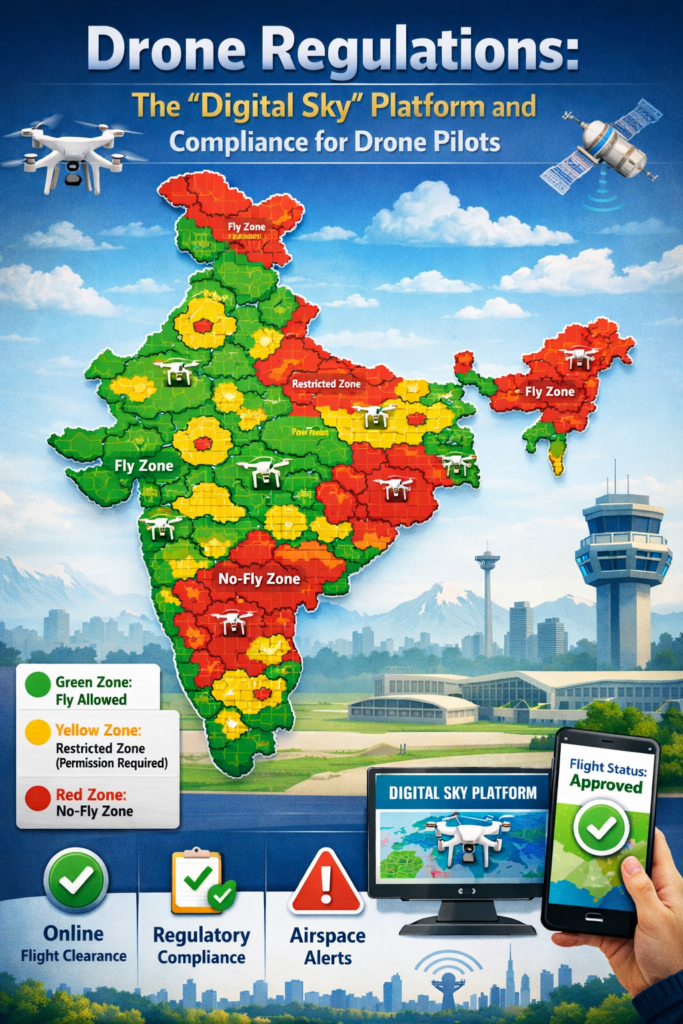
Digital Sky (digitalsky.dgca.gov.in) is an online platform that uses UTM (Unmanned Traffic Management) to ensure the smooth work of drones. Through Aadhaar OTP, pilots are registered to UIN, which creates a digital license in the form of a QR that is connected to the serial number of the drone.
Core Features:
- Airspace Map: With color-coded zones Green (unrestricted <400ft), Yellow (controlled <200ft with permission), Red (no fly near airports, borders).
- Submission of Flight Plan: NPNT guarantees auto-approval or rejection within a couple of seconds.
- Real-Time tracking ADS-B out transponders are broadcasting position and are used with ILST to avoid conflicts.
- Marketplace: Listed approved drone manufactures and training organizations.
Examples: A pilot operating a 5kg surveillance drone will file a flight plan; Digital Sky will cross-check against BASIS, weather API, and other nearby flights and approve over an app.
Recent Improvement: 2026 beta-test of 50+ drone swarm operations with their latency reduced to less than 1s [DGCA Circular, 2025]. The powerful system also enables the use of scalable cloud architecture, which will accommodate the growth of drone registrations at exponential rates that will be used in future years. The given technological foundation helps to interoperate with new standards including drone -to-drone communication, which will open the gate to coordinated swarm activities in processes such as large-scale mapping or search-and-rescue missions. In addition, the continual improvement of cybersecurity reduces the threat of unauthorized access, guaranteeing data integrity to all stakeholders in the activities of drones.
Compliance Imperatives for Drone Pilots
After training approved by DGCA (40 hrs ground plus 5 practice), drone pilots should obtain a Remote Pilot Certificate (RPC). The eligibility: class 10 physics/maths, 18 years of age.
Step-by-Step Compliance:
- Unity of Intangibles: Drone on Digital Sky; fee: 100-1000 as per category.
- Licensing of Pilots: Rights test (70% successful); renewed on an annual basis with 5hrs flight log.
- Insurance: Compulsory third-party liability (10 lakh minimum).
- Pre-Flight Checklist: Activation of NPNT, zone check, battery calibration.
- Incident Reporting: Within 24hrs portal based.
| Category | Weight | UIN Required | RPC Needed | Max Altitude | Permission Zones |
|---|---|---|---|---|---|
| Nano | <250g | No | No | 50m | Green only |
| Micro | 250g-2kg | Yes | Yes | 120m | Green/Yellow |
| Small | 2-25kg | Yes | Yes | 120m | All w/permission |
| Medium+ | >25kg | Yes | Yes | Per approval | Restricted |
Sanctions on non-compliance: Fine 25,000 -1 lakh; maximum sentence of 2yds (Rule 52).
Case Law: DGCA v. The Unauthorized Operators (Delhi HC, 2024)—the court issued a fine of 50000 to 50 pilots due to its red-zone flights, supporting the mandatory application of Digital Sky. The level of compliance measures is structured to create a standardized arrangement of skills within the pilots and takes into account real world experiences simulations, such as unfavourable weather conditions or technical breakdowns. The constant competency caused by regular renewals, and updates to the airspace classifications or NPNT protocols are handled by refresher modules, which thus reduce the risks of using obsolete knowledge.
No Permission No Take-off (NPNT): Operational Backbone
The rule 11 NPNT forbids landing without Digital Sky clearance. The drones have geofencing chips that self-disable in a no-fly zone.
Mechanics: Mechanics:
- Flight plan consists of coordinates, time, payload.
- Conflicts (e.g., within 50m distance) are detected by AI algorithms.
- Disaster ops integrated with N DMA are immediately granted green access.
Recent Case: 2025 Surat drone accident-pilot circumvented NPNT, resulting in 2000000-dollar damage; no license reinstated, exemplar case.
Enforcement, Penalties, and Judicial Oversight
The Drone Enforcement Wing of DGCA is satellite monitored. 2025 statistics: 2,000 infractions, 70 percent pilot error.
Penalties (Rule 52):
- First offense: ₹25,000 + seizure.
- Repeat: Suspension of the license and criminal prosecution according to 336/337 IPC.
Landmark Judgment: Karnataka HC in Drone Privacy Case (2024)—upheld FIR against pilot filming residences without consent, linking to IT Act 2000 privacy clauses.
Challenges and Reform Proposals
Problems such as rural connection lag (40 percent of pilots are off line), high certification cost (3-5 lakh training), and BVLOS regulation gaps are experienced.
Reforms:
- Nano-pilot courses subsidized.
- Blockchain of tamper-proof logs.
- PI scheme incentive harmonization.
Global Comparison Table:
| Jurisdiction | Platform | Key Feature | Pilot Compliance |
|---|---|---|---|
| India | Digital Sky | NPNT, Zone Maps | RPC mandatory |
| USA (FAA) | LAANC | Instant Auth | Part 107 Cert |
| EU (EASA) | UAS Portal | STS Certifications | A1/A3 License |
To resolve such issues, several stakeholders are necessary, such as government-business alliances to bring broadband services to more poorly covered areas and create affordable training courses using virtual reality games. Other reforms, such as the introduction of blockchain, would improve traceability, eliminate possible disagreements about flight records and ensure increased interest in the system.
Best Practices for Drone Pilots
- Daily Digital Sky sync; pre-flight privacy audits.
- Maintenance of Logbooks; become a member of DGCA approved organizations such as IGRUA.
- Interaction with weather applications; anti-emergency RTB rules.
- Prospects Revitalization Prospects for 2030 Digital Sky will become quantum-secure UTM, and 1 lakh pilots will be projected.
Not only will following these practices help in regulatory compliance but also help in reducing their operational standards, pilots can use community forums or webinars provided by the DGCA as a continuous learning technology to navigate the emergent threats such as cyber vulnerability or advanced geofencing methodologies. In the future, the quantum-secure UTM is apparently poised to supply with the ability to have mission-sensitive information secured by impossible-to-hack encryption, which allows nationwide drone highways to be used to facilitate logistics by 2030.