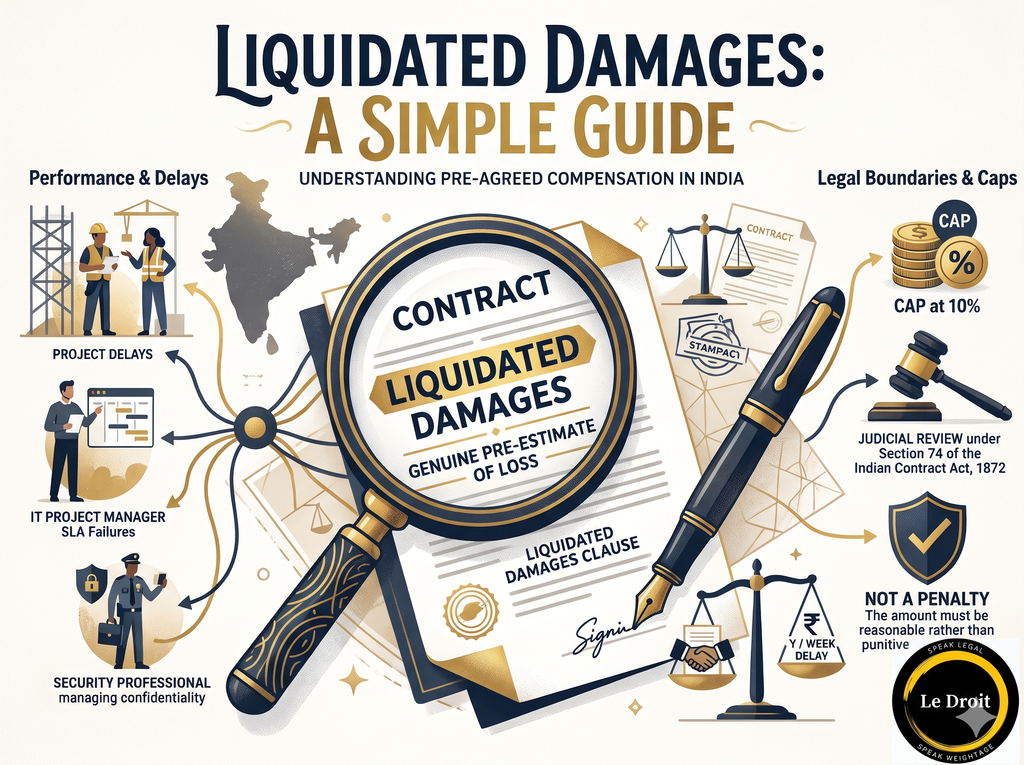
What Does “Liquidated Damages” Mean?
Liquidated damages are a fixed, pre-agreed amount of money that one party will pay the other if they breach the contract, decided and written down before any breach actually happens, instead of being argued over and calculated after the fact.
In plain words: instead of going to court and proving exactly how much loss you suffered, the parties simply agree upfront, “if X happens, Party A pays Party B ₹Y.” For example, a construction contract might say the contractor pays ₹1 lakh for every week the project is delayed past the deadline, that figure is the liquidated damages.
The appeal of liquidated damages is largely practical. Proving actual loss after a breach can be genuinely difficult, how do you put a number on the reputational harm of a data leak, or the knock-on cost of a delayed product launch that cascades into missed marketing windows and lost early customers? Liquidated damages sidestep that problem entirely by having the parties agree, while they are still on good terms and thinking clearly, what a fair figure would be if things go wrong later.
Where Does This Term Come From?
In Indian law, liquidated damages are governed by Section 74 of the Indian Contract Act, 1872, titled “Compensation for breach of contract where penalty stipulated for”:
“When a contract has been broken, if a sum is named in the contract as the amount to be paid in case of such breach… the party complaining of the breach is entitled, whether or not actual damage or loss is proved to have been caused thereby, to receive from the party who has broken the contract reasonable compensation not exceeding the amount so named…”
The key Indian twist is this: unlike some other countries, Indian courts don’t automatically enforce the exact figure named in the contract. Under Section 74, the named sum is treated as the upper limit of what can be awarded, and courts award “reasonable compensation” up to that cap, not necessarily the full amount. In the landmark case ONGC v. Saw Pipes Ltd. (2003), the Supreme Court held that if the sum named is a genuine pre-estimate of loss, courts generally need not undertake fresh elaborate proof of loss and can award the stipulated amount.
This is a meaningfully different approach from, say, English or American common law, where a properly drafted liquidated damages clause (as opposed to a penalty clause) is typically enforced at the stated figure without the court separately assessing whether that figure happens to match the actual loss suffered. India’s Section 74 approach is sometimes described as a hybrid: it accepts the commercial logic of liquidated damages (no need to prove actual loss from scratch) while still preserving judicial discretion to scale the figure down if it looks disproportionate or punitive. For anyone drafting cross-border contracts, this is an important point to flag, since a clause drafted with an English or American law mindset, expecting the stated figure to be enforced automatically, may not translate cleanly if the contract is governed by Indian law.
It is also worth noting how Indian courts have refined the “genuine pre-estimate” test since ONGC v. Saw Pipes. Later decisions, including Kailash Nath Associates v. DDA (2015), have clarified that Section 74 applies only once a breach is actually established, and that the court retains the discretion to award less than the stipulated sum (including nothing at all) where no legal injury has resulted from the breach. In other words, a liquidated damages clause does not dispense with the need to show that a breach occurred and that it caused some loss in principle; what it dispenses with is the need to quantify that loss precisely through evidence, provided the named figure was a genuine, reasonable pre-estimate at the time the contract was signed.
Why This Matters in a Contract
Liquidated damages matter because they remove uncertainty around what happens after a breach. They’re commonly used for:
- Delay in performance, a fixed amount per day/week of delay (common in construction and IT project contracts).
- Confidentiality or non-compete breaches, a fixed sum, since actual loss from a leak or competing act is hard to calculate.
- Service-level failures, a per-incident or per-hour amount for downtime or missed SLAs.
Liquidated damages are often confused with a penalty, but the two are different. A genuine pre-estimate of likely loss is enforceable as liquidated damages; an amount fixed purely to scare or punish the breaching party (far beyond any possible loss) is a penalty, and Indian courts will scale it down to what’s “reasonable,” per Section 74.
Without a liquidated damages clause, the injured party would have to prove its actual loss in court after every breach, which is slow, expensive, and often difficult, especially for intangible harms like reputational damage or data leaks.
A few other scenarios where liquidated damages routinely appear are worth highlighting. Intellectual property and technology transfer agreements sometimes use liquidated damages for unauthorised use or disclosure of licensed technology, where the actual commercial harm of misuse is notoriously hard to quantify. Employment and consultancy agreements occasionally include liquidated damages for breach of notice period obligations, giving both employer and employee certainty about the cost of an abrupt exit. Event and venue contracts frequently use liquidated damages for cancellation within a certain window before the event date, reflecting the fact that lost bookings close to an event are difficult to recover from and hard to price after the fact.
The common thread across all these contexts is the same: liquidated damages work best precisely where actual loss would otherwise be hard, slow, or expensive to prove, which is also why courts remain alert to the possibility that a clause is being used not to genuinely estimate loss, but to punish or deter breach through fear of an inflated figure.
How to Draft a Liquidated Damages Clause
A typical liquidated damages clause in a services or construction contract looks like this:
“Liquidated Damages. If Contractor fails to complete the Deliverables by the Completion Date, Contractor shall pay Client liquidated damages equal to 0.5% of the Contract Value per week of delay, subject to a maximum of ten percent (10%) of the Contract Value. The Parties agree that this amount is a genuine pre-estimate of the loss likely to be suffered by Client as a result of such delay, and not a penalty.”
When drafting or reviewing a liquidated damages clause, make sure it:
- Ties the figure to a genuine pre-estimate of loss, and says so explicitly, since courts look for this language when deciding enforceability.
- Sets a cap, so the amount doesn’t spiral into something disproportionate to the contract value.
- States whether it’s the exclusive remedy, or whether the injured party can still claim actual damages above the cap in cases of fraud or wilful breach.
- Avoids round, scary numbers with no logical basis, courts are more likely to strike these down as penalties.
- Specifies the trigger clearly, exactly what event (delay, breach of confidentiality, SLA miss) activates the clause.
A few additional drafting considerations are worth building into this checklist:
- Document the basis for the pre-estimate wherever possible. Simply stating in the clause that the figure is a “genuine pre-estimate” helps, but internal notes, emails, or a short recital explaining how the figure was calculated (expected cost of delay, anticipated cover costs, typical loss in comparable deals) can be valuable evidence if the clause is ever challenged as a penalty.
- Consider whether a single figure or a sliding scale better reflects the real risk. A flat daily or weekly rate is simple to administer, but in some contracts, loss genuinely increases non-linearly the longer a breach continues (for instance, delay in a product launch close to a critical seasonal window), and a tiered structure may better reflect the commercial reality while still being defensible as reasonable.
- Address the relationship between liquidated damages and termination rights. Some clauses allow the injured party to keep collecting liquidated damages indefinitely, which can create odd incentives; more carefully drafted clauses specify that once liquidated damages reach the cap, or after a certain period, the injured party may elect to terminate instead of continuing to accrue damages that are, by then, clearly not fully compensating the actual loss.
- Clarify whether liquidated damages and specific performance or injunctive relief can be sought together. In some cases, particularly confidentiality or IP breaches, the injured party may want both a liquidated sum and an injunction stopping continued misuse, and the clause should make clear that the liquidated damages are not meant to be the sole remedy in such cases.
- Review the figure periodically in long-term contracts. A liquidated damages figure that was a reasonable pre-estimate of loss at signing may become outdated if contract value, scope, or market conditions change significantly over a multi-year term, and a stale figure is more vulnerable to challenge as disconnected from any genuine estimate.
Common Pitfalls in Liquidated Damages Clauses
A few recurring issues show up repeatedly in liquidated damages drafting and litigation:
- No explanation or basis for how the figure was arrived at, making it harder to defend as a genuine pre-estimate if challenged later.
- Figures that are clearly disproportionate to any plausible loss, which Indian courts are likely to treat as a penalty and scale down regardless of the label used in the contract.
- No cap on cumulative liquidated damages, allowing the amount to grow indefinitely in a way that looks punitive rather than compensatory.
- Ambiguity about whether the clause is the exclusive remedy, leading to disputes about whether the injured party can also claim additional damages or seek termination.
- Treating liquidated damages clauses as boilerplate, copying a figure or percentage from an unrelated template contract without considering whether it bears any relationship to the actual risk in the current deal.
Practical Tip: Tracking Liquidated Damages Across a Contract Portfolio
A practical tip: once a contract has many clauses like this across delay, confidentiality, and SLAs, tracking who owes what and when becomes hard to manage manually, which is exactly the kind of thing a contract management tool helps with, by flagging trigger dates and calculating amounts automatically instead of leaving it to someone’s memory or a spreadsheet.
This becomes particularly important in portfolios with many active vendor or construction contracts running in parallel, where delay events, SLA breaches, and confidentiality triggers can occur across several agreements simultaneously. Without a systematic way of tracking which clauses have been triggered, when the notice period for invoking liquidated damages started, and how close any cumulative cap is to being reached, businesses risk either under-enforcing their own rights (letting a valid claim lapse) or over-claiming beyond what the contract actually permits, both of which can weaken the business’s position in a later dispute or negotiation.
If you want to get comfortable drafting clauses like this one from scratch, this is exactly the kind of skill we cover, step by step, in our contract drafting course, worth checking out if you’re looking to go beyond just reading about these terms.
Watch the Full Breakdown
Reading about liquidated damages is one thing, seeing how courts tell a genuine pre-estimate apart from a penalty makes it click much faster. Check out the video on this topic for a quick, visual walkthrough of the concept covered above.