Introduction
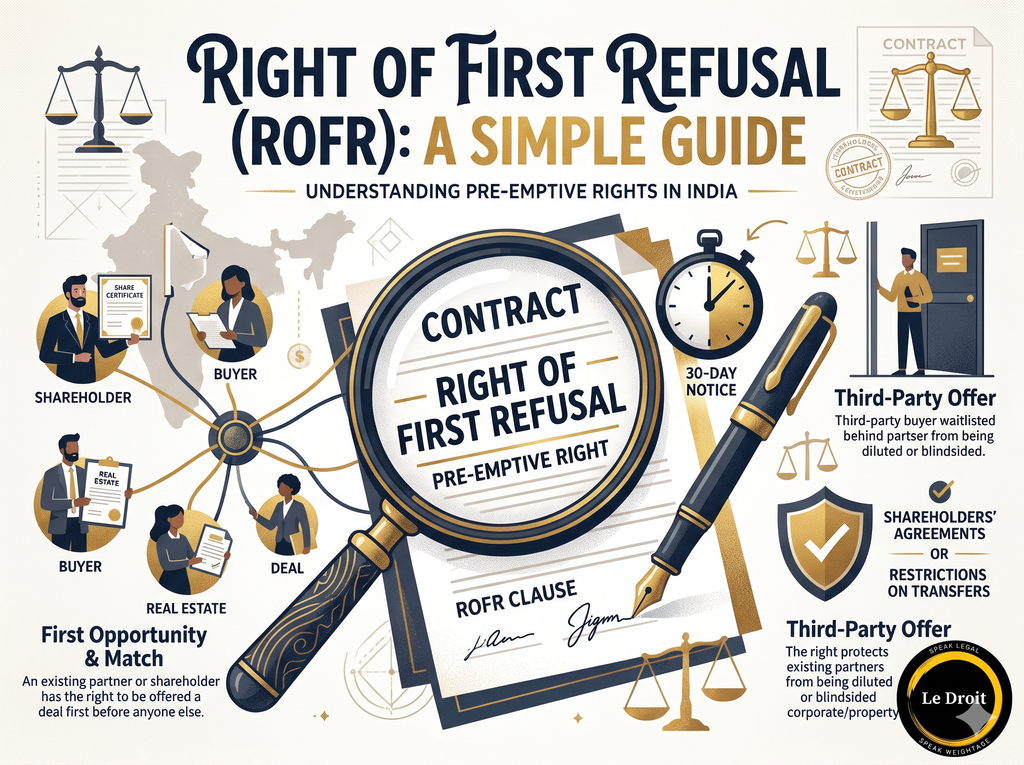
A Right of First Refusal (ROFR) is a contractual right that gives one party the opportunity to match or accept a deal before the other party is free to offer it to anyone else.
In plain words: if a shareholder wants to sell their shares, or a landowner wants to sell a property, and someone else holds a ROFR over it, that someone must be given the first chance to buy on the same terms, before the seller can go to a third party. It is a pre-emptive right, not a guarantee of ownership, the holder can still decline the offer.
ROFR clauses sit at an interesting point in contract design because they try to balance two competing interests that are both legitimate: the grantor’s freedom to sell their property or shares to whomever they choose, and the holder’s reasonable expectation of not being blindsided or excluded from a transaction they have a stake in. A well-drafted ROFR gives the holder a genuine, workable opportunity to step in, without indefinitely tying the grantor’s hands or killing deals with third parties who have no patience for an open-ended waiting period.
Legal Foundation: What Does Indian Law Say About It?
A ROFR is primarily a creature of contract, enforceable under the Indian Contract Act, 1872, rather than a right created directly by statute. It appears most often in two contexts in India:
- Shareholders’ agreements and joint ventures: Indian courts, notably in Messer Holdings Ltd. v. Shyam Madanmohan Ruia (2010, Bombay High Court), have upheld ROFR and other transfer-restriction clauses in shareholders’ agreements as valid and enforceable inter se between shareholders, as long as they don’t conflict with the free transferability of shares that public companies must otherwise preserve under the Companies Act, 2013. For private companies, Section 2(68) of the Companies Act expressly permits restrictions on share transfer in the articles of association, which is where ROFR mechanics are often embedded.
- Real estate and property transactions: in Pushpa Katoch v. Manu Maharani Hotels Ltd. (2005, Delhi High Court), the court recognised that a ROFR, while not an interest in property itself, is a valid and enforceable contractual right that can restrain a transfer made in violation of it.
The common thread across both contexts: Indian courts treat a ROFR as a binding negative covenant, the grantor cannot validly sell to a third party without first offering the holder the same opportunity, even though the holder has no automatic right to force a sale to themselves.
It is worth drawing out why this distinction between a “negative covenant” and a “positive right to acquire” matters so much in practice. Because a ROFR only restrains the grantor from selling to someone else without first offering the holder a chance, the holder’s remedy for breach is typically an injunction preventing the sale, or damages, rather than a court ordering the grantor to actually sell to the holder after the fact. This has an important practical consequence: a ROFR is most powerful as a deterrent and as leverage during negotiation, since by the time a breach is identified and litigated, the underlying transaction may already have closed. This is one reason sophisticated ROFR clauses are paired with strong notice obligations and, sometimes, a right for the holder to seek an injunction specifically preserving the status quo while the dispute is resolved.
It is also worth distinguishing a ROFR from its close cousin, the Right of First Offer (ROFO). Under a ROFO, the grantor must first offer the asset to the rights-holder before shopping it to third parties at all, whereas under a ROFR, the grantor can negotiate with third parties freely and only has to give the holder a chance to match the specific deal reached. ROFOs tend to favour the grantor (who is not locked into matching a specific external offer) while ROFRs tend to favour the holder (who gets to see and match an actual, binding third-party deal). The two are sometimes used interchangeably in casual drafting, which is itself a common source of disputes about what the parties actually intended.
Practical Relevance: Why Does It Matter in Actual Contracts?
ROFR clauses show up wherever one party wants protection against being diluted, displaced, or excluded from a future transaction:
- Shareholders’ agreements and joint venture agreements, protecting existing shareholders from a co-founder or investor selling out to an unwanted third party.
- Startup cap tables and investment agreements, where early investors want first access before new investors come in.
- Commercial leases, giving a tenant the first opportunity to buy the property if the landlord decides to sell.
- Supply and distribution relationships, where a long-standing partner wants first refusal before the other party contracts with a competitor.
For the holder, it’s a safeguard against being blindsided. For the grantor, it’s a constraint that can slow down or complicate an otherwise straightforward deal, which is why the process and timelines matter so much in drafting.
A few additional contexts deserve mention. Family-owned businesses and succession arrangements frequently embed ROFR provisions in family settlement agreements or wills, ensuring that shares or property stay within the family unless no family member is willing or able to match an outside offer. Intellectual property licensing, particularly in entertainment and media, sometimes grants a licensee a ROFR over future works by the same creator or a sequel to a licensed property. Venture debt and convertible note arrangements occasionally include a ROFR allowing the existing lender first refusal on any subsequent debt financing the company seeks, protecting the lender’s relative position in the capital structure.
What unites all of these situations is a desire for continuity and predictability: the holder wants assurance that a relationship, ownership structure, or strategic position they have invested in will not be upended by an outside party without at least being given a chance to preserve it themselves.
Practical Application: How Is It Drafted or Used?
A ROFR clause needs to answer three questions clearly: what triggers it, how much time the holder has to respond, and what happens if the holder declines or stays silent.
A typical clause looks like this:
“Right of First Refusal. If any Shareholder (the “Selling Shareholder”) proposes to transfer any of its shares to a third party pursuant to a bona fide offer, it shall first give written notice to the other Shareholders, specifying the number of shares, the price, and the material terms of the proposed transfer. The other Shareholders shall have thirty (30) days from receipt of such notice to elect, by written notice, to purchase all (and not less than all) of the offered shares on the same terms. If no such election is made within thirty (30) days, the Selling Shareholder may transfer the shares to the third party, on terms no more favourable than those offered to the other Shareholders, within ninety (90) days thereafter.”
When drafting or reviewing this clause, make sure it:
- Defines the trigger event precisely, a specific bona fide third-party offer, not merely an intention to sell, so the clause can’t be invoked prematurely or avoided through structuring.
- Sets a clear, workable notice period for the holder to exercise the right, long enough to arrange financing, short enough not to indefinitely freeze the grantor.
- States what happens on non-exercise or silence, typically permitting the grantor to proceed with the third party on terms no more favourable than those first offered to the holder.
- Specifies a sunset or outside date, after which the grantor must re-offer to the holder if the original third-party deal falls through or its terms change.
- Clarifies whether the right is assignable and whether it survives events like a merger, change of control, or transfer by operation of law.
Several further drafting considerations are worth adding to this checklist:
- Address what counts as “the same terms” when the third-party offer includes non-cash or non-standard elements. A third-party offer might include earn-outs, equity swaps, or services as part of the consideration, which a ROFR holder may not be able to replicate even if willing to pay an equivalent cash value. The clause should specify how such offers are valued or whether non-cash elements can be substituted with cash equivalents.
- Decide whether partial exercise is permitted. Many ROFR clauses, like the sample above, require the holder to take all or none of the offered shares or assets, precisely to prevent a seller from being left with an unsellable residual stake that no one else wants.
- Specify the consequence of multiple holders with overlapping rights. Where several shareholders each hold a ROFR, the clause needs to say how the offered shares are allocated between those who elect to exercise, typically on a pro-rata basis, to avoid disputes among co-holders.
- Clarify the interaction with tag-along and drag-along rights, which often appear in the same shareholders’ agreement and can create tension with a ROFR if not carefully sequenced. Typically, a ROFR is exercised first, and tag-along rights only become relevant if the ROFR is not exercised and the sale to the third party proceeds.
- Consider whether the right survives a transfer to an affiliate or family member, since many ROFR clauses carve out transfers within a corporate group or to immediate family, which are not treated as triggering events.
Common Pitfalls in ROFR Clauses
A number of recurring problems show up in ROFR drafting and enforcement:
- Vague or easily circumvented trigger language. A trigger defined loosely around “intent to sell” rather than a specific, bona fide third-party offer can be structured around by a determined seller.
- No clear mechanism for valuing non-cash consideration, leaving disputes about what the holder must actually match to exercise the right.
- Silence on what happens if the third-party deal changes after the notice period. Without a sunset date and re-offer obligation, a grantor could technically renegotiate materially different terms with the third party after the holder has declined the original offer.
- Confusing a ROFR with a ROFO, leading to drafting that doesn’t match either party’s actual commercial intent.
- Overlooking interaction with other transfer restrictions, such as tag-along, drag-along, or lock-up provisions, resulting in clauses that conflict with each other when a sale actually happens.
Business Connection: How Does It Relate to Real-World Legal Operations?
ROFR obligations are easy to overlook precisely because they only matter at the moment of a transaction, and by then, deal timelines are often tight. A business running an M&A process, a fundraise, or even a property sale needs to know well in advance which existing agreements carry a ROFR, who holds it, and what notice period it requires, long before term sheets are signed.
This is another area where contract lifecycle management tools add real value: flagging every agreement containing a ROFR or similar pre-emptive right, surfacing the applicable notice periods automatically when a relevant transaction is being planned, and preventing a deal from unravelling because a pre-emptive right buried in a years-old shareholders’ agreement was missed.
The practical cost of missing a ROFR is often much higher than the cost of missing other kinds of contractual obligations, because by the time it surfaces, it can unwind an entire transaction that is already well advanced, sometimes after significant diligence and negotiation costs have already been incurred by all sides. A buyer who discovers a ROFR only after signing a term sheet, or worse, after closing, faces the risk of the transaction being challenged or reversed. Building a simple cross-referenced register of every agreement that grants a pre-emptive right, who holds it, over what asset, and what notice it requires, is one of the highest-value, lowest-effort steps a legal team can take to avoid this kind of late-stage surprise.
Call to Action: Where Can You Learn More?
Clauses like this one don’t sit in isolation, they sit inside a much larger body of corporate and commercial law. If you want a structured, foundational understanding of how Indian company law shapes the contracts, governance, and compliance work you do every day, LeDroit India’s Company Laws in India Certificate Course is a good next step.