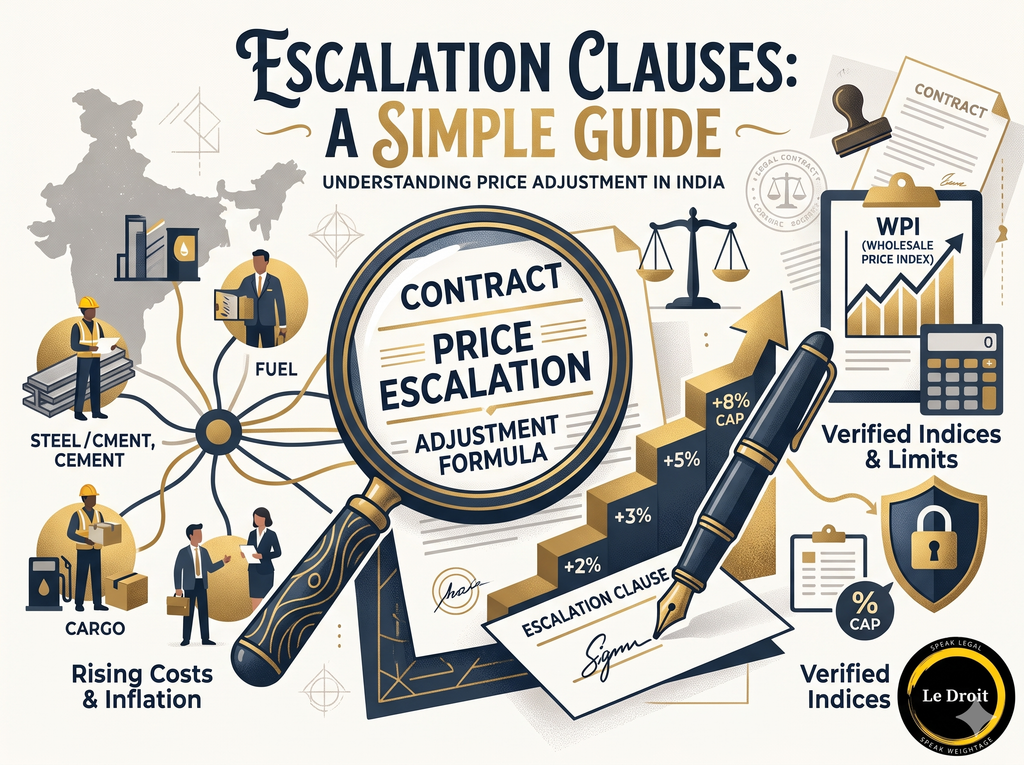
Introduction
An escalation clause is a contractual mechanism that allows the price, fee, or rate in a long-term contract to increase (or decrease) over time, based on a pre-agreed formula or index, instead of staying fixed for the entire duration of the agreement.
In plain words: instead of locking in today’s price for a contract that runs five years, the parties agree upfront, “the price will go up each year in line with [a named index, such as inflation or input costs].” The same word is also used for a different, related idea, a dispute escalation clause, which sets out a tiered process (negotiation, then mediation, then arbitration) before a dispute can go to court. This guide focuses on the price/cost escalation clause, which is the more common usage in supply, construction, and services contracts.
Escalation clauses sit quietly in the background of most long-term commercial relationships, and for good reason: they are the mechanism that keeps a multi-year deal economically viable for both sides as the world around it changes. A contract without one is essentially a bet, by both parties, that costs will stay flat for the full term. In most industries today, that is not a safe bet to make, which is exactly why escalation language has become close to standard in construction, manufacturing, and long-term services agreements.
Legal Foundation: What Does Indian Law Say About It?
There is no single section of the Indian Contract Act, 1872 dedicated to escalation clauses. Their enforceability rests on the general principle of freedom of contract: parties are free to agree on any lawful consideration, including a variable one, as long as the price or the method of calculating it is certain or capable of being made certain (a requirement that flows from Section 29, which voids agreements whose terms are uncertain).
This is why courts and arbitral tribunals in India have consistently upheld escalation clauses in long-term supply and construction contracts, provided the formula or index used is objective, verifiable, and not left to one party’s unilateral discretion. Where a contract (especially a government or public works contract) is silent on escalation, courts have sometimes read in a reasonable escalation based on actual cost increases, but this is far less certain and far more litigation-prone than simply drafting the clause upfront.
The underlying legal theme worth internalising is the distinction between a price term that is “certain” and one that is merely “ascertainable.” Courts do not require that the actual rupee figure be fixed in the contract itself; what they require is that the mechanism for arriving at that figure be objective enough that neither party, nor a court later asked to interpret it, has to guess. A clause that says “price may be revised as agreed between the parties from time to time” is far weaker than one tied to a named, independently published index, because the first leaves the actual adjustment to future negotiation (which may never happen, or may happen unfairly), while the second is self-executing and verifiable by anyone.
For GST-linked or tax-related cost changes, escalation clauses are also commonly drafted to reference statutory rate changes directly, so that a change in law (such as a GST rate revision) automatically triggers a price adjustment without needing to renegotiate the contract. This is a narrower but very practical application of the same principle: tying a price change to an external, objective, and easily verifiable event rather than to internal cost claims that the other party would have to independently verify and could reasonably dispute.
Practical Relevance: Why Does It Matter in Actual Contracts?
Escalation clauses matter most wherever a contract runs long enough for underlying costs to shift materially:
- Construction and infrastructure contracts, where steel, cement, and labour costs can move significantly over a multi-year project.
- Long-term supply and manufacturing contracts, where raw material or fuel prices fluctuate.
- Multi-year services and outsourcing contracts, where wage inflation affects the cost of delivering the service.
- Lease and rental agreements, where escalation is used for periodic rent increases.
Without an escalation clause, a party locked into a long fixed price can end up delivering at a loss, or a buyer can end up paying above-market rates if prices actually fall and there’s no corresponding downward mechanism.
There are a few other contract types where escalation clauses play an equally important, if less discussed, role. Facility management and maintenance contracts often run for several years and are heavily wage-dependent, so an escalation formula tied to minimum wage notifications or a labour cost index is standard practice. Long-term power purchase agreements (PPAs) frequently include fuel cost pass-through or escalation mechanisms, since the viability of a power project over fifteen or twenty years depends entirely on how input costs are allowed to move. Software and technology licensing agreements increasingly use escalation tied to a fixed annual percentage (rather than an external index), reflecting the vendor’s own rising cost of development and support rather than any external benchmark.
The common thread across all of these is duration: the longer a contract runs, the more an escalation clause shifts from “nice to have” to commercially essential. A one-year supply contract can reasonably absorb a fixed price. A ten-year infrastructure concession almost certainly cannot.
Practical Application: How Is It Drafted or Used?
A sound escalation clause names a specific, publicly available index or formula, sets the frequency of adjustment, and caps the maximum movement to avoid unpredictable swings.
A typical clause looks like this:
“Price Escalation. The Contract Value shall be reviewed annually on each anniversary of the Effective Date and adjusted by a percentage equal to the increase in the Wholesale Price Index (WPI) for the preceding twelve (12) months, as published by the Office of the Economic Adviser, Government of India, subject to a maximum upward adjustment of eight percent (8%) in any given year. Any such adjustment shall be notified by Supplier to Client in writing at least thirty (30) days in advance and shall take effect automatically unless disputed within that period.”
When drafting or reviewing this clause, make sure it:
- Names a specific, objective, third-party-published index or formula, never a figure left to one party’s discretion.
- Sets a clear frequency (annual, quarterly) and a clear trigger date, so neither party is guessing when the adjustment applies.
- Includes a cap (and, where relevant, a floor), so escalation doesn’t spiral unpredictably in either direction.
- Specifies the notice process, who calculates the adjustment, how it’s communicated, and what happens if the other party disputes it.
- States whether the adjustment is automatic or requires mutual written confirmation, since this materially affects how disputes are resolved later.
A few further drafting points are worth adding to this checklist:
- Choose an index the other party can independently verify. The best indices are the ones published by a recognised government body or a well-known industry association, precisely because neither side can be accused of manipulating them. An internal cost index maintained by one party, even if accurate, invites suspicion and disputes that an external index avoids entirely.
- Decide how rounding and partial years are handled. If the contract starts mid-year, is the first escalation prorated, or does it simply apply on the next full anniversary? Small mechanical questions like this cause disproportionate friction if left unaddressed.
- Clarify what happens if the named index is discontinued or changes methodology. Indices are occasionally rebased, renamed, or retired by the publishing authority. A clause that names a fallback index, or a mechanism for agreeing a substitute, avoids the clause becoming unworkable years into the contract.
- Consider a floor as well as a cap. Most drafters focus on capping upward movement, but in a contract where prices could fall (certain commodities, for instance), a floor can protect the supplier from having to pass on decreases that erode margin below a sustainable level.
- Specify who bears the burden if a dispute over the calculation arises. Does the pre-dispute price continue to apply until the dispute is resolved, or does the proposed new price apply provisionally? Silence here tends to produce a standoff exactly when cash flow is already under strain.
Common Pitfalls in Escalation Clauses
A few recurring mistakes show up again and again in escalation drafting:
- Referencing a vague or undefined index. Phrases like “inflation” or “market rates” without naming the specific published source leave room for genuine disagreement about which figure applies.
- No cap on movement. An uncapped escalation formula can produce a wildly unaffordable price in a year of unusual volatility, defeating the purpose of a formula meant to keep pricing predictable.
- Unclear effective date mechanics. Contracts that say escalation applies “annually” without specifying the exact trigger date create room for disagreement about whether an adjustment was due, and when.
- No process for disputing a calculation. If a party disagrees with how an adjustment was computed, the contract should say what happens next, rather than leaving the parties to work it out informally mid-dispute.
- Treating escalation and dispute-resolution escalation as the same thing. Because the word “escalation” is used for both a price mechanism and a tiered dispute process, poorly drafted contracts sometimes conflate the two, leading to confusion about which clause governs which situation.
Business Connection: How Does It Relate to Real-World Legal Operations?
In a portfolio of long-term contracts, missed escalation triggers are a quiet but real source of lost revenue or overpayment: a price adjustment that should have been applied on an anniversary date often simply isn’t, because nobody was tracking it.
This is a clear operational use case for contract lifecycle management: calculating and flagging escalation dates automatically, pulling in the relevant published index where possible, and ensuring price adjustments are applied (and documented) on time across every contract that contains one, instead of relying on someone remembering to check a spreadsheet each year.
The operational risk here cuts in both directions. A supplier who forgets to invoke an escalation clause on time effectively gives away margin every year that the adjustment is missed, and in many contracts, a late invocation cannot be applied retroactively, meaning that year’s increase is simply lost. On the other side, a buyer who fails to notice or challenge a miscalculated escalation may end up overpaying for years before anyone catches the error, particularly on long-running facilities, lease, or infrastructure contracts where no one revisits the pricing schedule unless prompted. Building a simple tracker, even a basic one listing each contract’s escalation index, frequency, next trigger date, and cap, goes a long way toward catching both failure modes before they compound year after year.
Call to Action: Where Can You Learn More?
Clauses like this one don’t sit in isolation, they sit inside a much larger body of corporate and commercial law. If you want a structured, foundational understanding of how Indian company law shapes the contracts, governance, and compliance work you do every day, LeDroit India’s Company Laws in India Certificate Course is a good next step.