Introduction
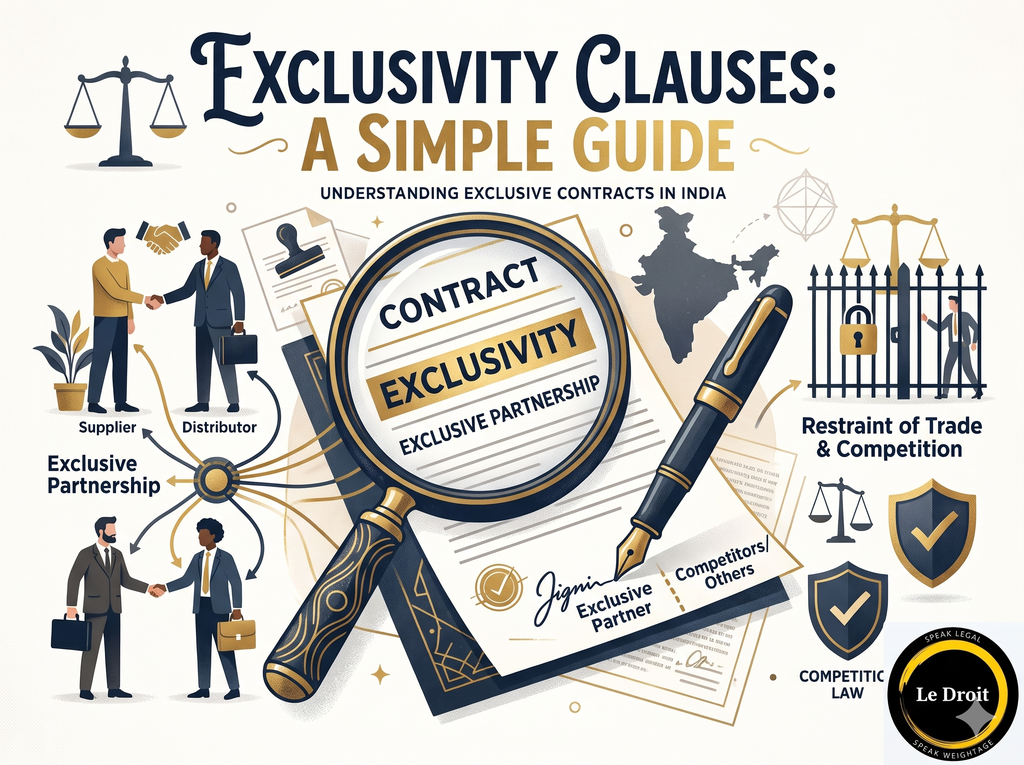
An exclusivity clause is a contractual promise by one party not to deal with, supply to, purchase from, or work with anyone else in a defined market, territory, or category, for as long as the agreement lasts.
In plain words: instead of a supplier selling to every buyer in a city, or a distributor stocking every competing brand, the parties agree that one side gets exclusive access, often in exchange for commitments like minimum purchase volumes, marketing investment, or a higher price.
Exclusivity is one of those clauses that looks like a single sentence in a contract but actually carries an entire relationship’s worth of risk and opportunity inside it. Get it right, and both sides have a predictable, focused partnership. Get it wrong — vague scope, no performance tie-in, no exit mechanism — and it becomes a source of disputes, regulatory exposure, or a slow-motion trap where one party is locked into an underperforming relationship with no clean way out.
Legal Foundation: What Does Indian Law Say About It?
Exclusivity clauses sit at the intersection of ordinary contract law and competition law in India.
- Indian Contract Act, 1872: exclusivity obligations that apply during the term of a contract are generally enforceable as ordinary contractual restraints. Section 27, which voids agreements “in restraint of trade,” has mainly been applied by courts to restraints that continue after a contract ends, such as post-termination non-competes, rather than exclusivity that operates only while the relationship is live. Courts have generally drawn a line between restrictions that operate during the subsistence of a contract — which are treated as ordinary, enforceable terms of the bargain — and restrictions that try to bind a party after the contract has ended, which attract much closer scrutiny under Section 27. This distinction matters enormously in drafting: an exclusivity clause confined to the term of the agreement sits on much safer ground than one that tries to extend into a post-termination non-compete.
- Competition Act, 2002: exclusive supply and exclusive distribution agreements are expressly recognised as a category of vertical agreement under Section 3(4). They are not automatically illegal, India follows a “rule of reason” approach, but the Competition Commission of India (CCI) can examine whether the arrangement causes an Appreciable Adverse Effect on Competition (AAEC), particularly where the party benefiting from exclusivity holds significant market power. In practice, this means the CCI’s concern is not with exclusivity as a concept, but with exclusivity that forecloses the market to competitors — for instance, an exclusivity arrangement between a dominant supplier and a dominant distributor that effectively locks up a large share of a market, making it difficult for rival suppliers or distributors to find outlets or sources of supply at all.
It is worth noting that the “rule of reason” approach means the CCI will typically weigh factors like the market share of the parties involved, the duration of the exclusivity, the existence of alternative channels in the market, and any efficiency justifications (such as investment incentives created by exclusivity) before concluding that an arrangement is anti-competitive. This is different from a “per se” prohibition, where the mere existence of the clause would be enough to trigger liability — Indian law does not take that stricter approach to exclusivity.
Practical Relevance: Why Does It Matter in Actual Contracts?
Exclusivity clauses are common, and commercially important, in:
- Distribution and dealership agreements, where a distributor agrees to sell only one brand’s products in a territory.
- Franchise agreements, where the franchisee cannot operate a competing business.
- Licensing and supply agreements, where a licensor grants exclusive rights to one licensee in a region or sector.
- Service agreements, such as a company engaging a single agency or vendor exclusively for a function.
The business rationale is usually mutual: the party giving exclusivity gets guaranteed volume, investment, or focus in return for giving up the freedom to work with others.
Beyond these four common categories, exclusivity also shows up in less obvious places. In technology and platform agreements, a startup might grant a single investor or strategic partner exclusive rights to a particular use case or vertical in exchange for funding or integration support. Also in manufacturing and OEM arrangements, a manufacturer may agree to produce a particular component only for one buyer, in exchange for that buyer underwriting tooling or capacity costs. In content and media deals, a creator or production house may grant one platform exclusive streaming or publishing rights for a fixed window, trading broader reach for a guaranteed fee.
What ties all of these together is the same underlying trade: one party gives up optionality, and in return expects either a guaranteed economic benefit (minimum volumes, fees, investment) or a structural advantage (first-mover position, reduced competition, control over a channel). Any time a lawyer sees an exclusivity clause, the first useful question to ask is: what is each side actually getting in exchange for what they’re giving up? If that exchange is lopsided or undefined, the clause is likely to cause friction later.
Practical Application: How Is It Drafted or Used?
A well-drafted exclusivity clause defines exactly what is exclusive (products, territory, customer segment), for how long, and what the exclusive party must do to keep that status, since exclusivity without performance obligations tends to disadvantage the grantor.
A typical clause looks like this:
“Exclusivity. During the Term, Supplier shall sell the Products exclusively to Distributor within the Territory, and shall not appoint any other distributor or sell directly to customers located in the Territory. In consideration of this exclusivity, Distributor shall purchase a minimum of [quantity/value] of Products per quarter. If Distributor fails to meet the minimum purchase obligation for two consecutive quarters, Supplier may convert this Agreement to a non-exclusive basis upon written notice.”
When drafting or reviewing this clause, make sure it:
- Defines the scope precisely — by product line, customer segment, and geography — so neither party can argue the exclusivity was broader or narrower than intended.
- Ties exclusivity to performance, such as minimum purchase or revenue targets, with a clear consequence if those are missed.
- Lists carve-outs explicitly — existing customers, online sales, or specific excluded products — rather than leaving them to be implied later.
- States the consequences of breach, including whether the non-exclusive party can terminate, claim damages, or both.
- Considers competition law exposure where the exclusive party has significant market share in the relevant market, and flags this for review rather than assuming it is automatically enforceable.
A few additional drafting considerations are worth building into the checklist above:
- Define the trigger for measuring performance clearly. “Minimum purchase of [quantity/value] per quarter” sounds precise, but disputes often arise over what counts — gross orders placed, or units actually delivered and paid for? Does a cancelled or returned order count against the minimum? Spelling this out avoids arguments at the exact moment the relationship is under strain.
- Specify the cure mechanism, not just the consequence. Rather than a binary “breach equals termination,” many commercially sensible clauses build in a notice-and-cure period, or — as in the sample clause above — a step-down to non-exclusive status before outright termination. This gives both sides a chance to recalibrate rather than ending a relationship that may still have value.
- Address exclusivity during transition periods. What happens to exclusivity obligations during notice periods, or while a dispute is being resolved? Silence here often leads to one party acting as though exclusivity has already lapsed while the other insists it is still binding.
- Think about mutuality. Is the exclusivity one-directional (only the supplier is restricted) or mutual (the distributor also agrees not to sell competing products)? Many disputes arise because one side assumed the restriction ran both ways when the drafting only restricted one party.
- Consider interaction with other clauses, particularly termination, force majeure, and assignment. An exclusivity obligation that survives an assignment to a competitor, for instance, can create awkward outcomes that neither original party intended.
Common Pitfalls in Exclusivity Clauses
Even experienced drafters fall into a few recurring traps with exclusivity clauses:
- Open-ended exclusivity with no performance link. A clause that grants exclusivity indefinitely, with no obligation on the exclusive party to actually perform, effectively locks the grantor out of a market with nothing guaranteed in return.
- Vague territorial or product definitions. Phrases like “in the region” or “similar products” invite disputes about what falls inside or outside the exclusivity, especially years into a relationship when business lines have evolved.
- No review or renewal mechanism. Markets change. A clause locked in at signing, with no built-in checkpoint to revisit scope or minimums, can become commercially irrational well before the contract term ends.
- Ignoring competition law exposure at the drafting stage. Teams often treat the CCI risk as something to think about only if a complaint arises, rather than flagging it during drafting when the market share and structure of the deal are still being negotiated.
- Overlooking carve-outs that will inevitably come up. Existing customer relationships, e-commerce or marketplace sales, and group company transactions are common sources of “this wasn’t really covered by exclusivity” disputes when they aren’t addressed upfront.
Business Connection: How Does It Relate to Real-World Legal Operations?
Exclusivity obligations are easy to agree to and easy to lose track of, especially across a growing network of distributors, vendors, or licensees. A business that has granted exclusivity in twenty different territories needs to know, at a glance, where those commitments exist, what triggers a breach, and when each one expires or comes up for renewal.
This is a natural fit for contract lifecycle management: flagging every active exclusivity obligation across the contract portfolio, tracking the minimum performance thresholds attached to them, and alerting the legal or sales team before an exclusivity term silently auto-renews or a minimum purchase deadline is missed.
In practice, this operational layer is often where exclusivity clauses succeed or fail — not in the drafting room, but in whether anyone is actually watching the obligations after signature. A distributor that quietly falls short of its minimum purchase target for three quarters in a row, with no one on the supplier’s side tracking it, effectively gets the benefit of exclusivity without delivering the performance that was supposed to justify it.
Equally, a business expanding into a new product line may not realise that an old exclusivity grant in an unrelated agreement already restricts who it can sell that product to in a given territory, until a conflict surfaces. Building a simple internal register — even a basic spreadsheet listing each exclusivity grant, its scope, its performance conditions, and its review date — goes a long way toward preventing both scenarios, and is often the first recommendation worth making to a client who has several exclusivity arrangements in play at once.
Call to Action: Where Can You Learn More?
Clauses like this one don’t sit in isolation, they sit inside a much larger body of corporate and commercial law. If you want a structured, foundational understanding of how Indian company law shapes the contracts, governance, and compliance work you do every day, LeDroit India’s Company Laws in India Certificate Course is a good next step.