(This article is written by Anindita Biswas , Snehanghshu kanta acharya institute of law under university of kalyani, BA .LL.B(hons) and 4th year during her internship at LeDroit India)
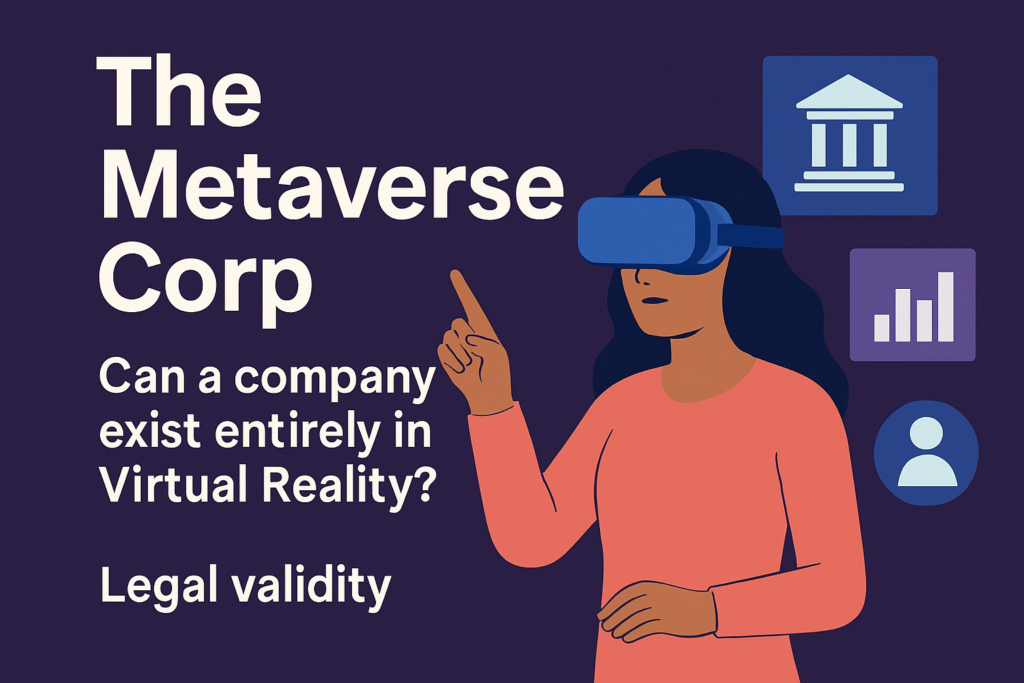
Scope of the Article:
1. Introduction
2. Conceptual Foundation
3. Legal Personality in Virtual Reality
4. Contractual and Commercial Validity
5. Regulatory and Governance Challenges
6. Comparative and Future Perspectives
7.Judicial Interpretation and Landmark Case Laws
8. Practical and Ethical Dimensions
9. Technological Infrastructure and Security
10. Conclusion
11. Reference
ABSTRACT:
The companies may operate entirely within virtual environments, raising profound questions about the legal validity of such entities in which the emergence of the metaverse has introduced a transformative paradigm. In virtual reality, this article explores whether a corporation can exist exclusively, examining the conceptual foundations of digital corporate identity and the challenges of recognition under existing legal frameworks. In a borderless digital ecosystem, it investigates the applicability of corporate law, contract enforcement, intellectual property rights and consumer protection while also addressing issues of jurisdiction, liability and taxation.
Nevertheless, potential governance models for metaverse corporations, the discussion extends to the role of blockchain, smart contracts and decentralized autonomous organizations (DAOs). Comparative perspectives or outlook are drawn from cyber law, e-commerce regulation and international trade norms to highlight both the opportunities and limitations.
KEY WORDS –
- Virtual Incorporation
- Legal Validity
- Judicial Interpretation
- Technological Infrastructure
- Ethical Responsibility
- Global Harmonization
1.INTRODUCTION:
Digital technologies by rapid evolution have given rise to the concept of the metaverse—a collective, immersive virtual environment where individuals and organizations interact beyond the physical space by constraints. Within this emerging ecosystem, virtual reality has become a subject of both fascination and legal inquiry by the possibility of companies existing entirely . The metaphor of the “metaverse crop” captures this phenomenon: in digital soil ,enterprises are cultivated, grown and sustained exclusively, without tangible offices, assets, or geographical boundaries.
Such a development challenges the traditional foundations of corporate law, which have historically relied on physical incorporation, territorial jurisdiction, and material accountability.
2. Conceptual Foundation :
The concept of the metaverse represents a convergence of immersive technologies are virtual reality (VR), augmented reality (AR), blockchain and artificial intelligence, where individuals and organizations interact beyond physical boundaries- into a shared digital environment. In virtual reality challenges conventional notions of corporate identity and legal recognition, Within this ecosystem, the idea of a company exists entirely.
Traditionally, in the physical world through incorporation, registration and territorial jurisdiction the corporations are anchored. They are defined by tangible elements which are touchable, like offices, employees and assets. In contrast, a metaverse corporation and in digital soil, the “metaverse crop”—is cultivated and sustained exclusively. It may have no physical headquarters, no material assets, and no geographical location, it can engage in commerce, enter into contracts and generate value through virtual goods, which are services and currencies. Furthermore, the metaverse blurs or obscures the line between real and virtual economies. The metaverse can have tangible financial and legal consequences as virtual assets, from NFTs to cryptocurrencies, increasingly hold real-world value, and transactions conducted.
3. Legal Personality in Virtual Reality :
Digital avatars, blockchain records, smart contracts and decentralized governance structures by identity may be defined. This raises the fundamental question , can such a virtual entity be granted legal personality under existing legal frameworks or does it require a new category of recognition? This is discussed in below –
3.1. Criteria for Recognition :
In incorporation and registration, the cornerstone of corporate existence lies, which traditionally requires a physical jurisdiction, a registered office, and compliance with statutory procedures. In the metaverse, however, this foundation is disrupted. In incorporation and registration a company may exist entirely without a tangible office or geographical location, relying instead on blockchain-based validation or decentralized autonomous organization (DAO) infrastructures. Assigning liability for fraud, breach or negligence becomes complex without physical presence .
3.2. Jurisdictional Complexities :
The ability to enter into binding agreements from Legal personality is inseparable or indivisible. In the metaverse, without intermediaries, corporations can execute smart contracts by self-executing agreements coded on blockchain platforms that facilitate transactions. In courts remains uncertain, while these contracts ensure efficiency and transparency, their enforceability. In case of breach, jurisdictions differ in their recognition of digital agreements and questions arise about the consent, jurisdiction, and remedies.
3.3. Emerging Models of Virtual Personality :
In virtual reality is accountability and liability, Perhaps the most complex dimension of legal personality. Traditional corporations are subject to regulatory oversight, duties of director and statutory obligations that ensure responsibility for fraud, negligence or breach of law. In contrast, a metaverse corporation may operate anonymously with avatars among governance distributed or decentralized nodes. Assigning liability in such a structure becomes problematic, as the absence of physical presence and identifiable directors can obscure responsibility.
4. Contractual and Commercial Validity :
Here’s a brief discussion of contractual and commercial validity,those are discussed in below –
4.1. Contractual Validity :
In virtual environments, the contractual dimension of metaverse corporations revolves around the enforceability of agreements executed. Traditional contracts often employ smart contracts that are self-executing codes stored on blockchain platforms, which rely on written or oral consent, metaverse transactions. By automatically performing obligations once conditions are met these digital agreements ensure efficiency and transparency. Nevertheless, their lawful validity remainder contested. In cross-border contexts, when disputes arise courts must grapple with questions of consent, interpretation, jurisdiction and their remedies, particularly where parties may be subject to multiple lawful systems.
4.2. Commercial Validity :
Beyond contracts, the recognition of their transactions, assets and regulatory compliance depends on the commercial legitimacy of metaverse corporations.legal status varies across jurisdictions, Virtual assets such as cryptocurrencies, non-fungible tokens (NFTs) and digital goods increasingly hold significant real-world value. Some states classify them as property or financial instruments, while others impose restrictions or bans them. In virtual reality, this inconsistency creates uncertainty for corporations seeking to operate exclusively. In a borderless or boundless digital marketplace, protection of consumer, rights of intellectual property and data privacy present pressing challenges. Anonymous or nondescript transactions and intangible goods heighten risks of fraud and exploitation, demanding adaptation of existing commercial laws to safeguard or safekeeping users.
5. Regulatory and Governance Challenges :
In virtual reality, the rise of corporations that exist entirely presents profound challenges for regulatory systems and structures of governance. Traditional corporate regulation is built or created upon territorial jurisdiction, compliance which is statutory and physical accountability.
5.1. Jurisdictional Ambiguity :
In a clear jurisdiction one of the foremost challenges is absence. A metaverse corporation may conduct business simultaneously or at the same time across multiple countries making it difficult to determine which legal system governs its incorporation, taxation and dispute or problem resolution. To avoid accountability, this ambiguity risks creating regulatory gaps where corporations exploit inconsistencies between national laws .
5.2. Regulatory Oversight and Compliance :
On decentralized governance models as a Metaverse corporations often rely is such as decentralized autonomous organizations (DAOs), where decision-making is distributed or provided, shared among token holders or coded into smart contracts. When these structures enhance transparency,fairness and participation, they complicate regulatory oversight or mistake. In code rather than centralized management, traditional regulators may struggle to monitor compliance with corporate duties, financial reporting or the consumer protection when governance is embedded.
5.3. Cross-Border Enforcement :
The borderless nature of the metaverse raises questions about the enforcement or imposition. Regulators must consider how to impose or enforce sanctions, solve disputes, problems or enforce judgments against corporations that lack physical presence. Without harmonized international frameworks, enforcement risks becoming fragmented, metaverse commerce by undermining the legitimacy.
6. Comparative and Future Perspectives :
Those are explained in below –
6.1. Comparative Insights :
The evolution of corporate law provides or shares useful parallels for the understanding of the metaverse corporation. In territorial incorporation and physical accountability the traditional companies are anchored, while e‑commerce and cyber law have already demonstrated or elaborated how businesses can thrive or prosper without physical storefronts. Courts and regulators gradually adapted to recognize or identify electronic contracts, online marketplaces and digital transactions offering precedents for how metaverse corporations might be treated.
6.2. Future Perspectives :
In corporate recognition and governance, the metaverse may drive a transformation. One possibility is the virtual incorporation by emergence, where companies are registered through digital or blockchain‑based systems instead of territorial offices. While operating primarily in virtual reality, hybrid models may also develop with corporations maintaining minimal physical registration. At the global level harmonization of rules on taxation, dispute resolution and consumer protection will be essential to prevent or avart regulatory arbitrage. In virtual environments, new governance institutions ex (digital tribunals or specialized regulatory bodies ) may arise to oversee compliance or conformity and accountability.
6.3. Broader Implications :
The metaverse corporation is both a challenge and an opportunity to reveal the comparative and future perspectives. By questioning the necessity of physical presence, it challenges the foundations of corporate law yet it offers opportunities for innovation, inclusivity and global commerce. The metaphor of the “metaverse crop” captures this duality or dichotomy: in digital soil, businesses are cultivated, nurtured by technological infrastructure and harvested through virtual trade.
7. Judicial Interpretation and Landmark Case Laws :
Those cases can be further explained as follows –
7.1. State of Maharashtra v. Dr. Praful B. Desai (2003)
The Supreme Court held or highlighted that under Indian law, recording evidence via video conferencing is valid. The Court interpreted “presence” briefly, recognizing that virtual presence can satisfy statutory requirements or is inescapable. This case is crucial for metaverse corporations in legal processes because it shows the judiciary’s openness to non-physical participation, a principle that could extend to the virtual existence of corporations.
7.2. Shafhi Mohammad v. State of Himachal Pradesh (2018)
The Supreme Court held the strict certification requirements or needed for electronic records under Section 65B of the Evidence Act 1872. On the other side, it ruled that electronic evidence can be admitted if authenticity is established. In Indian courts, this judgment is significant for metaverse corporations, as it affirms that digital records, blockchain transactions and smart contracts could be admissible, virtual agreements by strengthening the legal validity.
7.3. Trimex International FZE Ltd. v. Vedanta Aluminium Ltd. ( 2010)
The Supreme Court recognized that contracts concluded via electronic communication like emails are valid and enforceable. The Court emphasized that an agreement in the absence of a physical signature does not invalidate if consensus and idem (meeting of minds) is established. In the metaverse can carry binding legal force under Indian law, this case directly supports the argument that virtual contracts and digital negotiations
7.4. Ooki DAO Case (U.S., 2022)
The U.S. court held that Ooki DAO was an association which is incorporated under the Commodity Exchange Act; it could be sued and held accountable. The ruling clarified that token‑holding members who participated in governance could be personally liable for the unlawful trading activities of DAO. In essence, from legal responsibility and regulatory oversight the judgment established that decentralization does not shield DAOs or virtual corporations.
8. Practical and Ethical Dimensions :
Those are discuss in below –
8.1. Practical Dimensions :
In virtual reality, the practical challenges of recognizing a company that exists entirely are multifaceted. Without physical infrastructure on a functional level, such corporations must demonstrate the ability to enter contracts, manage assets and ensure accountability. This requires reliance on blockchain systems, smart contracts and digital currencies which efficiently raise questions of enforceability across jurisdictions.
8.2. Ethical Dimensions :
Metaverse corporations of the ethical implications are equally significant. In a virtual environment, operating may blur lines of responsibility, transparency and fairness. In governance fosters inclusivity or enables exploitation, questions arise about whether anonymity. In immersive environments, ethical concerns also extend to consumer protection, as users may be vulnerable to misleading practices, unsafe digital products or manipulation.
9. Technological Infrastructure and Security :
The backbone of their legal and ethical validity, the technological infrastructure and security of metaverse corporations form Operating entirely in virtual reality requires resilient systems built on blockchain, smart contracts and decentralized networks that can authenticate digital identities and sustain global transactions. This innovation comes heightened responsibility: corporations must guard against cyberattacks, fraud and misuse of personal data, ensuring that privacy and transparency, equity are not compromised.
Into the very design of virtual enterprises, ethical dimensions intertwine with these technical demands, as inclusivity, fair access and accountability must be embedded. The “metaverse crop” can only flourish if its technological roots are strong and its ethical safeguards or safekeeping are crystal clear, allowing it to grow as both a legally valid and socially responsible entity.
10. Conclusion
The technological innovation alone cannot guarantee legitimacy and the ethical dimensions of metaverse corporations reveal; in responsibility, it must be anchored fairness and trust. In virtual reality, a company existing entirely faces heightened duties to protect privacy, making sure transparency and in environments prevent exploitation where anonymity and immersive interaction blur traditional boundaries. Ethical governance requires balancing inclusivity with accountability, safeguarding consumer rights and digital infrastructure by resisting monopolization. In essence, the “metaverse crop” will only flourish if cultivated with integrity which is ethical alongside technological strength and allowing virtual corporations to grow not merely as digital experiments but as legally valid and socially responsible entities.