This article is written by Rajalakshmi Ganesan, Renaissance University, LLB, 3rd year during her internship at LeDroit India
Keywords: TDSAT, TRAI Act, telecom scams, spam penalties, broadcasting rights, reforms, national governance.
Scope of Article:
- Historical Development of Telecom Regulation in India
- Statutory Framework and Jurisdiction of TDSAT
- Telecom Disputes and Litigation Themes
- Broadcasting Rights and Regulatory Conflicts
- Major Case Studies
- Telecom Crimes and Scams
- Reforms and Institutional Improvements
- National Governance and Public Impact
- Comparative Legal Perspectives
- Conclusion and Future Outlook
Abstract
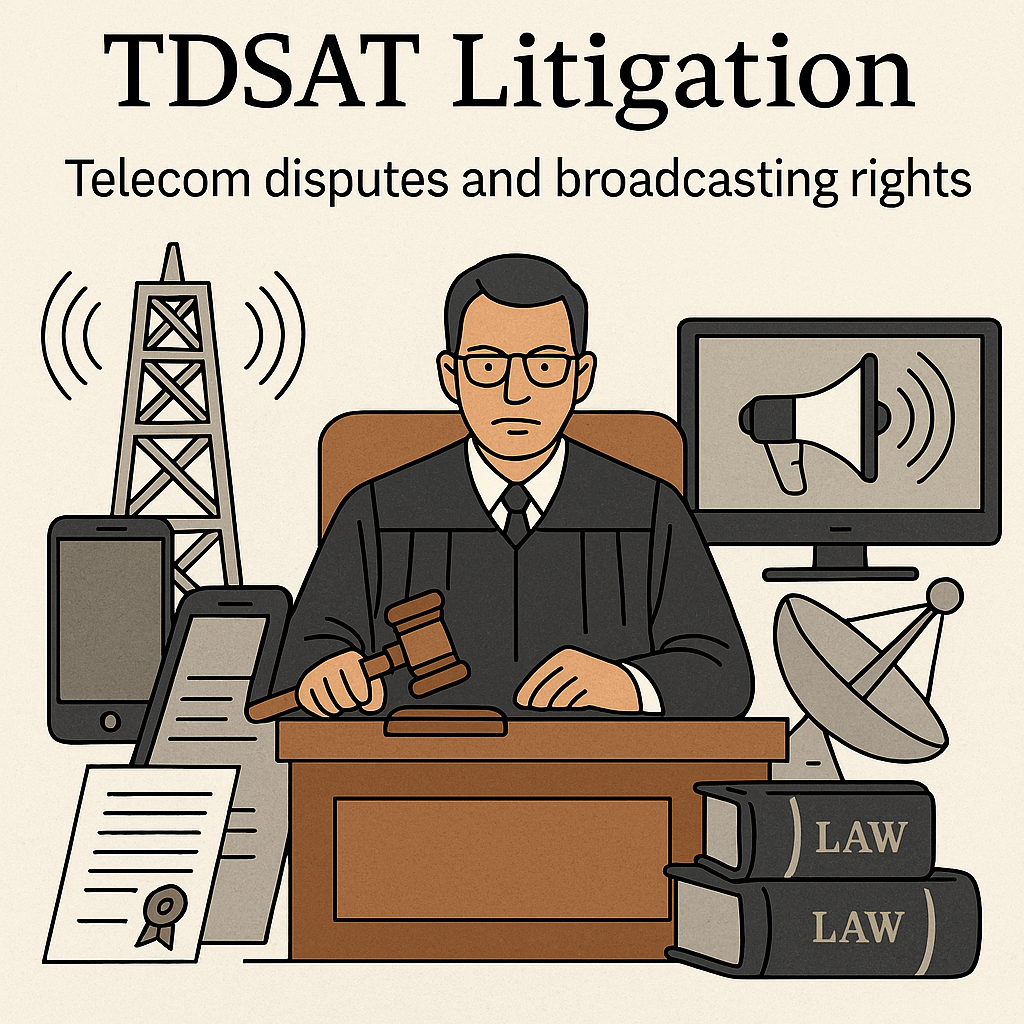
The Telecom Disputes Settlement and Appellate Tribunal (TDSAT), established under the Telecom Regulatory Authority of India Act, 1997, is India’s specialized forum for adjudicating disputes in the telecom and broadcasting sectors. Its jurisdiction, defined in Section 14 of the TRAI Act, extends to conflicts between licensor and licensee, service providers, and consumers, as well as appeals against orders issued by TRAI. By vesting TDSAT with civil court powers, Parliament ensured that complex disputes involving technical and contractual issues could be resolved with expertise and procedural fairness.
This article examines TDSAT’s role from a legal perspective, tracing its historical development, analyzing statutory provisions, and evaluating judicial precedents. Landmark cases such as BSNL vs Reliance Communications Ltd. (2010), Vodafone Idea Ltd. vs TRAI (2020), and Star India Pvt. Ltd. vs TRAI (2007) illustrate how the tribunal balances commercial imperatives with consumer rights. Beyond routine disputes, TDSAT has engaged with telecom scams, spam penalty cases, and fraudulent billing practices, reflecting its role in safeguarding industry integrity.
Comparative perspectives with the United States’ Federal Communications Commission (FCC) and the United Kingdom’s Ofcom highlight both strengths and challenges in India’s model. The paper concludes by emphasizing reforms to strengthen TDSAT’s capacity in the digital age, particularly in addressing OTT platforms and convergence disputes.
Introduction

Establishment of TDSAT and Its Jurisprudential Significance
The creation of the Telecom Disputes Settlement and Appellate Tribunal (TDSAT) in 2000 was not merely an administrative reform but a deliberate legislative choice aimed at restructuring India’s communications law. Prior to the amendment, the Telecom Regulatory Authority of India (TRAI), established under the TRAI Act, 1997, was entrusted with both regulatory and adjudicatory functions. This dual role raised serious concerns of bias, conflict of interest, and violation of natural justice, since the same authority that framed regulations also adjudicated disputes arising under them.
Recognizing these shortcomings, Parliament amended the TRAI Act to establish TDSAT under Section 14, thereby separating regulatory and adjudicatory functions. TRAI was confined to its regulatory role—framing tariffs, issuing directions, and ensuring compliance—while TDSAT was vested with the exclusive jurisdiction to adjudicate disputes between licensor and licensee, service providers, and consumers, and to hear appeals against TRAI’s orders. Appeals from TDSAT’s decisions were made to lie directly before the Supreme Court under Section 18, bypassing High Courts, reflecting legislative intent to ensure speed, finality, and specialized adjudication.
TDSAT was designed as a quasi-judicial body with powers akin to a civil court under the Code of Civil Procedure. It can summon witnesses, receive evidence, and issue binding orders. This statutory framework ensures that disputes are adjudicated independently, with procedural safeguards comparable to those in civil litigation.
The tribunal’s jurisprudence demonstrates how statutory interpretation, equitable principles, and constitutional values intersect in telecom and broadcasting disputes. For instance:
- Statutory interpretation: TDSAT frequently interprets provisions of the TRAI Act, license agreements, and TRAI regulations, clarifying the scope of regulatory powers and contractual obligations.
- Equitable principles: In disputes over interconnection charges or carriage fees, TDSAT applies doctrines of fairness and non-discrimination to prevent abuse of dominance by larger operators.
- Constitutional values: Broadcasting disputes often implicate rights under Article 19(1)(a) (freedom of speech) and Article 19(1)(g) (freedom of trade), requiring TDSAT to balance regulatory objectives with fundamental rights.
The Supreme Court has reinforced this framework in cases such as Cellular Operators Association of India vs TRAI, observing that TDSAT is the proper forum for resolving technical and contractual disputes in the telecom sector. Similarly, in BSNL vs Reliance Communications Ltd. (2010), the Court emphasized that damages under interconnection agreements must reflect genuine pre-estimates rather than penalties, underscoring the tribunal’s role in shaping telecom contract law.
Thus, TDSAT’s establishment marked a jurisprudential shift in Indian communications law: disputes are no longer treated as mere administrative matters but as specialized judicial proceedings requiring mastery of multiple legal doctrines. Practitioners must be adept not only in the TRAI Act but also in contract law (for licensing and interconnection agreements), administrative law (for regulatory oversight), and constitutional law (for broadcasting and consumer rights).
Historical Background
Indian Telegraph Act, 1885

The Indian Telegraph Act, 1885 was the first comprehensive legislation governing communications in colonial India. It vested the exclusive privilege of establishing, maintaining, and operating telegraph services in the Government of India, effectively creating a state monopoly. Private participation was prohibited unless licensed by the government. The Act also empowered the state to intercept messages in the interest of public safety or national security. This framework reflected colonial priorities of control and surveillance rather than consumer welfare, and it entrenched the principle of state monopoly in communications.
Post-Independence: Telecom under DoT; Broadcasting under AIR and Doordarshan

After independence in 1947, the government retained monopoly control over telecommunications through the Department of Telecommunications (DoT). Telephone services were treated as a public utility, with limited innovation and no private participation. Broadcasting was similarly centralized under All India Radio (AIR) and later Doordarshan, both functioning as state-controlled entities. Disputes were resolved internally within government departments, leaving little scope for independent judicial review. This period was marked by slow expansion of services, long waiting lists for telephone connections, and limited consumer choice.
Liberalization (1991)
The economic reforms of 1991 marked a turning point in India’s communications sector. Liberalization opened the telecom industry to private operators, inviting domestic and foreign investment. This competitive environment led to disputes over licensing, tariffs, and interconnection agreements. Private operators challenged government policies on spectrum allocation, license fees, and revenue sharing. Without a specialized adjudicatory body, such disputes often reached High Courts and the Supreme Court, burdening the judiciary and delaying resolution. The entry of multiple players created the need for a regulator that could ensure fair competition, consumer protection, and orderly growth of the sector.
TRAI Act, 1997
In response, Parliament enacted the Telecom Regulatory Authority of India Act, 1997 (TRAI Act), creating the Telecom Regulatory Authority of India (TRAI) as an independent regulator. TRAI was tasked with overseeing tariffs, interconnection, and licensing. However, TRAI was initially vested with both regulatory and adjudicatory powers, which created conflicts of interest. TRAI framed regulations and then adjudicated disputes arising under those regulations. This arrangement was criticized as violating principles of natural justice and separation of powers, since the same authority acted as both rule-maker and judge. Judicial review of TRAI’s decisions often led to inconsistent outcomes, highlighting the need for a separate adjudicatory forum.
2000 Amendment: Establishment of TDSAT
Recognizing these concerns, Parliament amended the TRAI Act in 2000, creating the Telecom Disputes Settlement and Appellate Tribunal (TDSAT) under Section 14. TDSAT was empowered to adjudicate disputes between:
- Licensor and licensee,
- Service providers,
- Service providers and consumers, and
- Appeals against TRAI’s directions, decisions, or orders.
Appeals from TDSAT’s orders lie directly to the Supreme Court under Section 18, bypassing High Courts. This reflects legislative intent to ensure speed, finality, and specialized adjudication in telecom disputes. TDSAT was designed as a quasi-judicial body with powers akin to a civil court, capable of summoning witnesses, receiving evidence, and issuing binding orders.
The establishment of TDSAT marked a jurisprudential shift in Indian communications law: disputes were no longer treated as administrative matters but as specialized judicial proceedings requiring mastery of statutory interpretation, contractual analysis, and constitutional scrutiny.
Jurisdiction and Powers of TDSAT
The Telecom Disputes Settlement and Appellate Tribunal (TDSAT) was established under the 2000 amendment to the Telecom Regulatory Authority of India Act, 1997 (TRAI Act) to serve as a specialized adjudicatory forum for disputes in the telecom and broadcasting sectors. Its jurisdiction is broad and carefully defined to ensure that disputes arising from regulatory decisions, contractual obligations, and consumer grievances are resolved by a body with both technical expertise and judicial authority.
Scope of Jurisdiction
Under Section 14 of the TRAI Act, TDSAT is empowered to adjudicate disputes involving:
- Licensor and licensee: This covers disputes between the Government of India (acting through the Department of Telecommunications) and private telecom operators regarding license conditions, spectrum allocation, and revenue sharing.
- Service providers inter se: Disputes between telecom operators, broadcasters, and distributors, often concerning interconnection agreements, carriage fees, or infrastructure sharing.
- Service providers and consumers: Consumer grievances relating to tariffs, service quality, and unfair practices.
- Appeals against TRAI’s orders: Any direction, decision, or regulation issued by TRAI can be challenged before TDSAT, making it the primary forum for reviewing regulatory action.
This jurisdiction ensures that TDSAT functions as the exclusive forum for telecom and broadcasting disputes, preventing fragmentation of litigation across multiple courts.
Powers of a Civil Court
TDSAT enjoys powers akin to those of a civil court under the Code of Civil Procedure (CPC).
It can:
- Summon and enforce the attendance of witnesses.
- Require the discovery and production of documents.
- Receive evidence on affidavits.
- Issue binding orders and directions.
These powers enable TDSAT to conduct proceedings with the same procedural rigor as civil litigation, while also allowing flexibility to address the technical nature of telecom disputes.
Appeals to the Supreme Court
Under Section 18 of the TRAI Act, appeals from TDSAT’s orders lie directly to the Supreme Court of India, bypassing High Courts. This provision reflects legislative intent to ensure speed and finality in telecom disputes, given their economic and policy significance. The Supreme Court has repeatedly emphasized that TDSAT is the proper forum for resolving technical and contractual disputes in the sector, reinforcing its central role in communications jurisprudence.
Judicial Interpretation
The Supreme Court in Cellular Operators Association of India vs TRAI underscored that TDSAT is not merely an appellate body but a specialized tribunal with wide powers of judicial review. Similarly, in BSNL vs Reliance Communications Ltd. (2010), the Court clarified that TDSAT’s jurisdiction extends to interpreting contractual obligations under interconnection agreements, thereby shaping telecom contract law.
Telecom Disputes Before TDSAT

Licensing disputes often concern spectrum allocation. In BSNL vs Reliance Communications Ltd. (2010, Supreme Court), the Court clarified damages under interconnection agreements, shaping contract law principles in telecom disputes.
Tariff regulation has been contentious. In Vodafone Idea Ltd. vs TRAI (2020, TDSAT), the tribunal held that TRAI’s suspension of Vodafone’s premium RedX plan lacked prima facie reasons, granting relief to the operator.
Interconnection disputes involve charges, points of interconnection, and quality of service, requiring careful contractual interpretation.
Broadcasting Rights Litigation
Broadcasting disputes often concern carriage fees, content sharing, and distribution.
In Star India Pvt. Ltd. vs TRAI (2007, Delhi HC), the broadcaster challenged TRAI’s tariff orders and interconnection regulations, raising constitutional issues of free speech and trade. Later, in 2015, carriage fee regulations were scrutinized, emphasizing consumer protection.
In Prasar Bharati vs Chinnar Circuit Ltd. (2023, TDSAT), the tribunal dealt with unauthorized use of licensed infrastructure, reinforcing contractual compliance and protecting public broadcasters’ rights.
Case Study 1: Reliance Communications vs BSNL (Interconnection Usage Charges, 2006–2010)
This case dealt with interconnect usage charges (IUC) between BSNL and private operators. BSNL levied higher charges on Reliance Communications, arguing that traffic imbalance justified discriminatory rates. Reliance challenged this before TDSAT.
- TDSAT’s Ruling (2006): The tribunal held that BSNL’s charges were discriminatory and violated the principle of non-discrimination under TRAI’s regulations.
- Supreme Court Appeal (2010): BSNL appealed, and the Supreme Court clarified that damages under interconnection agreements must reflect genuine pre-estimates rather than penalties.
Legal Impact:
- Established that interconnection charges must be uniform and non-discriminatory.
- Strengthened contractual fairness in telecom agreements.
- Lawyers now cite this case to argue against arbitrary charges by dominant operators.
Case Study 2: Cellular Operators Association of India vs TRAI (3G Roaming Agreements, 2012)
This case addressed the legality of intra-circle 3G roaming agreements between telecom operators. TRAI argued that such agreements violated license conditions, while operators claimed they were essential for seamless connectivity.
- TDSAT’s Ruling (2012): The tribunal upheld the validity of 3G roaming agreements, reasoning that they promoted consumer interest and did not breach license terms.
- Supreme Court Appeal (2014): The Supreme Court later overturned TDSAT’s ruling, holding that intra-circle roaming violated license conditions.
Legal Impact:
- Highlighted tension between consumer interest (seamless connectivity) and strict license compliance.
- Demonstrated how TDSAT’s pro-consumer stance can be curtailed by higher judicial interpretation.
- Lawyers use this case to illustrate the limits of tribunal discretion when statutory license terms are explicit.
Telecom Crimes and Scams
Telecom has historically been a fertile ground for fraud, scams, and regulatory disputes, given the sector’s rapid growth, high financial stakes, and complex licensing framework. TDSAT has often played a crucial role in examining the contractual and regulatory dimensions of these controversies.
- Spectrum Scam (2G Case)
The infamous 2G spectrum allocation scam involved allegations of irregularities in the grant of telecom licenses and spectrum at below-market prices, causing massive losses to the exchequer. While the Supreme Court in 2012 cancelled 122 licenses, the fallout of this decision led to numerous contractual disputes between operators and the government. Several of these disputes—particularly those relating to penalties, compensation, and revenue sharing—were heard by TDSAT, which clarified the contractual obligations of licensees and the scope of government powers under the TRAI Act.
Significance: TDSAT’s involvement ensured that even in the wake of criminal findings, civil and contractual issues were resolved through a specialized forum, preventing arbitrary enforcement.
- Spam Penalty Cases (2025)
In 2025, TRAI imposed penalties amounting to ₹141 crore on major operators including Reliance Jio, Airtel, and Vodafone Idea for failing to curb unsolicited commercial communications (spam). The operators challenged these penalties before TDSAT. The tribunal granted temporary relief, directing TRAI to justify its sanctions and demonstrate compliance with due process.
Significance: This case illustrates TDSAT’s role in balancing consumer protection against regulatory overreach, ensuring that penalties are proportionate and legally sound.
- Fraudulent Billing and Interconnection Disputes
Operators have frequently accused each other of inflating charges, misreporting traffic, or breaching interconnection agreements. Such disputes often involve complex technical and contractual issues, including call termination charges and points of interconnection. TDSAT has consistently clarified contractual obligations, enforced principles of non-discrimination, and prevented unjust enrichment.
Significance: By resolving billing disputes, TDSAT has promoted fairness in inter-operator relationships and maintained stability in the telecom market.
Reforms and Improvements
Data Protection Appeals (2025)
With the enactment of the Digital Personal Data Protection Act, 2023, India introduced a new framework for safeguarding personal data. In 2025, reforms extended TDSAT’s jurisdiction to include appeals from the Data Protection Board of India. This integration reflects the growing convergence between telecom regulation and digital governance. By empowering TDSAT to hear data protection appeals, the legislature ensured that disputes involving privacy, consent, and digital rights are resolved by a tribunal already experienced in handling complex technology-driven issues.
Significance: This reform strengthens TDSAT’s role as a central adjudicatory body in the digital ecosystem, bridging telecom, broadcasting, and data protection.
Digital Case Management
TDSAT has modernized its procedures through digital case management systems, including e-filing of petitions, online cause lists, and electronic records. These reforms reduce administrative delays, improve transparency, and make proceedings more accessible to litigants across India. Lawyers and service providers can now track cases in real time, submit documents electronically, and avoid procedural bottlenecks.
Significance: By adopting digital tools, TDSAT aligns itself with broader judicial reforms in India, enhancing efficiency and reducing backlog in highly technical disputes.
Judicial Accountability
The Supreme Court of India has issued directions mandating time-bound disposal of telecom disputes. Given the economic and policy significance of telecom litigation, prolonged delays can stall investment, disrupt services, and harm consumer interests. By requiring TDSAT to dispose of cases within fixed timelines, judicial oversight ensures accountability and reinforces public confidence in the tribunal.
Significance: This reform enhances predictability in dispute resolution, reduces uncertainty for operators, and strengthens consumer protection by ensuring timely adjudication.
How TDSAT Helps the Nation
The Telecom Disputes Settlement and Appellate Tribunal (TDSAT) plays a pivotal role in strengthening India’s governance framework in the communications sector. Its contributions extend beyond dispute resolution, shaping consumer rights, industry confidence, and national policy outcomes.
1. Consumer Protection
TDSAT shields consumers from exploitative practices such as arbitrary tariff hikes, unfair carriage fees, and poor service quality. By adjudicating disputes between service providers and consumers, it ensures that regulatory standards are enforced and that consumer interests remain central to telecom and broadcasting policy. This enhances public trust in the sector and promotes accessibility.
2. Industry Stability
Clear and consistent rulings by TDSAT provide certainty to telecom operators and broadcasters. Investors are more willing to commit resources when disputes are resolved transparently and fairly. By clarifying contractual obligations and regulatory compliance, TDSAT reduces uncertainty, stabilizes the market, and encourages long-term investment in infrastructure and innovation.
3. Judicial Efficiency
Telecom and broadcasting disputes are highly technical, involving complex contracts, spectrum allocation, and regulatory frameworks. By diverting these cases from civil courts, TDSAT reduces judicial backlog and ensures that disputes are heard by a specialized forum with sectoral expertise. This specialization leads to faster, more informed decisions, improving overall judicial efficiency.
4. Policy Alignment
TDSAT’s jurisprudence supports India’s telecom policy goals of affordability, accessibility, and digital inclusion. By interpreting TRAI’s regulations and government licensing conditions, the tribunal ensures that industry practices align with national objectives such as universal service, rural connectivity, and consumer affordability. Its rulings often reinforce the government’s vision of a digitally inclusive India.
5. Economic Impact
Telecom disputes often involve billions of rupees in license fees, tariffs, and interconnection charges. By resolving these disputes efficiently, TDSAT prevents capital from being locked in prolonged litigation. This improves liquidity for operators, supports infrastructure expansion, and contributes to economic growth. In effect, TDSAT’s functioning has a direct impact on India’s GDP and digital economy.
Comparative Perspective
India: The TDSAT Model
India separates regulatory and adjudicatory functions. TRAI frames regulations, while TDSAT adjudicates disputes under Section 14. Appeals lie to the Supreme Court under Section 18. Strengths include independence and specialization; challenges include limited capacity, enforcement delays, and adapting to OTT disputes.
United States: The FCC Approach
The FCC, established in 1934, combines regulation and adjudication. It issues rules, enforces compliance, and adjudicates disputes, with appeals lying to federal courts. Its strength lies in strong enforcement powers, but impartiality concerns arise because the same body regulates and adjudicates.
United Kingdom: The Ofcom Framework
Ofcom, established in 2003, integrates regulatory and adjudicatory functions but emphasizes transparency and stakeholder consultation. It conducts public consultations before issuing regulations, ensuring industry and consumer voices are considered.
Comparative Lessons
India’s separation of adjudication from regulation is a strength, reducing conflicts of interest. However, unlike the FCC’s enforcement powers or Ofcom’s participatory processes, TDSAT faces challenges of capacity and speed. Strengthening resources and incorporating participatory mechanisms would enhance TDSAT’s role in the digital age.
Conclusion
The establishment of the Telecom Disputes Settlement and Appellate Tribunal (TDSAT) under the 2000 amendment to the TRAI Act constitutes a structural innovation in India’s regulatory jurisprudence, designed to insulate adjudication from regulatory bias and to uphold the principles of natural justice and institutional independence. By vesting TDSAT with powers equivalent to a civil court and channeling appeals directly to the Supreme Court under Section18, Parliament ensured that disputes of immense economic and constitutional significance would be resolved with both finality and expertise.
Over the past two decades, TDSAT has developed a body of jurisprudence that integrates statutory interpretation, contractual enforcement, and constitutional scrutiny. Its rulings on interconnection agreements, tariff regulation, and broadcasting rights have clarified the limits of regulatory power, reinforced doctrines of non-discrimination and proportionality, and safeguarded consumer interests against exploitative practices. In doing so, the tribunal has become a cornerstone of India’s communications law, balancing commercial imperatives with public interest.
The tribunal’s contribution extends beyond dispute resolution. By stabilizing industry expectations, diverting specialized matters from overburdened civil courts, and aligning adjudication with national telecom policy goals of affordability and inclusion, TDSAT has strengthened both judicial efficiency and economic governance. Its interventions in cases involving fraud, scams, and regulatory penalties underscore its role in maintaining accountability and integrity within the sector.
Comparative analysis with the FCC in the United States and Ofcom in the United Kingdom highlights India’s distinctive advantage in separating adjudication from regulation, while also revealing areas for reform—particularly in enhancing institutional capacity, enforcement mechanisms, and participatory processes.
In sum, TDSAT embodies the fusion of regulatory oversight and judicial adjudication, serving as a guarantor of fairness, a stabilizer of industry, and a protector of constitutional values in the digital age. Its continued evolution will be indispensable to India’s ambition of building a digitally inclusive, transparent, and resilient communications ecosystem.