This article is written by Aakanksha Pandey, I.P.E.M Law Academy, CCS University, LL.B. 3rd year during her internship at LeDroit India
Scope of the article
• This article will analyse the concept of error of fact as defined in the Indian Contract Act of 1872 and its impact on the legal status of contracts.
• In order to prove an example of a bilateral error, the necessary elements of mutuality, an essential element of fact, and the absence of true consent are examined.
• The difference between a bilateral mistake of fact and the common law principle of common mistake will be examined.
• The legal effects of an error of fact will be explored, along with the principle that a contract entered into based on an error of fact is void ab initio.
• The study will include an analysis of the relevant judicial interpretations of contracts, using leading cases, such as Couturier v. Hastings and Bell v. Lever Brothers Ltd., and ground-breaking decisions, such as Great Peace Shipping Ltd. v. Tsavaliris Salvage (International) Ltd.
• It will compare the Indian legal system’s approach to bilateral error with the more restrictive understanding of common mistake in English law.
• The study will also address the implications for contractual drafting and risk management to reduce potential issues stemming from bilateral errors.
Abstract
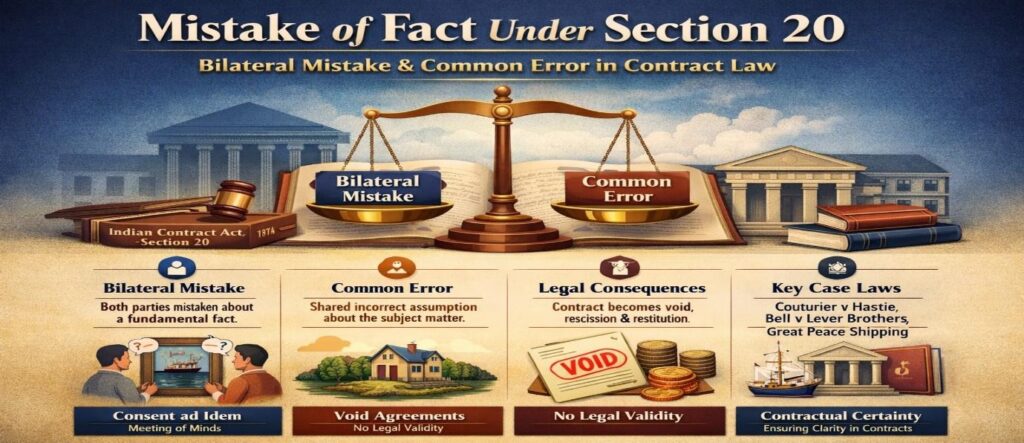
The legal doctrine of a mistake has a primary role in assessing whether an agreement represents authentic agreement. The Indian Contract Act of 1872, Section 20 sets forth the doctrine’s basic definition of a mistake, i.e., a mistake of fact, with two categories of mistakes being of particular interest: bilateral and common. A bilateral mistake occurs when both parties have an incorrect assumption with regard to a fact that is central to the contract.
As a result, the requirements necessary for establishing a meeting of the minds no longer exist. Common errors are very similar to bilateral mistakes; however, they are also found to apply to both parties. Thus, both parties would have the same incorrect assumption with regard to a fact or situation; however, the common error also has the potential for one or both parties to find that the subject matter of the contract is either not available (e.g. contrary to the assertions of both parties) or radically altered from its original condition.
The purpose of this article is to critically review and evaluate the doctrinal underpinnings of the mistake doctrine as applied to the mistake of fact, including case law, statutory interpretation, and unique industry perspectives. The article compares and endows both conceptually and legislatively the issue of identifying the differences between common errors and bilateral mistakes, and proceeds to analyse the legal consequences flowing from Section 20 of the Indian Contract Act, and contract certainty.
Keywords: Mistake of Fact, Bilateral Mistake, Common Error, Section 20 Indian Contract Act, Void Agreements
Understanding Mistake of Fact in Contract Law
Definition and Scope
A factual error occurs when both parties enter into a contract under a misapprehension of some vital fact. The law in Section 20 states that if both parties are under a mistaken belief about a relevant fact then the contract will be void. This provision reflects the underlying principle of consensus ad idem; parties must share mutual understanding of the same common subject when creating their contract.
The application of this doctrine has been deliberately limited. A mistake does not automatically nullify a contract; the mistake must be material, bilateral, and of great importance to the subject matter of the contract. Courts have frequently ruled that errors in regard to secondary or ancillary matters do not impair an agreement’s validity. The doctrine thus achieves a fair balance between equity and commercial certainty, thereby preventing an entire market from being deprived of its ability to rely on contracts.
It is equally important to draw a distinction between a mistake of fact and a mistake of law in regard to contracts. While a mistake of fact can have a voiding effect on a contract, a mistake of law does not create a voiding effect on a contract because of the lawyer’s well-known principle, “ignorantia juris non excusat” (ignorance of the law is not an excuse).
Types of Mistakes in Contract Law
There are three main types of mistakes in contract law:
• A unilateral mistake is a mistake made by one party. A unilateral mistake alone will not usually invalidate a contract, unless the party to whom the contract is made had knowledge of the mistake or contributed to the mistake in some way.
• A bilateral mistake is when both parties to a contract share the same erroneous belief regarding a material fact. Section 20 specifically deals with bilateral mistakes and provides that the agreement will be void.
• Common Error is a term used specifically in English law to refer to a mutual incorrect belief that has to do with the existence or identity of the subject matter.
Both bilateral mistake and common error are significant because they challenge a party’s ability to provide genuine consent to a contract.
Defining Bilateral Mistake: Key Characteristics
Bilateral Mistake Requirements
When examining a bilateral mistake under Section 20 a number of criteria must be satisfied, these include:
1. Both parties have been wrong in the same way.
2. The fact which is wrong is an essential fact of the agreement.
3. The error occurred at the time of formation of the contract.
4. Neither party was aware of what the situation actually was.
The courts define “Essential Fact” to mean:
• Existence of subject matter
• Identity of subject matter
• Title or ownership
• Fundamental quality (can vary depending on situational factors)
If you meet all of the requirements for a bilateral mistake the agreement will be considered void ab initio, meaning that the agreement has no legal validity from inception.
The best example is Couturier v Hastie where the parties entered into a contract to sell goods which had been lost at sea. As both parties believed the goods existed the contract was determined void.
Another important case is Tarsem Singh v Sukhminder Singh, where the Supreme Court reiterated that a mutual mistake concerning an essential fact results in the agreement being void under Section 20.
Likewise, in Raffles v Wichelhaus, both parties referred to a vessel named “Peerless,” yet each envisioned a different ship. The lack of agreement led the court to determine that no enforceable contract was in place.
These cases illustrate that a bilateral mistake occurs when the basis of the agreement disintegrates due to a shared misconception.
The Notion of Common Error: Consequences and Illustrations
Defining Common Error
Common error denotes a scenario in which both parties function under a collective but erroneous assumption regarding a crucial element of the contract. In contrast to bilateral mistake as understood in Indian law, common error has been interpreted more restrictively in English legal thought. The authoritative case, Bell v Lever Brothers Ltd, determined that a contract does not become void solely due to the parties’ misunderstanding. The error must be so significant that it alters the subject matter to a degree that it is fundamentally different from what was originally intended.
Consequently, common error is concerned not just with mutual misinterpretation, but with whether the mistake undermines the identity or existence of the subject matter.
Real-World Scenarios Illustrating Common Error
The principle was further elucidated in Great Peace Shipping Ltd v Tsavliris Salvage (International) Ltd, where both parties mistakenly believed that a rescue vessel was nearer than it truly was. The court ruled that the contract remained valid as performance was still feasible.
This case established that:
• Mere inconvenience or hardship does not suffice
• The mistake must make performance impossible or significantly altered
Common error may occur in situations involving:
• Non-existent subject matter
• Erroneous beliefs regarding legal rights
• Contracts founded on fundamentally flawed assumptions
The limited application of this doctrine indicates a judicial hesitance to disturb contractual certainty.
Legal Consequences of Mistake of Fact under Section 20
Remedies Available for Affected Parties
When a bilateral mistake is demonstrated under Section 20, the contract is deemed void, rather than voidable. This distinction is vital.
The primary remedy is:
• Rescission: The contract is regarded as if it never existed
Additionally, courts may provide:
• Restitution: To avert unjust enrichment
• Equitable relief: In specific circumstances
In contrast to voidable contracts, there is no possibility to affirm the contract once a bilateral mistake is established.
Impact on Contract Validity
The consequence of a mistake under Section 20 is definitive: the agreement is void ab initio. Nevertheless, courts exercise this doctrine with caution to avoid potential abuse.
They necessitate stringent proof that:
• The mistake is mutual
• It pertains to a crucial fact
• It was present at the time of the agreement
This prudent strategy guarantees that parties cannot evade liability simply by claiming a mistake.
Differentiating Between Bilateral Mistake and Common Error
Key Distinctions and Similarities
While frequently confused, bilateral mistake and common error are distinct in several significant ways:
• Legal Foundation: Bilateral mistake is established under Indian law, whereas common error is developed through judicial decisions.
• Range: Bilateral mistake encompasses a wider scope; common error is more narrowly defined.
• Criteria: Common error necessitates impossibility or a fundamental difference.
Nonetheless, both principles are rooted in the lack of genuine consent.
Legal Criteria for Differentiation
Judicial bodies employ specific criteria:
• Bilateral Mistake Criterion: Whether the mistake pertains to a crucial fact that underpins the agreement.
• Common Error Criterion: Whether the mistake makes performance impossible or fundamentally altered.
The differentiation ultimately hinges on the extent of the mistake’s effect on the contract.
Case Law Examination: Pivotal Rulings on Mistake of Fact
Summary of Notable Cases
The doctrine has progressed through pivotal rulings:
• Couturier v Hastie – A non-existent subject matter renders the contract void
• Bell v Lever Brothers Ltd – Limited scope of common mistake
• Great Peace Shipping Ltd v Tsavliris Salvage (International) Ltd – Clarified the requirement of impossibility
• Tarsem Singh v Sukhminder Singh – Indian perspective on mutual mistake
• Raffles v Wichelhaus – Absence of consensus ad idem
Insights Gained from Case Law
These rulings illustrate essential principles:
• The doctrine is applied with precision
• Courts favour certainty over adaptability
• Parties are responsible for confirming their assumptions
They also underscore the judiciary’s hesitance to annul contracts unless the mistake is genuinely fundamental.
Practical Applications: Navigating Errors in Contract Formation
Best Practices for Drafting Contracts
To reduce the risk of errors:
• Clearly articulate the subject matter and key terms
• Incorporate representations and warranties
• Distribute risk through specific provisions
• Steer clear of ambiguous terminology
Strategies for Preventing Errors
• Undertake comprehensive due diligence
• Facilitate clear communication among parties
• Conduct pre-contractual verification
• Obtain legal counsel in intricate transactions
These strategies significantly diminish the chances of disputes.
Conclusion
One of the key points of Section 20’s mistake of fact doctrine is that genuine consent is necessary in creating contracts. Even though there are many similarities and overlapping characteristics of both common errors (bilateral mistakes) and unilateral errors, in their application and scope, both exist. The courts acknowledge these concepts to ensure that errors in logic will not force agreements to be enforceable.
Future challenges to contract law will arise from the development of the digital marketplace and algorithmic standards in conducting business. The development of automated contract systems may further complicate the identification of intention and consent, meaning that judges may have to adapt existing contract law principles to fit new ways of doing business.
Due to the continuous increase in the complexity of commercial transactions, the need will continue to exist for parties to exercise greater vigilance in performing their obligations. The mistake doctrine will still exist as a way to prevent unjust enrichment; however, judges will have to be careful and detailed in their implementation of the doctrine in order to provide the certainty of outcome.
In the end, the most important point is that the parties need to be clear on their contractual intentions. To the extent that there is a lack of clarity, the mistake doctrine will come into play, not to rectify people’s mistakes, but to protect the parties from injustice.