This Article is written by Sanjana Kesarwani of Pt. Som Chandra Dwivedi Vidhi Mahavidyalaya pursuing BA LLB , 5th year during her internship at Ledroit India.
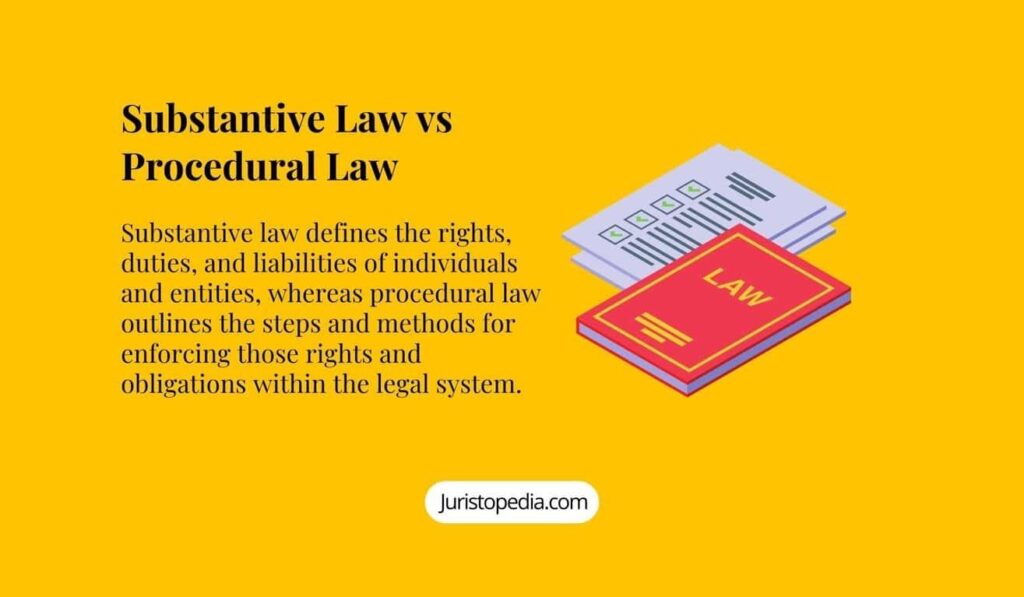
1.Abstract
Law, as an instrument of social control, comprises numerous branches that work collectively to ensure justice, security, and social order. Among these, procedural law and substantive law play a foundational role in shaping both the rights of individuals and the mechanisms used to enforce them. Substantive law defines the legal rights, duties, obligations, and liabilities of people, whereas procedural law outlines the processes and rules courts must follow while administering justice. Although distinct in nature and operation, both are interdependent and complement each other in achieving the aims of justice. This paper examines the meaning, characteristics, scope, importance, judicial interpretations, and key differences between procedural and substantive law, with special reference to the Indian legal system. It further highlights landmark case laws that clarify the interplay between these two legal pillars and concludes that a balance between the two is essential for an efficient and fair justice delivery system.
2.Keywords:
Substantive Law, Procedural Law, Legal Rights, Enforcement of Law, Justice System, Indian Judiciary, Rule of Law
3. Introduction: Origin of the Terms
“Substantive Law” and “Procedural Law”
The distinction between substantive and procedural law is one of the oldest conceptual divisions in legal theory. The origins of these terms can be traced back to Roman law, which formed the foundation for most modern civil and common law systems. Roman jurists used the terms ius (law/right) and actio (action). Ius referred to the set of rights a person possessed, while actio referred to the method of enforcing those rights through legal mechanisms. Over time, European legal scholars drew from Roman jurisprudence to elaborate a distinction between substantive rules (the content of rights) and procedural rules (the mechanisms through which these rights could be claimed).
Later, during the development of English common law, jurists like Blackstone expanded this division. Blackstone viewed substantive law as the primary rights and procedural law as the secondary rights—those meant to enforce primary rights. This distinction became central in the emerging American legal philosophy, where 19th-century jurists used the terms “substantive law” and “procedural law” to differentiate between laws dealing with rights and duties versus laws dealing with legal processes.
By the 20th century, with modern codification in countries like India, Germany, and France, the distinction evolved into a universally recognized classification. Today, this separation helps courts, legislators, and lawyers understand how laws operate in theory and in practice.
Substantive law and procedural law form the twin pillars of the Indian legal system, each performing a distinct but complementary role in the administration of justice, and the distinction between them has been the subject of extensive judicial interpretation, academic analysis, and legislative practice over the course of India’s legal evolution, which draws heavily from the common law tradition inherited from the British. Substantive law refers to the body of rules that defines rights, duties, and liabilities of individuals and institutions, determining the nature and scope of legal relationships and the consequences of conduct recognized by the State, such as the provisions contained in the Indian Penal Code, 1860 which define offences like murder, theft, and defamation, specifying elements of the crimes and associated punishments, and similarly civil substantive statutes such as the Indian Contract Act, 1872, the Transfer of Property Act, 1882, and the Hindu Marriage Act, 1955 which establish legal concepts, rights in property, contract formation requirements, status, personal relations, and entitlements in family law; whereas procedural law comprises the set of rules governing the machinery of courts and the process by which substantive rights are enforced, including how cases must be filed, what pleadings should contain, the manner of service of summons, admissibility of evidence, trial conduct, appeal mechanisms, limitation periods, and execution of decrees, as seen in the Code of Civil Procedure, 1908 (CPC) and the Code of Criminal Procedure, 1973 (CrPC) which are designed to ensure fairness, due process, efficiency, and legal certainty in litigation.
4.Meaning and Concept of Substantive Law
Substantive law refers to the body of rules that create, define, and regulate rights, duties, and liabilities of individuals. It lays down the actual legal relationship between persons and the State or among persons themselves. It answers essential legal questions such as:
- What constitutes a crime?
- What are the essential elements of a contract?
- Who has a civil right to claim damages?
- What are the rights of an accused?
- What duties does a citizen owe?
5. Definitions
Salmond, the renowned jurist, defined substantive law as “the part of the law that courts apply in deciding cases, excluding the rules governing procedure.”
Cheshire and Fifoot describe it as the law that determines “the rights and obligations which the law gives to people.”
6. Nature of Substantive Law
Substantive law is concerned with rights, not the method of enforcing those rights. It tells individuals:
- What rights they possess
- What conduct is permissible
- What activities are prohibited
- What remedies exist for wrongs
- It includes both civil and criminal laws.
7. Examples of Substantive Law
- Indian Penal Code, 1860 (IPC) – defines crimes like murder, theft, rape, etc., and prescribes punishments.
- Contract Act, 1872 – defines agreements, contracts, void agreements, breach, etc.
- Transfer of Property Act, 1882 – governs sale, mortgage, lease, gift, and exchange.
- Torts law – defines civil wrongs and liabilities.
- Family law – marriage, divorce, custody, maintenance.
These laws create the substance of rights and liabilities—hence the term “substantive”.
One of the most important implications of the distinction is that courts treat procedural irregularities as curable unless they cause prejudice or injustice, whereas violation of substantive law usually renders an act void or illegal, and this is grounded in equity principles to prevent miscarriage of justice. Substantive and procedural laws interact dynamically: the recognition of new rights through judicial activism, such as the expansion of Article 21 to include privacy, health, clean environment, and dignity in cases like Maneka Gandhi v. Union of India (1978) and Justice K S Puttaswamy v. Union of India (2017), necessitates procedural reforms to make enforcement effective, leading to fast-track courts, e-filing, virtual hearings, and victim compensation schemes, illustrating how legal evolution demands harmony between the two branches.
Substantive law without procedure is powerless, like a sword without a hand to wield it; procedure without substance is meaningless, like a well-defined road that leads nowhere. Indian courts interpret procedural rules liberally when technical rigidity threatens substantive rights, guided by the maxim ubi jus ibi remedium meaning where there is a right, there must be a remedy, reinforcing the importance of giving substantive rights practical effect rather than allowing procedural complexity to overshadow justice.
8. Meaning and Concept of Procedural Law
Procedural law is the machinery of law. It consists of rules that govern the process through which substantive rights are enforced. While substantive law determines what a right is, procedural law determines how that right will be claimed.
It includes all rules governing:
Jurisdiction of courts,Filing of cases,Service of summons,Production and admissibility of evidence,Court fees, limitation, appeals,Arrest, bail, investigation, trial,Execution of decrees
9.Definitions
Salmond explains procedural law as “the law of actions: the body of rules regulating the process of litigation.”
Bentham called it “the adjective law” as opposed to substantive or “the principal law.”
10.Nature of Procedural Law
- It does not create new rights.
- It provides the method to enforce rights created by substantive law.
- It ensures fairness, order, and justice in legal proceedings.
11.Examples of Procedural Law
- Code of Criminal Procedure, 1973 (CrPC) – governs investigation, trial, bail, FIR, charge-sheet, etc.
- Code of Civil Procedure, 1908 (CPC) – governs suits, interim orders, evidence, execution of decrees, appeals.
- Indian Evidence Act, 1872 – governs production, examination, and admissibility of evidence.
- Limitation Act, 1963 – specifies time limits for filing cases.
Thus, procedural law provides the pathway through which substantive law is implemented.
12. Historical Evolution of the Two Branches
Roman Law
The earliest legal systems did not sharply distinguish between substantive and procedural law. In Roman law, actiones were central, and substantive rights were often embedded in procedural mechanisms. Over time, scholarly interpretation separated the two.
English Common Law
As common law developed through judicial decisions, jurists observed that courts needed separate rules for how cases were heard and what rights people had. This led to the formulation of procedural rules like writs and trials by jury.
American Legal Evolution
American courts, especially during the 19th century, began codifying procedures separately from substantive rights. Procedural fairness became a constitutional requirement (due process), strengthening the distinction.
Indian Context
India adopted separate codes:
- IPC for substantive criminal law
- CrPC for criminal procedure
- CPC & Evidence Act for civil procedure
- Indian jurisprudence has consistently recognized the need for this separation.
13. Key Differences Between Substantive Law and Procedural Law
Below is a detailed, analytical comparison:
1. Definition
Substantive Law: Deals with rights, duties, and liabilities.
Procedural Law: Deals with enforcement and implementation of those rights.
2. Purpose
Substantive: Determines what constitutes a legal wrong.
Procedural: Provides the process to prove or defend that wrong.
3. Nature
Substantive: Permanent and stable in nature.
Procedural: Can be changed frequently to improve justice delivery.
4. Scope
- Substantive laws define crimes, torts, contracts, and rights.
- Procedural laws define litigation methods, evidence rules, limitation periods.
5. Examples
Substantive: IPC, Contract Act, Property Law.
Procedural: CPC, CrPC, Evidence Act.
6. Creates Rights?
Substantive: Yes, creates legal rights.
Procedural: No, does not create rights.
7. Regulates:
Substantive: Human conduct.
Procedural: Legal proceedings.
8. Related to Justice
Substantive: Deals with justice in content (what is fair).
Procedural: Deals with justice in method (how fairness is ensured).
9. Retrospective Operation
Substantive laws are generally not retrospective.
Procedural laws can be retrospective, unless affecting vested rights.
10. Burden of Proof
Substantive law determines what must be proved.
Procedural law determines how it will be proved.
14. Judicial Interpretation
Courts around the world have elaborated the distinction.
Indian Cases
Hitendra Vishnu Thakur v. State of Maharashtra (1994)
- The Supreme Court held that substantive laws relate to rights and are not retrospective while procedural laws are normally retrospective unless affecting vested rights.
Thirumalai Chemicals Ltd. v. Union of India (2011)
- The court emphasized that procedural law only regulates the journey of litigation.
State of Maharashtra v. B.E. Billimoria (2003)
- Held that procedural laws are “handmaids of justice”.
International Cases
Guaranty Trust Co. v. York (U.S. Supreme Court, 1945)
- Distinguished procedure from substance in conflicts of law.
Hanna v. Plumer (1965)
- Clarified that federal courts must apply federal procedural rules.
Thus, courts preserve the conceptual purity of both branches.
15. Importance of the Distinction
The division between substantive and procedural law is vital for multiple reasons:
1. Ensures Fairness
Procedural law guarantees due process, preventing arbitrary trials.
2. Simplifies Legal Analysis
Lawyers can distinguish between what rights exist and how to enforce them.
3. Influences Legislative Drafting
Parliament drafts separate codes for procedure and substantive rights.
4. Impacts Constitutional Review
Courts examine whether a law violates substantive rights or procedural fairness.
5. Affects Retrospective Legislation
Substantive laws cannot apply retrospectively without violating Article 20(1).
16. Overlap Between Substantive and Procedural Law
Although distinct, they sometimes overlap:
- The Evidence Act contains both substantive (privileges) and procedural rules.
- The Limitation Act is procedural but sometimes affects substantive rights.
- CrPC contains provisions like plea bargaining which have substantive impact.
- Courts resolve such overlaps by examining the object and purpose of the provision.
Despite their differences, substantive and procedural law remain interdependent components of a unified legal structure whose ultimate aim is the protection of legal rights and imposition of legal responsibilities in a fair, impartial, and constitutionally consistent manner. However, tensions sometimes arise when overly detailed procedural requirements delay justice, prompting criticism under the saying “justice delayed is justice denied,” highlighting the need for procedural simplification and digitization while maintaining safeguards that guarantee fair trial standards; and this concern has propelled reforms such as Lok Adalats, Alternative Dispute Resolution, plea bargaining under the CrPC, and recent amendments promoting electronic records and virtual proceedings, showing that procedural innovation is essential to uphold the substantive goal of timely justice delivery. In conclusion, while the Indian legal system clearly distinguishes substantive law as defining legal rights and procedural law as ensuring their enforcement, both are essential for the attainment of justice, equity, and constitutional values, and the judiciary’s interpretation continues to ensure that procedural mechanisms evolve to support substantive protections in a progressively complex society, safeguarding the balance between authority and liberty, social order and individual dignity, and the enduring principle that procedure must serve, never subvert, the cause of substantive justice.
17. Conclusion
The distinction between substantive and procedural law originates from ancient Roman legal philosophy and has evolved into a foundational aspect of modern legal systems. Substantive law defines rights, duties, and liabilities, forming the core of legal relationships. Procedural law, on the other hand, provides the machinery through which these rights are enforced. Both are equally essential—substantive law would remain ineffective without procedural mechanisms, while procedural law would be meaningless without substantive rights to protect.
The two together ensure that justice is not merely theoretical but practical and actionable. In the Indian legal framework, the clear separation in codes like IPC, CrPC, CPC, and the Evidence Act highlights their complementary roles. Ultimately, the harmony between substantive and procedural law enables courts to deliver justice efficiently, fairly, and consistently.
References
1. Salmond, Jurisprudence, 12th Edition, Universal Law Publishing.
2. Indian Penal Code, 1860.
3. Code of Civil Procedure, 1908.
4. Code of Criminal Procedure, 1973.
5. Indian Evidence Act, 1872.
6. State of Punjab v. Gurdev Singh, (1991) 4 SCC 1.
7. A.R. Antulay v. R.S. Nayak, (1988) 2 SCC 602.
8. Uday Shankar Triyar v. Ram Kalewar Prasad Singh, (2006) 1 SCC 75.
9. Garikapati Veeraya v. N. Subbiah Choudhry, AIR 1957 SC 540.