This article is written by Mimanshi Tripathi, Shambhunath Institute of Law, BA.LLB(Hons), 4 YEAR during his/her internship at LeDroit India
SCOPE OF ARTICLE
This article generally reviews the key subject of biopiracy in particular the innovative Kani Tribe-Jeevani benefit-sharing model. The scope includes:
1. Our Biopiracy and Traditional Knowledge: Conceptual Framework.
2. Laws: Laws at the International and National Levels on Biopiracy.
3. The Kani Tribe: Native Knowledge custodians of the Western Ghats.
4. The Jeevani Drug: Development and Commercialization.
5. The Benefit-Sharing Model: An Innovative Agreement.
6. Neem Patent, Basmati Rice and Turmeric Patent: Landmark Cases.
7. Critical Evaluation: Advantages and Weaknesses of the Model.
8. Critical Evaluation: Advantages and Weaknesses of the Model.
KEYWORDS
Biopiracy, Traditional Knowledge, Kani Tribe, Jeevani, Benefit- Sharing, Biodiversity Convention.
ABSTRACT
Biopiracy is simply the case of taking under the carpet, indigenous knowledge and natural resources of the traditional folks without their consent and this is highly detrimental to both the biodiversity and the rights of the people who use and protect them. We discuss in this paper the Kani Tribe- Jeevani benefit -sharing model, a pioneer scheme that tried to divide the cake equally in case of commercial products produced using the indigenous knowledge.
The basis of the Jeevani drug is the arogyapacha plant, which is not a new concept to the Kani people of Kerala, and this was one of the first bargains in India to take advantage of the benefit-sharing mechanism established by the Biodiversity Convention. We will explore the international mechanisms such as the CBD and TRIPS, the 2002 Biological Diversity Act, and high profile court cases to find out the effectiveness of the Jeevani model in the real world.
The study reveals that despite the model making significant precedents in acknowledging the role of the indigenous input and remunerating them, there are still significant obstacles in the path of translating the agreement into action and implementing it along with preserving traditional knowledge without infringement.
I. INTRODUCTION
One of the most burning issues of the global law today is the combination of traditional knowledge, conservation, and intellectual property law. Of particular concern to the developing countries that are biologically endowed yet are mostly cheated by large corporations in the developed world, is biopiracy which involves the extraction and sale of the biological resources and the accompanying knowledge without a fair share. These local communities have preserved a treasure trove of knowledge over the generations yet they are losing it as mega companies patent things that belong to them.
Bio-piracy has been witnessed in India with its massive species multiplicity and extensive systems of traditional knowledge. Some well known examples are turmeric, neem and basmati rice patents that have been granted to foreign companies and this is how Indian knowledge gets stolen. With all that in mind the Kani Tribe-Jeevani model can be considered a promising one demonstrating that it is possible to arrange a fair agreement that will take the input of the indigenous people into account and will also aid scientific development.
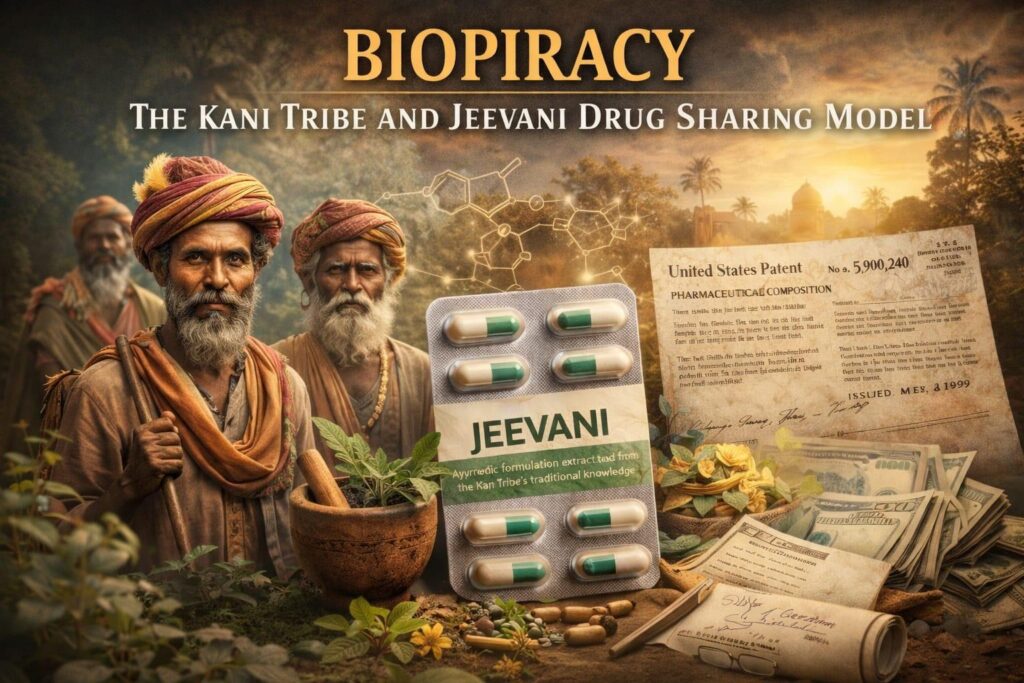
Jeevani began in the early 1990s when researchers at the Tropical Botanic Garden and Research Institute (TBGRI) in Kerala had learned that arogyapacha plant (Trichopus zeylanicus) is taken by the Kani tribe to enhance energy and counteract fatigue. That folk wisdom resulted in the designs of Jeevani which was a herbal formula that was found to lessen stress and fatigue. TBGRI struck an innovative benefit-sharing agreement with the Kani tribe in which they paid license fees and royalties. In the broader context of the prevention of biopiracy and protection of traditional knowledge, this paper examines that landmark model.
II. CONCEPTUAL FRAMEWORK: UNDERSTANDING BIOPIRACY
A. Defining Biopiracy
Bio piracy is a term that was invented by Pat Mooney of the Rural Advancement Foundation International (RAFI). He employed it to explain how individuals or institutions steal the genetic materials and information of farms and indigenous people to gain a monopoly by patenting or other IP rights. It is not legally defined, but biopiracy is typically the three related practices
(1) appropriation of biological materials in biodiverse locations without authorization,
(2) misappropriation of the associated traditional knowledge, and
(3) patents on products or procedures based on those materials without providing benefits to the communities of origin.
The biopiracy manifests in various forms. Direct biopiracy literally means making biological samples without any consent. Indirect biopiracy occurs when the knowledge is documented, patented, or auctioned without recognition and payment of the owners. Patent-based biopiracy is the worst form of biopiracy where companies patent products or processes based on the traditional knowledge and their knowledge is privatized, and communities are denied access to their own ancestral knowledge.
B. Traditional Knowledge and Indigenous Rights
Traditional knowledge refers to a body of accumulated knowledge, innovations, and practices that the indigenous and local communities have come up with over the years as they engage with their surroundings. It is spread orally and culturally, encompassing such aspects as medicinal flora, agricultural methods, ecological organization, and the use of resources in a sustainable way. In comparison to the modern science of knowledge, traditional knowledge is usually social, constantly changing and connected to cultural and spiritual tradition.
According to the United Nations Declaration on the Rights of Indigenous Peoples (UNDRIP), adopted in 2007, the indigenous people are entitled to preserve, possess, safeguard, and utilize their intellectual property of cultural heritage, traditional knowledge, and traditional cultural expression. The right to manage their genetic information and their traditional knowledge is directly addressed in Article 31, as it offers a legal framework of benefit-sharing and an anti-biopiracy measure.
III. LEGAL FRAMEWORK: INTERNATIONAL AND NATIONAL DIMENSIONS
A. Convention on Biological Diversity
The Convention on Biological Diversity (CBD), literally the primary international legal tool, which discusses the conservation of biodiversity and methods to divide the benefits in a just manner. It was embraced in the earth summit of Rio de Janeiro in 1992. Article 8(j) is particularly essential – it states that we have to respect, conserve and maintain the knowledge, innovations and practices of indigenous and local communities which are of importance to biodiversity. And we must win their consent and engage them in the procedure. The big takeaway? The fruits and fruits of that knowledge must be distributed equally.
The Nagoya Protocol on Access and Benefit-Sharing, that was established in 2010 and became effective in 2014 actually defines how these rules of benefit-sharing are actually working in practice. It specifies processes of accessing genetic resources and ensures that the benefits that arise because of the utilization of those resources are fairly shared. Article 12 dwells on the traditional knowledge that is associated with genetic resources and it mandates that Parties should obtain prior informed consent (PIC) of indigenous peoples. It further presupposes that conditions of sharing benefits (MAT) are agreed to. India has been very serious with these responsibilities as it ratified the Nagoya Protocol in 2012.
B. Biological Diversity Act, 2002
The Biological Diversity Act, 2002 passed in India to transform the CBD responsibilities into ground-level policies. The Act establishes a three level structure whereby at the national level, there is the National Biodiversity Authority (NBA), the state level has the State Biodiversity Boards (SBBs), and the local level has the Biodiversity Management Committees (BMCs). The concept is to engage the community and, in particular, the indigenous/local communities.
Section 3 states that no foreigner, NRIs and foreign entities are allowed to gain access to the biological resources and any other traditional knowledge without the approval of an NBA. Also Section 4 then applies that to Indian companies attempting to acquire IP rights using the research based on such resources. Section 6 is a section on benefit-sharing, it empowers the NBA to establish rules that can ensure there is a fair distribution of the benefits gained by the commercial exploitation of the biodiversity and other traditional knowledge. In essence, it is a good protection against biopiracy.
Section 19 provides the punishment of the violation to the extent of five years imprisonment and fines to the extent of ten lakh rupee. That indicates how the legislature is committed to discouraging biopiracy and enforce it strictly. The real implications of the Act, however, are jeopardized by other factors such as poor institutional capacity, sluggishness in application processing and insufficient community involvement in the BMCs. Therefore, it is important to make the Act a serious deterrent to biopiracy by strengthening these institutions and engaging communities more.
IV. THE KANI TRIBE: CUSTODIANS OF TRADITIONAL KNOWLEDGE
The Kani (alternatively known as Kanikaran or Kanikkar) is a Scheduled Tribe that is primarily located in the Western Ghats in Kerala and Tamil Nadu, particularly in Thiruvananthapuram and Kanyakumari districts. They are defined as a Particularly Vulnerable Tribal Group (PVTG). The strong connection to forest ecosystems has seen them accumulating a rich ethnobotanical knowledge in centuries of sustainable forest usage. Their income sources involve collection of forest products, small-scale agriculture and hunting which are informed by high level of knowledge concerning local ecology and medicinal plants.
The pharmacopoeia of the Kani is voluminous, hundreds of medicinal plants are described as applied to treat different diseases. Such knowledge is passed on orally throughout generations and it incorporates the identification of plants, how to prepare them, dosage, and contraindication. The most notable is the arogyapacha plant (Trichopus zeylanicus) referred to by the Kani as the King of Herbs. It has been traditionally consumed to treat fatigue during long walks through the areas; increase stamina and its general vitality, using the leaves and the fruits. This custom application led to the scientific study which culminated to the formulation of Jeevani.
The Kani community is socio-economically marginalized and has less access to education, healthcare, and employment, and therefore, they are particularly vulnerable to exploitation. Forest extraction in the past did not usually benefit the tribal groups, and outsiders were able to extract the biological resources and the knowledge involved without any fee. The Jeevani benefit-sharing model also marked a major departure on that trend, establishing a different precedent on how indigenous knowledge holders are recognized and paid.
V. THE JEEVANI DRUG: SEVELOPMENT AND COMMERCIALIZATION
A. Scientific Discovery and Development
Ethnobotanical surveys on the Agasthyamala hills took place in 1987 by scientists of the Kerala State Council of Science and Technology, the Tropical Botanic Garden and Research Institute (TBGRI), which carried out surveys in the area. At the time of those surveys, Kani guides provided information regarding the anti-fatigue benefits of the arogyapacha plant. The members of the TBGRI team observed that the guides were very energetic as they trekked in the forest although the scientists themselves would feel tired.
Curiosity prompted TBGRI to carry out an elaborate scientific study of Trichopus zeylanicus. Phytochemical analysis detected different bioactive compounds – glycosides, steroids, phenolic compounds. Strong anti-stress, anti-fatigue and adaptogenic effects were observed on lab animals by pharmacological tests. The study established that arogyapacha extracts enhance physical endurance, postexhaustion recovery, and increase overall vitality devoid of any side effects.
TBGRI proceeded to make a standardized herbal preparation known as Jeevani (meaning that which gives life in Sanskrit) a mixture of arogyapacha with other herbs that are supportive. The effectiveness of Jeevani in performance improvement and in decreasing stress was proven in clinical trials. Bibbly It was a natural energy beverage and health tonic with huge commercial potential. TBGRI registered IP on the formulation composition and manufacturing process and was awarded the IP rights to the innovation that was based on the traditional Kani knowledge.
B. Commercialization and Licensing
Jeevani was licensed to TBGRI in 1995 to the manufacturing and marketing rights of Arya Vaidya Pharmacy (Coimbatore) Limited a popular Ayurvedic pharma company. The licensing transaction created a good deal of license fees and anticipated sales royalties. More importantly, TBGRI realized that the product was based on Kani traditional knowledge and they chose to distribute benefits with the Kani people. They institutionalized this by developing a benefit sharing provision, which was a model to be followed in the future in regard to fair sharing of benefits.
VI. THE BENEFIT -SHARING MODEL: A PIONEERING FRAMEWORK
A. Structure and Implementation
In 1997, TBGRI entered into an official benefit-sharing agreement with the Kani tribe, contributing 50 percent of the license fee (approximately Rs. -475,000 at Arya Vaidya Pharmacy) to that tribe. They also settled on sharing royalties on the sales of products. The Kerala Kani Samudaya Kshema Trust was established to dispose of and clear the pockets of the money. The Trust consisting of the Kani community representatives assumed control over the cash utilization towards the local welfare and development.
They decentralize the gains over Kani settlements in Thiruvananthapuram, giving attention to such aspects as education, health, and improvement of livelihoods. The money was used to construct schools, distribute study materials, establish clinics and initiate income-generating projects. It was even the consideration of training and scholarships of Kani youth to the model-it is not just the fair distribution of benefits but whole towns are being dug into.
B. Significance and Recognition
The Kani-Jeevani model received a lot of national and international accolades as a pioneering model that has shown that equitable sharing is achievable. Some reasons why it was important: first, it predated the introduction of the Biological Diversity Act in India, which struck the books with voluntary standards that were subsequently copied and adapted into laws. Second, it established that research organizations had the capability of collaborating ethically with indigenous communities by crediting and cash their traditional knowledge..
Third, it provided a template that can be customized to suit other circumstances.
The model attracted commendations even amongst the World Bank as a best practice model. It demonstrated that good science and decent pay may co-exist. This fiction contributed to the writing of benefit-sharing regulations both in and outside the country, such as amendments to the Biological Diversity Act and Nagoya Protocol plans.
VII. LANDMARK BIOPIRACY CASES: LESSONS FROM INDIAN EXPERIENCE
A. The Turmeric Patent Case
The first big victory against biopiracy is the turmeric case of India. As early as 1995, the University of Mississippi Medical Center obtained U.S. Patent No. 5,401,504 patented the use of turmeric (Curcuma longa) to treat wounds. In India, the same door was knocked by CSIR which claimed that the healing mix of turmeric was being used in India since thousands of years.
They put in a stack of ancient Sanskrit books and medical records indicating centuries of use.
In 1997, the patent was called off by the USPTO which indicated that it was not novel due to the huge prior evidence. The victory emphasized the importance of the fact that the traditional knowledge might be used as prior art and win the patent claim as a precedent to counteract biopiracy with proper documentation. The case was also an impetus to the establishment of the Traditional Knowledge Digital Library (TKDL).
B. The Neem Patent Case
The neem (Azadirachta indica) patent case highlighted biopiracy’s environmental justice dimensions. In 1995, the European Patent Office (EPO) granted Patent No. EP 0436257 to W.R. Grace Company and the U.S. Department of Agriculture in respect of a process in which neem oil was used to kill fungi. Neem had been in use in the communities in Asia since time immemorial in pest control, medicine and personal care. The Research Foundation of Science, Technology and Ecology headed by Dr. Vandana Shiva joined hands with the International Federation of Organic Agriculture Movements and the local indigenous representatives to launch a challenge.
Following many years of contention the EPO finally revoked the patent in 2005 on the grounds of absence of novelty and inventive step, and accepting neem known weed-killing gifts. It demonstrated that when the civil-society push is organized and supported by sufficient evidence, biopiracy can be toppled even when major corporations have committed it, which highlights the need to protect traditional know-how against patent theft.
C. The Basmati Rice Case
The basmati rice situation is an example of how biopiracy is a threat to geographic indications and farmer independence. In 1997, RiceTec Inc. acquired U.S. Patent No. 5,663,484 on strains of rice that resembled that of basmati. The patent was hovering above the basmati market in India and undermining the breeding strategies of farmers in the country that had existed since time immemorial. There was a struggle by various government agencies, groups of farmers, and research bodies.
In 2001, the USPTO narrowed the patent after several efforts to having removed most claims linked to the basmati-like characteristics. This partial victory demonstrated the steep climb that the preservation of traditional kinds of crops and agricultural expertise has toward plant-patent appropriation.
VIII. CRITICAL ANALYSIS: EVALUATING THE JEEVANU MODEL
A. Strengths and Achievements
With regard to the Jeevani benefit-sharing model, therefore, it was a rather nice demonstration that equitable benefit-sharing can indeed be practiced. It established an example of future projects. Most significantly, the model approached indigenous communities as informed stakeholders who should also be compensated as opposed to passive research subjects. The Kani community was enjoying improvements in the real sense with cash payments and community development. And, as it was voluntary and conducted prior to any legislation that was necessary, it also sounded off a strong signal as to ethical research.
On the institutional level, the Kerala Kani Samudaya Kshema Trust introduced actual ways of having the community participate in the process of benefit distribution. The community would be at the heart in deciding how to utilize the funds by including the Kani reps in the trust governance. Even this approach led to similar models of benefit-sharing in other traditional knowledge innovations in other countries. Besides, it contributed to policy discussion and aided in the creation of the benefit sharing of the Biological Diversity Act of 2002.
B. Limitations and Challenges
Although the model was an innovator, there are still significant gaps in it. The quantity which the Kani community really received remained quite low. The initial license fee fee was won, the subsequent royalty fee was dulled by the small commercial victory of Jeevani. The plan merely benefited Kani settlements in Thiruvananthapuram leaving their brothers and sisters at Tamil Nadu with the same know-how. It was difficult to perceive this as the universal benefit-sharing of all Kani people because that regional disparity.
Opponents noted that the possibility of receiving a half of the license fee was generous, but it failed to reflect the reality that the whole concept was based on the Kani knowledge. They also questioned whether the Kani communities were well informed of the business component of it particularly in their rights and commercial implication. Since no definite law on this was in place, the entire transaction was mostly based on the moral obligation of TBGRI instead of being enforced by law.
Getting the cash in the right hands proved to be very difficult. The distributions of every Kani settlement were a logistical nightmare to make sure that each received their fair slice. It was also a concern on whether any benefit will be retained after the initial round of payments. Adding to the latter, the model did not assist in solving the existing problems such as access to arogyapacha plants or ensuring the Kani had the opportunity to continue using centuries-old acquired knowledge. Certain members of the community became uncomfortable with the fact that commercialization of the same would result in over-harvesting of the plant and destroy the traditions.
Taking into consideration the long-term vision, the discussion remains open. The wider community did not experience a significant change, although on the one hand, some families were doing better. Such aspects as education and health were made better, no doubt, but they never broke the habitual marginalization the Kani experience. According to critics, fair play implies beyond a payment, they must have an actual partnership in the process of both research and development and selling the product with Kani having a real ownership of the knowledge and resources they possess.
IX. CONTEMPORARY CHALLENGES AND FUTURE DIRECTIONS
A. Digital Biopiracy and Genetic Resources
Today, however, bio-piracy is going virtual, particularly with genome information. Genomics, bioinformatics and synthetic biology enable individuals to access the information about genes without even physically touching the living thing. Digital Sequence Information (DSI) may be extracted out of databases and sold to profit without providing any payment to the source population. In order to prevent this, we should revise international rules in such a way that DSI also makes benefit-sharing.
B. Strengthening Community Righta and Participation
In the future, benefit models must go beyond mere classifying the community at the forefront and get the Free, Prior and Informed Consent process nailed. Indigenous people should be collaborators at the very beginning – since the first research question, the stages of the product design, and the commercial launching. It is necessary to develop their ability to bargain great deals and actually influence decisions. Collective knowledge and collective ownership of traditional knowledge also need to be included under law as community intellectual property.
C. Enhancing Implementation and Enforcement
Ending biopiracy depends on the implementation of the current laws. In India, the National Biodiversity Authority and State Biodiversity Boards need to increase their control over the accessibility of the biological resources and traditional knowledge by whoever. Local Biodiversity Management Committees must have sufficient resources in the form of funding, training, and authority to make concrete participation to happen. Applications of patents should be tougher on stating the source of the biological material and knowledge itself. The cooperation of the countries is crucial to halt cross-nation biopiracy and ensure that the gains are shared.
X. CONCLUSION
The Kani-Jeevani model is one of the milestones in terms of combating the biopiracy and establishing a reasonable system of using traditional knowledge. The model inverted a large component of the normal workflow of research by recognizing indigenous contribution and compensating them. It also demonstrated to governments that they can have an ethical conversation with knowledge holders and that it can affect wider policy and also lead to benefit models later.
However, re-reading it, one does not forget the actual problems. Even the compensation to Kani was not significant when compared to the weight that the innovation placed on their expertise. The fact that the money was distributed in geographical distances, that the Kani actually knew the commercial game or not is all indicative of the need to incorporate more non-exclusive approaches. Although certain communities became better, the overall change in the community was not extensive. This is simply to demonstrate that there is not sufficient money, but a partnership whereby the community itself governs the research and the business aspect.
An end to biopiracy brings to a halt a variety of strategies: tough and well-implemented laws, institutions that stand a real possibility of action, community empowerment, and cross-border agreement. The Biological Diversity Act of 2002 is a strong foundation, which requires additional resources, training, and community voice. The Traditional Knowledge Digital Library is a worthy proactive measure in the capturing and preservation of knowledge, but it should be accompanied by actual control of the knowledge to the people in question so that they can derive the benefits, which remain on par.
Going forward, the benefits models need to be more than Jeevani, learn more, encompass all geographies with a traditional knowledge base, engage community in all phases of research and marketing, appreciate the value of collective intellectual property and establish long-term sustainable benefits. FPIC must be used in a rigorous manner and communities must be fully aware of the risk of the business and must have the power to make the actual decision.