Analysis: IPR Valuation – Methods to Value Intangible Assets During M&A
This article is written by Neeraja Santhosh, 5th year, BBA-LLB(H), REVA University during her internship at LeDroit India.
Keywords: Intellectual Property Rights (IPR), M&A Valuation, Intangible Assets, Income-Based Approach, Relief from Royalty, Patent Valuation, IFRS 3, Purchase Price Allocation.
Abstract
In today’s mergers and acquisitions (M&A), the most substantial part of corporate worth centres around corporate intangibles in the knowledge-based economy. In research across multiple industries (technology, pharmaceuticals), intangibles account for more than 80% of corporate market valuation. Patents, trademarks, copyrighted materials, and trade secrets collectively termed Intellectual Property Rights (IPR) are critical for assessing the value of transactions, competitive positioning, and post-merger integration success. The distant future cash flows, coupled with regulatory complexity and the assets’ intrinsic enigma, make the evaluation of these assets most challenging. This article explains the valuation of IPRs in M&As, the predominant methods used, highlighting key legal and financial issues, future valuation of intangibles and emerging issues.
Introduction
The global business landscape has undergone a fundamental transformation, shifting from asset-intensive models to innovation-driven economies. Today, intangible assets represent a dominant share of enterprise value across sectors such as technology, pharmaceuticals, and digital services. As a result, mergers and acquisitions increasingly focus on acquiring intellectual capital rather than physical assets. In this context, accurate valuation of IPRs has become central to M&A transactions. Buyers rely on valuation to assess future income potential, legal risks, and strategic alignment. For sellers, proper valuation ensures fair recognition of intellectual assets developed over time. Inaccurate valuation may result in mispricing, disputes, regulatory scrutiny, and post-merger inefficiencies, making structured valuation methodologies indispensable.
Role of Intangible Assets in M&A
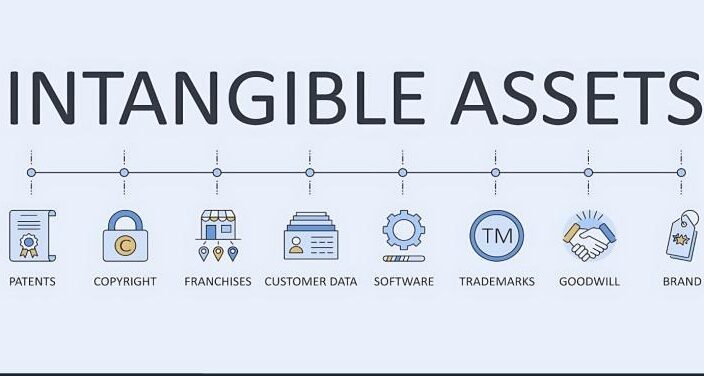
Intangible assets include legally protected rights such as patents, trademarks, copyrights, industrial designs, and trade secrets, along with commercially valuable know-how, data, and proprietary technologies. These assets often form the foundation of a firm’s innovation capacity and long-term profitability. In technology and pharmaceutical industries, IP portfolios frequently constitute the primary rationale behind acquisitions. Unlike tangible assets, the value of IPRs depends on enforceability, market relevance, and revenue-generating potential. Consequently, their valuation directly influences deal structure, negotiation dynamics, and post-merger integration strategies. Intangible assets drive competitive advantage, enable premium pricing, facilitate market entry barriers, and create sustainable differentiation that justifies acquisition premiums in contemporary transactions.
Importance of IPR Valuation in Deal Structuring
IPR valuation plays a pivotal role throughout the M&A lifecycle, significantly influencing deal structuring decisions. Accurate valuation determines the purchase price allocation between tangible and intangible assets, directly impacting tax treatment, depreciation schedules, and financial reporting. In deal negotiations, robust IP valuation provides empirical justification for premium pricing and strengthens negotiating positions for both buyers and sellers.
The valuation methodology chosen affects earnout structures, where future payments depend on IP performance metrics such as patent monetization, royalty generation, or market penetration. Additionally, IP valuation informs financing decisions, as lenders increasingly accept IP assets as collateral, requiring credible valuation to determine loan-to-value ratios. Strategic buyers use IP valuation to assess synergies, including cross-licensing opportunities, technology integration potential, and defensive patent positioning. Furthermore, valuation identifies value preservation strategies, risk mitigation requirements, and integration priorities that shape post-merger success. Consequently, IPR valuation transcends mere price determination, becoming a strategic tool that influences transaction structure, risk allocation, and value creation pathways.
Methods of IPR Valuation
Valuation theory recognizes three principal approaches to valuing intangible assets. The selection of an appropriate method depends on the nature of the IP, availability of data, and transaction objectives.
1. Cost-Based Approach
The cost-based approach estimates IPR value based on the costs incurred to develop or replace the asset, including research and development expenses, registration fees, and legal costs. While relatively simple and objective, this method does not reflect future earning potential or market demand and is therefore suitable mainly for non-income-generating assets or defensive patents where replication cost provides meaningful valuation insight.
2. Market-Based Approach
This approach values an IP asset based on how similar assets have been valued in past transactions, like licensing agreements or IP sales. Because IP is often unique and most IP transactions are confidential, reliable comparables are frequently absent, therefore this approach is often insufficient in M&A transactions. However, when comparable transactions exist particularly in standardized technology sectors this method provides market-validated benchmarks.
3. Income-Based Approach
The income approach is the most common approach used in M&A transactions. This approach analyzes the present value of future economic gains expected from the IP and uses methods like Discounted Cash Flow (DCF) analysis and the relief-from-royalty approach. This approach is effective for income-generating assets, but relies heavily on the strength of projections, which require assumptions regarding market growth, competitive risks, and legal enforceability. The relief-from-royalty method calculates savings achieved by owning rather than licensing IP, making it particularly applicable for established brands and patented technologies.
Due Diligence and Risk Assessment
Comprehensive IP due diligence constitutes a critical prerequisite for accurate valuation, encompassing legal, technical, and commercial assessments. Legal due diligence verifies ownership, examines freedom-to-operate, reviews licensing agreements, and identifies litigation risks or encumbrances that could impair value. This includes validating chain of title, examining employee invention assignments, and assessing third-party rights.
Technical due diligence evaluates patent quality, claim scope, remaining patent life, and technological obsolescence risks. For pharmaceuticals, this includes regulatory pathway assessment and clinical trial data validation. Trade secret due diligence examines confidentiality protocols, employee agreements, and security measures protecting proprietary information.
Commercial due diligence assesses market positioning, competitive landscape, customer dependencies, and revenue attribution to specific IP assets. Risk assessment matrices quantify infringement risks, regulatory compliance issues, and geographic enforcement limitations. These due diligence findings directly inform valuation adjustments, warranty negotiations, and indemnification structures, ensuring that purchase price reflects identified risks and opportunities inherent in the IP portfolio.
Legal and Accounting Considerations
According to IFRS 3 (Business Combinations), acquired intangible assets must be identified separately and measured at fair value. Yet, most Intellectual Property Rights (IPR) lack active markets, necessitating estimation-based approaches. This increases subjectivity and judgment requirements, heightening expectations for valuation professionals to demonstrate methodological consistency and transparency.
Under ASC 805 (U.S. GAAP), intangible assets require recognition when separable or arising from contractual rights, mandating purchase price allocation that disaggregates goodwill from identifiable intangibles. This separation significantly impacts future financial reporting, as identifiable intangibles undergo systematic amortization while goodwill requires annual impairment testing.
Section 56(2)(viib) of the Income Tax Act, 1961 governs taxation of business acquisitions in India, requiring arm’s length valuation to prevent tax avoidance through mispricing. Legal enforceability concerns, including jurisdictional variations in IP protection strength and litigation uncertainty, necessitate risk-adjusted discount rates that reflect enforceability risks. Additionally, moral rights provisions in civil law jurisdictions and work-for-hire doctrines affect IP ownership clarity, requiring careful legal analysis during valuation exercises.
Valuation of Different Categories of IPR
Different IP categories require tailored valuation approaches reflecting their distinct characteristics and value drivers.
Patents: Patent valuation emphasizes remaining patent life, claim breadth, technological significance, and commercial implementation. Standard-essential patents command premium valuations due to FRAND (Fair, Reasonable, and Non-Discriminatory) licensing obligations that ensure revenue streams. Defensive patent portfolios require cost-based or strategic value assessment rather than income approaches.
Trademarks: Brand valuation typically employs relief-from-royalty or price premium methods, assessing brand recognition, customer loyalty, market positioning, and geographic reach. Established brands with strong consumer recognition justify higher royalty rates, while emerging brands require growth projections and market penetration assumptions.
Copyrights: Copyright valuation in media, software, and content industries focuses on licensing revenue potential, content library monetization, and technological protection measures. Software copyright valuation often merges with trade secret assessment, particularly for proprietary algorithms and source code.
Trade Secrets: Trade secret valuation presents unique challenges due to secrecy requirements that limit comparable transaction data. Valuation emphasizes competitive advantage duration, replication difficulty, and confidentiality maintenance costs. Manufacturing processes, customer lists, and proprietary formulas require income-based approaches reflecting sustained competitive differentiation.
Cross-Border M&A Issues
Cross-border M&A transactions introduce additional complexity in IP valuation due to jurisdictional variations in legal systems, enforcement mechanisms, and tax treatments. Different legal frameworks govern IP ownership, with civil law jurisdictions often providing stronger moral rights protection than common law systems, affecting transferability and valuation.
Enforcement strength varies significantly across jurisdictions, with developed markets generally offering more predictable litigation outcomes than emerging markets. This enforcement uncertainty requires country-specific risk adjustments in discount rates. Transfer pricing regulations under OECD guidelines mandate arm’s length pricing for intercompany IP transfers, requiring contemporaneous documentation justifying valuations and preventing profit shifting.
Withholding tax implications on royalty payments vary across bilateral tax treaties, affecting net cash flows and valuation. Additionally, exchange rate volatility, capital controls, and repatriation restrictions in certain jurisdictions require careful modelling in cross-border IP valuations. International regulatory compliance, including export control regulations and foreign investment restrictions, further complicates valuation exercises in technology-sensitive sectors.
Taxation and Transfer Pricing Implications
Taxation significantly influences IPR valuation in M&A transactions through multiple mechanisms. Purchase price allocation between goodwill and identifiable intangibles affects amortization deductions, with certain intangibles qualifying for accelerated tax depreciation. In India, Section 32 of the Income Tax Act governs depreciation on intangible assets, allowing specific deduction rates for patents, copyrights, and know-how.
Transfer pricing regulations under OECD’s Base Erosion and Profit Shifting (BEPS) framework require multinational enterprises to price intercompany IP transactions at arm’s length. This necessitates robust valuation supporting intercompany licensing arrangements, cost-sharing agreements, and IP ownership transfers. Tax authorities increasingly scrutinize IP valuation in cross-border restructurings, particularly when IP migration to low-tax jurisdictions lacks economic substance.
Capital gains tax treatment varies based on asset classification, with certain IP transfers qualifying for preferential rates. Additionally, goods and services tax (GST) implications on IP licensing and stamp duty on IP transfer instruments require consideration during deal structuring. Tax-efficient structuring increasingly drives IP valuation methodologies, as acquirers seek to maximize tax benefits while maintaining defensible positions against regulatory challenges.
Case Studies
This case study focuses primarily on the valuation of intellectual property for mergers and acquisitions using the example of Google’s acquisition of Motorola Mobility in 2011. Despite the deal’s estimated value of $12.5 billion and its portrayal as strengthening Google’s Android ecosystem, the acquisition of Motorola was fundamentally driven by its patent portfolio. This is evident from Google’s post-acquisition sale of Motorola’s operating divisions while retaining most patents.
A significant portion of the patent collection was valued at $5.5 billion, reflecting the importance of intellectual property and associated technologies. The valuation involved multiple approaches income, market, cost, and options methods with particular emphasis on the relief-from-royalty method due to FRAND obligations attached to standard-essential patents. The case demonstrates how strategic defensive positioning against patent litigation justified premium pricing despite uncertain direct monetization paths.
Additionally, Facebook’s acquisition of WhatsApp for $19 billion in 2014 exemplified valuation of network effects and data assets as intangible IP, where user base and messaging technology represented the core value proposition. These cases highlight how legal constraints, regulatory oversight, and integration of IP within broader technology ecosystems shape IP-driven valuations in modern M&A transactions.
Emerging Challenges and Limitations
Contemporary IPR valuation faces unprecedented challenges from technological disruption and regulatory evolution. Artificial intelligence-generated content raises fundamental questions about inventorship, ownership, and copyright eligibility, creating valuation uncertainty for AI-generated patents and creative works. Current legal frameworks inadequately address whether AI systems can be inventors or authors, complicating valuation of AI-developed IP portfolios.
Data as an intangible asset presents valuation challenges due to privacy regulations, including GDPR and India’s Digital Personal Data Protection Act, 2023, which restrict data monetization and transfer. Valuing proprietary datasets requires assessing regulatory compliance costs, anonymization requirements, and consent management frameworks.
Blockchain and NFT technologies challenge traditional IP ownership and licensing models, introducing decentralized ownership structures and smart contract-based licensing that existing valuation frameworks struggle to accommodate. Open-source software creates valuation complexity, as commercial value derives from service ecosystems rather than software licensing, requiring alternative valuation approaches.
Rapid technological obsolescence in sectors like software and telecommunications shortens IP asset lifecycles, requiring aggressive depreciation assumptions. Additionally, increasing patent litigation costs and uncertain enforcement outcomes introduce volatility in patent portfolio valuations. Environmental, social, and governance (ESG) considerations increasingly influence IP valuation, particularly for green technologies and sustainable innovations commanding premium valuations in climate-conscious markets.
Conclusion
In an innovation-driven global economy, the valuation of Intellectual Property Rights has become central to modern mergers and acquisitions dominated by intangible assets. Emerging technologies such as artificial intelligence, machine learning, and blockchain are reshaping traditional valuation methods by improving accuracy, reducing subjectivity, and enabling transparent, market-based valuation mechanisms, including IPR tokenization. However, no single valuation framework is sufficient on its own, as intangible assets are often complex and inadequately defined. Therefore, interdisciplinary approaches integrating legal considerations, financial models, technological analysis, and regulatory compliance are essential. Such integrated frameworks ensure durable, transparent, and strategically sustainable IPR valuations, supporting responsible deal execution and long-term value creation in contemporary M&A transactions. As IP continues to dominate corporate valuation landscapes, developing robust, adaptable valuation methodologies remains imperative for transaction success and economic value preservation.