This article is written by Sameer Ranjankumar Pandit of MMM’s Shankarrao Chavan Law College, Pune, BBALLB, YEAR: 3rd Year during his internship at LeDroit India.
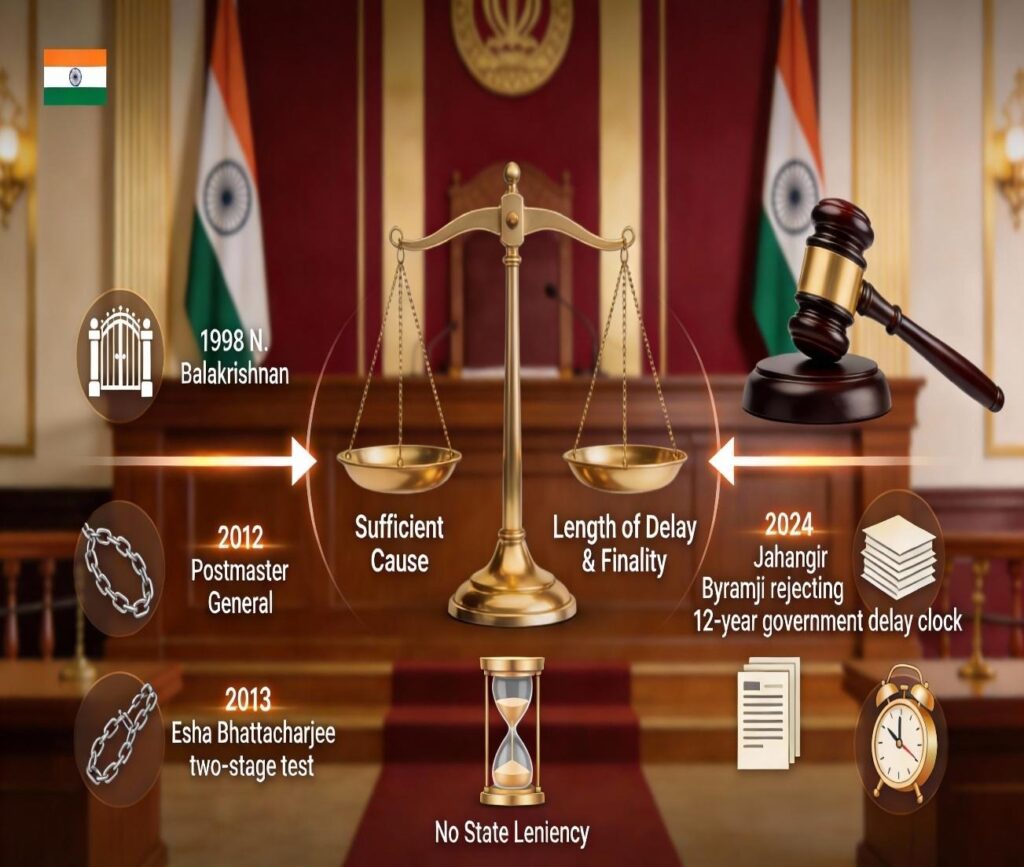
Condonation of Delay Under Section 5 of the Limitation Act, 1963: A Comprehensive Analysis
Abstract
Section 5 of the Limitation Act, 1963, operates as a crucial procedural safeguard that empowers courts to extend limitation periods when applicants demonstrate “sufficient cause” for delay in filing appeals and applications. This provision balances the competing imperatives of legal finality and substantive justice. While the Limitation Act enforces temporal discipline to prevent stale claims, rigid application can cause manifest injustice where genuine obstacles impede timely pursuit of remedies. Judicial interpretation has evolved from an early liberal stance (emphasizing substantial justice) through a structured two-stage test (differentiating sufficient cause from merits), culminating in recent judgments like Union of India v. Jahangir Byramji Jeejeebhoy (2024) and Mool Chandra v. Union of India (2024), which establish that “sufficient cause” demands credible, fact-intensive justification rather than mere professional judgment. This article examines the statutory framework, doctrinal evolution, landmark precedents, and contemporary standards for delay condonation, providing practical guidance for litigants and legal professionals navigating this critical intersection of procedural law and equitable justice.
Keywords: Limitation Act 1963, Section 5, sufficient cause, condonation of delay, bona fides, judicial discretion, procedural fairness.
1. Introduction
The law of limitation serves a foundational purpose in procedural justice: it enforces temporal boundaries within which legal remedies must be pursued, thereby promoting finality, certainty, and the deterrence of dilatory tactics. As observed by jurists, limitation laws do not extinguish substantive rights but restrict their enforcement after a prescribed period, thereby preventing indefinite uncertainty and protecting settled transactions. Yet, the tension inherent in this principle is acute. Rigid enforcement may cause profound injustice where delays arise from unavoidable circumstances—genuine illness, misleading judicial orders, or counsel’s unauthorized neglect—rather than from a party’s culpable negligence or bad faith.
Section 5 of the Limitation Act, 1963, addresses this tension through a remedial exception. It empowers courts to admit appeals and applications beyond the prescribed limitation period if the applicant demonstrates “sufficient cause” for the delay. This provision reflects the judiciary’s recognition that substantive justice and procedural finality, though distinct, must ultimately serve the paramount objective of doing justice between parties. Consequently, Section 5 has become a battleground for competing doctrinal approaches: judicial liberalism (favoring justice on merits), institutional discipline (maintaining certainty and predictability), and equality (ensuring that governmental actors are not privileged over private litigants).
This article synthesizes the evolution of Section 5 jurisprudence from foundational precedents through contemporary landmark judgments, distills the doctrinal principles governing “sufficient cause,” and provides practitioners with guidance on procedural and evidentiary standards for successful condonation applications.
2. Statutory Framework and Foundational Principles
Section 5: Text and Scope
Section 5 of the Limitation Act, 1963, states:
“Any appeal or any application, other than an application under any of the provisions of Order XXI of the Code of Civil Procedure, 1908, may be admitted after the prescribed period if the appellant or the applicant satisfies the court that he had sufficient cause for not preferring the appeal or making the application within such period. Explanation.—The fact that the appellant or the applicant was misled by any order, practice or judgment of the High Court in ascertaining or computing the prescribed period may be sufficient cause within the meaning of this section.”
Critical Scope Limitations:
Section 5 does not extend to suits filed after limitation has expired; it applies only to appeals, applications, and tribunal proceedings. This distinction reflects a legislative determination to enforce temporal discipline on primary claims while permitting some flexibility at the appellate or post-decretal stage.
Foundational Principles Established in Ramlal v. Rewa Coalfields Ltd. (1962)
The Supreme Court in Ramlal v. Rewa Coalfields Ltd. (AIR 1962 SC 361) established two enduring principles:
1. Vested Right to Finality: Expiry of limitation confers a vested right upon the respondent to resist the appeal or application, thereby privileging finality and certainty in litigation.
2. Burden of Proof: The burden lies wholly upon the applicant seeking condonation to justify the delay; no presumption favors the applicant.
These principles underscore that condonation is an equitable concession, not an entitlement, and demand rigorous proof of justified cause.
3. Judicial Evolution of “Sufficient Cause“
From Liberalism to Structured Discretion
Phase 1: Liberal Interpretation (1998–2010)
In N. Balakrishnan v. M. Krishnamurthy (1998) 7 SCC 123, the Supreme Court adopted a liberal construction of “sufficient cause,” cautioning that rigidity in applying limitation laws can defeat substantial justice. The Court held that absence of mala fides and negligence should weigh favorably toward condonation, emphasizing that length of delay is not decisive.
However, this liberalism was tempered in subsequent decisions. In State of Haryana v. Chandra Mani (1996), while recognizing that governmental litigants face bureaucratic constraints, the Court clarified that these administrative realities do not exempt the State from exercising bona fide diligence and promptitude.
Phase 2: Structured Discretion
—The Esha Bhattacharjee Two-Stage Test (2013)
In Esha Bhattacharjee v. Managing Committee of Raghunathpur Nafar Academy (2013) 12 SCC 649, the Supreme Court systematized the approach through a seminal two-stage test:
Stage 1: Sufficient Cause Assessment
The court must first determine whether the applicant has demonstrated sufficient cause for the delay, independent of the substantive merits of the case.
Stage 2: Merits as Tiebreaker
Only if both parties’ positions on the delay are evenly balanced may the court consider the prima facie merits of the underlying case as a secondary factor.
Esha Bhattacharjee also laid down guiding criteria:
– Absence of mala fides and deliberate inaction is crucial.
– Gross negligence, concocted explanations, and casual attitudes must be rejected.
– Long delays demand closer scrutiny and more cogent justification.
– The court should avoid a mechanical or pedantic approach but apply pragmatic reasoning.
Phase 3: Heightened Scrutiny and Rejection of Stale Delays (2010–2012)
In Oriental Aroma Chemical Industries Ltd. v. GIDC (2010) 5 SCC 459, a four-year delay was rejected due to vague explanations and false affidavits. The Court reaffirmed that limitation law is grounded in public policy and that condonation is not a formality but an equitable remedy.
More decisively, in Postmaster General v. Living Media India Ltd. (2012) 3 SCC 563, the Supreme Court rejected a 427-day delay by a government department, holding that “the law shelters everyone under the same light” and warning that delay condonation cannot become an anticipated privilege, particularly for governmental entities.
4. Contemporary Doctrine
The Jahangir Byramji and Mool Chandra Judgments (2024)
Union of India v. Jahangir Byramji Jeejeebhoy (2024): A Watershed Moment
Facts: The Union of India sought restoration of a writ petition concerning leased property in Pune after a delay of 12 years and 158 days. The Supreme Court, in a judgment authored by Justice J.B. Pardiwala, rejected the condonation application and set a controlling precedent on delay condonation standards.
Key Doctrinal Contributions:
1. Parity Between State and Private Parties: The Court emphatically held that the government stands on an identical footing as private litigants. State machinery cannot invoke sovereignty or administrative complexity to excuse indolence. The Court warned that “state lethargy cannot claim protection under Section 5.”
2. Length of Delay as a Relevant Factor: While reiterating that length alone is not decisive, the Court clarified that delays of extraordinary duration (12 years) necessarily trigger strict and sceptical examination. Allowing endless delays would “make a mockery of justice” and perpetually hang the “Sword of Damocles” over decree-holders.
3. Reaffirmation of Esha Test with Emphasis on Bona Fides: The judgment stressed that courts must not begin with substantive merits; instead, they must first rigorously assess the bona fides and coherence of the explanation, and only in narrow cases may merits be considered as a secondary tiebreaker.
4. Limitation as Public Policy: The Court framed limitation law as reflecting equity and public policy, not mere technicality. The judgment emphasized that limitation serves the justice system by preventing perpetual litigation and protecting the finality of judgment.
Mool Chandra v. Union of India (2024 INSC 577): The Counterweight—Blameless Litigants and Counsel Error
Facts: A delay of more than 425 days occurred when counsel withdrew an appeal without informing the client, thereby keeping the litigant in the dark. The Supreme Court (Justices Aravind Kumar and Sandeep Mehta) condoned the delay, but in so doing, articulated an important principle.
Key Doctrinal Contribution:
The Court famously observed: “It is not the length but the cause of delay that is determinative.” Critically, the bench held that where a litigant is wholly blameless and has acted diligently upon becoming aware of the dismissal, a justice-oriented, liberal approach must be adopted. The Court distinguished between counsel negligence (which should not prejudice the client) and unauthorized acts beyond the client’s control.
Reconciliation with Jahangir Byramji: Together, these judgments establish that modern jurisprudence is **differential**, not uniformly restrictive. They are strict against institutional lethargy, false affidavits, and concocted explanations, but liberal where an innocent litigant faces genuine, documentable hardship beyond their control.
5. What Constitutes “Sufficient Cause“
Accepted Categories of Sufficient Cause
Judicial practice reveals recurring factual patterns that typically satisfy Section 5:
1. Serious Illness or Hospitalization: Documented medical incapacity preventing appearance, supported by medical certificates and contemporaneous evidence showing inability to pursue remedies during the relevant period.
2. Misleading Judicial Orders or Practices: Where litigants act in good faith on procedural guidance later found erroneous, or where court orders create confusion regarding limitation periods. (Section 5 Explanation explicitly recognizes this.)
3. Authorized Administrative Delays: For institutional litigants, genuine delays in obtaining certified copies, inter-departmental approvals, or record tracing, provided these are supported by contemporaneous correspondence demonstrating continuous follow-up and urgency.
4. Counsel Error Outside Applicant’s Control: Per Mool Chandra, unauthorized withdrawal of appeals without notification, dismissals for default not communicated to clients, or counsel’s withdrawal of instructions. The critical element is that the litigant was blameless and unaware.
5. Significant Changes in Law: Where judicial pronouncements alter the legal landscape, affecting the applicant’s understanding of limitation or remedies.
Rejected Categories and Illustrative Cases
1. Bare Negligence: In Oriental Aroma, vague assertions of administrative delays without supporting documentation were rejected. The Court held that concocted stories cannot overcome delay.
2. False or Contradictory Affidavits: Courts have consistently held that falsehood is fatal to any plea of equitable relief. Any material inconsistency between affidavits or annexures undermines credibility and defeats condonation.
3. Routine Bureaucratic File Movement: In Postmaster General v. Living Media, a government department’s argument that files were “in process” was rejected. Mere circulation without evidence of urgency or internal tracking does not constitute sufficient cause.
4. Reliance on Case Merits: Repeatedly, courts have held that the importance, arguability, or public interest dimension of a case cannot substitute for explaining the actual delay. In Pathapati Subba Reddy v. Special Deputy Collector (2024), the Court reaffirmed that negligence, want of bona fides, or inactivity cannot be justified even by strong case merits.
5. Delays Attributable to the Applicant’s Inaction: In Inder Singh v. State of Madhya Pradesh (2025 LiveLaw (SC) 339), a 1537-day delay (which included a two-year delay in filing a review petition itself dismissed for want of cause) was condoned, but only with a cautionary note against future negligence and with imposition of costs.
Illustration: Inder Singh v. State of Madhya Pradesh (2025) — A Nuanced Application
Facts: The State of Madhya Pradesh delayed filing a review petition by two years and then delayed the second appeal by about a year thereafter. The matter concerned government land, and the trial court’s initial dismissal was reversed by the appellate court, requiring adjudication on merits.
Supreme Court’s Approach: Despite the substantial delay (1537 days reckoned from the appellate order), the Court condoned it because:
– The underlying dispute involved valuable government land requiring adjudication on merits.
– The delay, though substantial, did not result from gross negligence or mala fides but from administrative procedures and the COVID-19 pandemic.
– The Court balanced procedural finality against substantial justice, noting that merits had never been heard.
However, the Court imposed conditions: Rs. 50,000 costs to offset the appellant’s hardship, a cautionary note against future tardiness, and a direction to the High Court to expedite the hearing. This illustrates that modern jurisprudence applies condonation contextually but with heightened accountability for institutional actors.
6. Procedural and Evidentiary Standards for Successful Condonation
Contemporary case law has raised the bar on pleadings and documentary proof in condonation applications. Courts now demand:
Chronological, Gap-Free Explanations
Applicants must present a date-wise narrative addressing every phase of delay, not broad generalizations like “we acted diligently.” Courts scrutinize whether the explanation accounts for each material period and identifies specific reasons for each segment.
Contemporaneous Documentary Support
Medical certificates, official correspondence, email communications, postal receipts, office notings, or certified records demonstrating the claimed impediment are routinely mandated. Absence of corroborating documents invites skepticism.
Affidavits by Competent Persons
For institutional litigants, affidavits must be sworn by officers with direct knowledge of the facts, not clerical staff. In government and corporate litigation, courts examine the seniority and accountability of the deponent.
Consistency and Candour
Any inconsistency between pleadings, affidavits, and annexures is viewed as undermining credibility. Paradoxically, candid admission of inadvertent lapses, coupled with evidence of corrective action, often strengthens condonation pleas more than attempts at concealment.
Absence of Mala Fides
Courts examine whether the applicant took steps to mitigate prejudice to the respondent, sought extensions proactively where available, or maintained continuous engagement with counsel and courts.
7. Sector-Specific Applications
Government and Public Bodies
Post-Jahangir Byramji and Living Media, the earlier leniency toward governmental delay has been decisively curtailed. In State of Uttar Pradesh v. Satish Chand Shivhare (2022 SCC OnLine SC 2151), a 337-day delay by the State was rejected, with the Court holding: “The law of limitation binds everybody including the Government. The usual explanation of red tapism, pushing of files and the rigmarole of procedures cannot be accepted as sufficient cause.”
Government departments are now expected to maintain docketed limitation calendars, assign responsibility to specific officials, and demonstrate urgency through documented file notings and approvals.
Tribunals and Specialized Forums
Section 5 applies, directly or through pari materia provisions, to appeals before tribunals (labor, tax, consumer, industrial relations) when the governing statute incorporates or references limitation principles. While tribunals often adopt a relatively liberal stance, particularly for unrepresented individuals, they too demand evidentiary proof of unavoidable impediment.
Consumer Forums and Lay Litigants
Consumer protection forums, recognizing the non-professional nature of complainants, condone minor delays accompanied by plausible explanations. However, where corporate complainants or insurers seek condonation of substantial delays, commissions apply the strict standard of Jahangir Byramji, particularly where delay prejudices the opposite consumer party.
8. Modern Doctrinal Balance and Emerging Trends (2023–2025)
A synthesis of recent judgments reveals several consolidated trends:
1. Cause-Centric Review: Courts explicitly prioritize cause over duration. Yet the longer the delay, the more compelling and credible the cause must be. This creates a graduated standard, not a binary rule.
2. Merits Demoted to Secondary Status: Decisions like Jahangir Byramji and Mool Chandra consistently hold that substantive case strength enters the analysis only after sufficient cause is prima facie established and equities are otherwise evenly balanced. Merits cannot rescue deficient procedural justification.
3. Equality of Treatment: The State is now expressly placed on identical footing as private parties. No special doctrinal carve-out exists for governmental litigants, though courts recognize the structural realities of bureaucratic functioning.
4. Ethic of Truthfulness: False affidavits, concealment, and shifting stands are treated not merely as grounds for rejection but as conduct fundamentally undermining the claim to equitable relief. Courts view such dishonesty as offensive to the judiciary’s capacity to do justice.
5. Proportional Scrutiny: Delays of weeks or months involving minor oversights receive liberal treatment; delays of years demand exceptional justification and attract close examination of every assertion.
9. Practical Guidance for Drafting Condonation Applications
Essential Elements of a Successful Application
1. Detailed Limitation Chart: Create a precise timeline from the date of the impugned order to the filing date, identifying each phase of delay and its specific cause. Avoid vague periods.
2. Documentary Annexures: Attach medical certificates, official correspondence, email exchanges with counsel, departmental notings, postal acknowledgments, and any record demonstrating the claimed impediment.
3. Affidavit of Competent Deponent: Ensure the affiant is a person with direct knowledge and authority. For entities, involve the responsible official (e.g., law department officer, company general counsel).
4. Explicit Denial of Mala Fides: Directly address and refute any inference of deliberate delay or negligence. Affirmatively state that the applicant pursued the matter diligently upon discovering the bar.
5. Acknowledgment of Procedural Lapses: Where lapses exist, acknowledge them candidly while explaining why they arose from circumstances beyond the applicant’s control.
6. Mitigation Measures: Mention steps taken to offset prejudice to the respondent—for instance, offering early hearing or proposing interim arrangements.
Checklist for Applicants
– Provide date-wise chronological explanation for every identifiable delay period.
– Attach supporting documents contemporaneous with the delay (not retrospectively created).
– Ensure affidavit is sworn by a person with direct personal knowledge.
– Avoid reliance on case merits to justify delay.
– Reference any prior attempts to seek extension or any communication with the respondent or court.
– Clearly identify any factors beyond the applicant’s control.
– State whether any counsel error is involved and, if so, distinguish negligence from unauthorized acts.
– Include costs offered or prejudice mitigation steps.
Preventive Best Practices
– Maintain a docketed calendar of all limitation dates for pending matters.
– Ensure counsel and clients communicate regularly on deadline compliance.
– Document all communications with courts, counsel, and internal departments regarding limitation periods.
– Seek proactive extensions before expiry where procedural mechanisms permit.
– Maintain transparency with clients and stakeholders regarding deadline statuses.
10. Unresolved Issues and Areas for Reform
Justice vs. Finality Tension
Section 5 highlights an enduring tension in procedural law. While courts have increasingly favored finality (as evidenced by Jahangir Byramji), some legal scholars argue that rigid application risks denying genuine justice to meritorious claimants facing unavoidable obstacles. The optimal balance remains contested.
Government Litigation Parity: Theory vs. Practice
While parity with private parties promotes equality (as stated in Jahangir Byramji), practical challenges persist. Government departments operate within multi-layered hierarchies, budgetary constraints, and inter-departmental coordination requirements that private litigants do not face. Whether a truly uniform standard is equitable remains a subject of doctrinal debate.
Counsel Error and Client Responsibility
Mool Chandra expanded the interpretation of sufficient cause by including unauthorized counsel actions, yet consistent parameters defining when counsel error qualifies remain unsettled. Should clients bear responsibility for counsel negligence? The Court’s approach suggests a distinction between foreseeable attorney malpractice and extraordinary situations, but the boundary requires further clarification.
11. Conclusion
Section 5 of the Limitation Act, 1963, reaffirms a fundamental principle: justice should not be sacrificed on the altar of procedural rigidity. Yet it equally underscores that judicial discretion must be exercised responsibly, with respect for the rule of law and finality.
The doctrinal journey from Ramlal (1962) through Jahangir Byramji (2024) demonstrates an evolving jurisprudence that has matured from mechanical application toward contextual, principled discretion. The modern doctrine rests on six foundational tenets:
1. Causation-Focused Inquiry: Delay condonation depends on credible explanation of cause, not substantive case merit.
2. Parity Principle: Government and private parties face identical accountability standards under Section 5.
3. Escalating Scrutiny: Inordinate delays (typically exceeding one year) invite strict examination; minor delays receive liberal treatment.
4. Falsity is Fatal: False, contradictory, or evasive affidavits negate any claim to “sufficient cause.”
5. Length Relevance: While not decisive, delay duration remains a relevant factor triggering graduated levels of judicial scrutiny.
6. Honest, Document-Backed Justification: Truthful, detailed, and materially supported explanations merit judicial indulgence; vague assertions do not.
Recent judgments—Jahangir Byramji emphasizing finality and institutional accountability, Mool Chandra recognizing innocent litigants’ rights—establish that modern jurisprudence is neither uniformly liberal nor mechanically restrictive. Rather, it is differential and contextual, calibrated to the specific facts, the party’s conduct, and the imperatives of both justice and certainty.
For practitioners and litigants, the imperative is clear: condonation applications must be treated as serious, substantive pleadings grounded in meticulous factual documentation, candid disclosure, and bona fide explanation. The courts have signaled that they will reward truthfulness and diligence while penalizing negligence and deception. In this evolved landscape, Section 5 remains a genuine safety valve, but one requiring credibility, accountability, and respect for the rule of law to operate legitimately.
—
Key Landmark Judgments Reference Table
| Case | Year | Key Principle | Citation |
|---|---|---|---|
| Ramlal v. Rewa Coalfields | 1962 | Burden on applicant; vested right to finality | AIR 1962 SC 361 |
| N. Balakrishnan v. M. Krishnamurthy | 1998 | Liberal interpretation; absence of mala fides | (1998) 7 SCC 123 |
| Oriental Aroma v. GIDC | 2010 | Vague explanations rejected; public policy grounding | (2010) 5 SCC 459 |
| Postmaster General v. Living Media | 2012 | Government parity; 427-day delay rejected | (2012) 3 SCC 563 |
| Esha Bhattacharjee v. Raghunathpur Nafar | 2013 | Two-stage test; merits as secondary factor | (2013) 12 SCC 649 |
| Union of India v. Jahangir Byramji | 2024 | 12-year delay rejected; state lethargy unacceptable | 2024 INSC 262 |
| Mool Chandra v. Union of India | 2024 | Blameless litigants; counsel unauthorized acts | 2024 INSC 577 (5 Aug 2024) |
| Inder Singh v. State of Madhya Pradesh | 2025 | Contextual condonation with conditions; costs imposed | 2025 LiveLaw (SC) 339 |
| Pathapati Subba Reddy v. Special Deputy Collector | 2024 | Negligence bars condonation; merits insufficient | 2024 SCC OnLine SC 513 |
| State of Uttar Pradesh v. Satish Chand | 2022 | Red tapism no excuse; 337-day delay rejected | 2022 SCC OnLine SC 2151 |